Events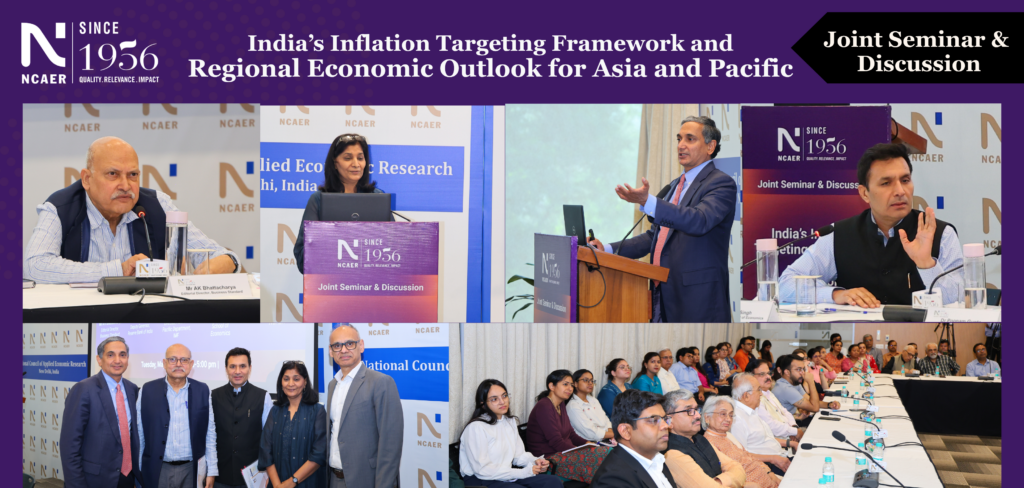
NCAER hosted a joint seminar and discussion on: (i) ‘India’s Inflation Targeting Framework’ and (ii) ‘Regional Economic Outlook for Asia and Pacific’, at its campus.
The session featured two complementary themes: an overview and assessment of India’s inflation targeting regime by Dr Poonam Gupta, Deputy Governor of the Reserve Bank of India (RBI), and a broader discussion of the recently released IMF biannual publication, the ‘Regional Economic Outlook for Asia and Pacific’ by Dr Krishna Srinivasan, Director of IMF’s Asia Pacific Department.
Mr A.K. Bhattacharya, Editorial Director, Business Standard, chaired and moderated the session. Dr Ram Singh, Director, Delhi School of Economics, served as a discussant, along with the two speakers. And Mr Suresh Goyal, Director General, NCAER, delivered the welcome remarks and introduced the speakers.
In the context of assessment of India’s inflation targeting regime, Dr Poonam Gupta stated that India’s ‘Inflation Targeting Framework’ has broadly succeeded by ensuring lower inflation, greater stability, and improved credibility without hurting growth. It has also ushered in a transparent monetary policy with better anchored expectations.
Justifying the inflation tolerance band of 2-6 per cent, she said that there is a strong consensus to maintain the status quo at least till the next review cycle, which is 2031. The current 4 per cent target is considered suitable for India’s economic development and for stabilising growth over the business cycle while the 2 per cent tolerance band on either side provides flexibility for absorbing large external shocks such as the pandemic and geopolitical crises. Dr Gupta also asserted that India is aligned with global best practices, as it is neither an outlier nor lagging in inflation targeting design. Future reforms would thus be dependent on data, and if macro stability continues.
The discussion on Dr Gupta’s presentation emphasised that communication is as important as policy design, as clear messaging strengthens the effectiveness of inflation targeting. Headline inflation should remain the anchor, as it is more relevant and impactful than core inflation. Further, the decisions by the Reserve Bank of India (RBI) on the Inflation Targeting Framework point to a broader policy judgement and expertise, with public consultation and stakeholder outreach increasingly becoming part of a growing trend toward participatory and more evidence-based policymaking.
Dr Krishna Srinivasan noted that the energy markets had been severely disrupted by the West Asia conflict whose scale and duration would shape the global outlook, going forward. He said that the new fuel shock would have a significant policy-related impact, as a prolonged conflict could intensify inflationary pressures due to supply-side disruptions and adversely affect growth through deepening cost of living challenges. “It is critical to keep inflation expectations well anchored. Proactively responding to the new energy shock requires policy coordination”, he said.
He suggested that given the current circumstances, India should continue its prudent macro policies, including excise cuts in oil and fertiliser subsidies. He also maintained that the pre-war baseline for Asia was for strong growth and had largely contained inflation. Asia’s growth was supported by the global tech cycle and export diversification; recovery in consumption amid weak investment; and accommodative financial conditions despite some recent tightening driven by corrections in the equity markets.
Discussing both the presentations, Dr Ram Singh said that though India has so far controlled inflation and been insulated from global shocks, the risks of fiscal strain remain if the shocks persist or intensify in the long term. He concluded by arguing that the future outlook depends heavily on global developments and duration of the geopolitical conflict in West Asia. However, the following two factors are grounds for optimism:
- Rising global fuel prices may create pressure for faster conflict resolution; and
- Historically, oil shocks have shown a tendency to stabilise relatively quickly after peaking.
All the speakers emphasised the need for Asian economies to implement structural reforms for building resilience and to strengthen policy buffers for dealing with future shocks. Other emerging economies could learn from India’s approach accentuating sustainable development, financial sector stability, and macroeconomic discipline to shape future economic growth.