

 Events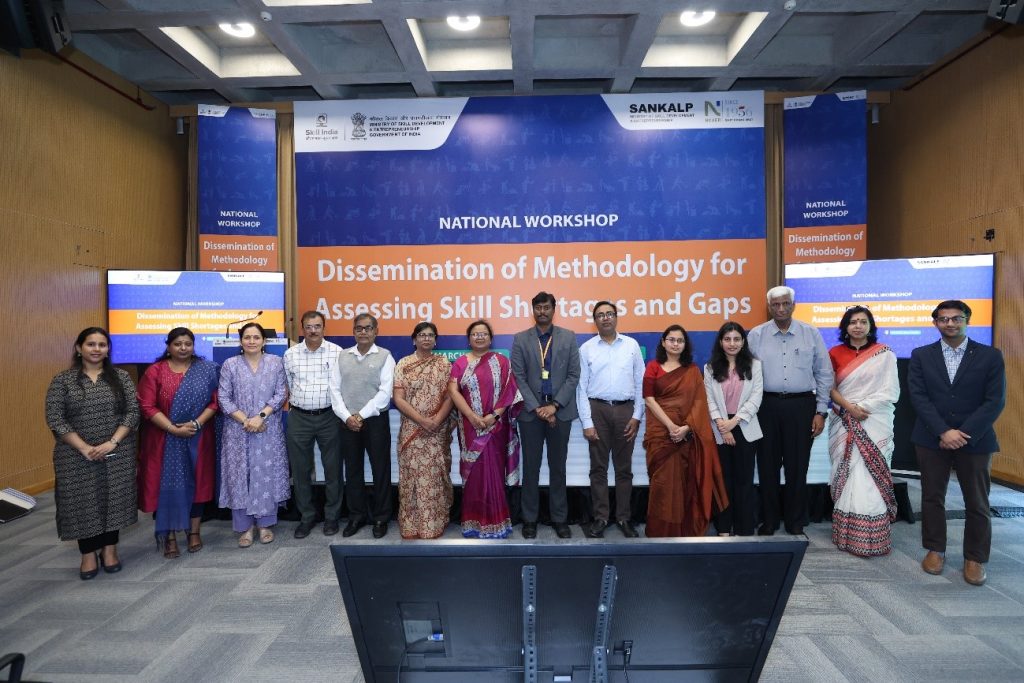
The NCAER and Ministry of Skill Development and Entrepreneurship jointly organised the National Workshop on ‘Dissemination of Methodology to Assess Skill Shortages and Gaps’ on 18 March 2025, at the NCAER Auditorium in New Delhi. The workshop was attended by 85 in-person participants, and 53 participants who joined virtually from State Governments around the country.
The keynote address at the workshop was delivered by Shri Atul Kumar Tiwari, Secretary, MSDE.
Welcome Address by Dr Anil Sharma, Secretary, National Council of Applied Economic Research (NCAER)
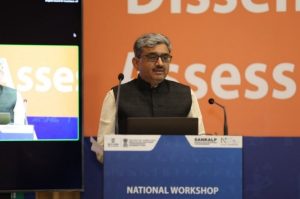 Dr. Sharma welcomed everyone to the workshop. He discussed about the challenges we are facing today for upskilling and reskilling the labour, and keeping this in mind NCAER started working on skills about 10 years ago.
First study done in this space was ‘Skilling India –No Time to Lose’. There was another study on skilling in schools that was done for Central Board of Secondary Education, under which NCAER evaluated the programmes and initiatives by the schools. It was appreciated by World Bank as well. There were several other studies interlinked with skilling. At present 3 different types of studies are ongoing at NCAER, which are in collaboration with the MSDE. One for which the workshop is being held i.e. methodology for assessing skill shortages and gaps in the 7 high growth sectors led by Dr. Bornali Bhandari. The other two are led by Dr. Poonam Munjal, regarding ‘Concurrent Evaluation of the PM Vishwakarma Scheme’ and ‘Concurrent Monitoring of the PM Kaushal Vikas Yojana Scheme (PMKVY)’.
Inaugural Remarks by Shri Atul Kumar Tiwari, Secretary, Ministry of Skill Development and Entrepreneurship (MSDE)
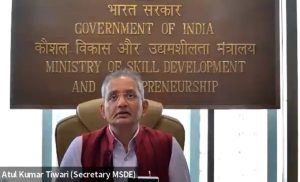 Shri Tiwari thanked Dr Poonam Gupta, Dr Anil Sharma and Prof Bhandari and her team. He introduced to the audience that the national workshop was the culmination of a series of workshops to present the methodology for assessing skill shortage and gap. From a public policy perspective, the importance of the study stems from the fact that India needs targeted skilling interventions, for which we need a proper understanding of what the skill demand is.
Shri Tiwari provided examples of how such studies have been done internationally, by highlighting instances of demand driven analyses from other countries, such as: quantitative forecasting models in the United States, employer led skill demand studies from Germany, qualitative approaches of Australia, foresight and scenario planning of Brazil, and big data and real time analytics of Europe.
He mentioned that MSDE’s objective was to arrive at a methodology which can used for anticipating and adapting skills at the national level, and essentially to have a labour market information system that assesses skills and shortages at present, and also anticipates future skill demands. The ministry approached NCAER to take forward this work due to the institute’s established eminence in this field of work.
 Shri Tiwari hoped for this methodological prototype to serve as a dynamic framework for continuous skill demand assessment, which evolves with economic shifts and technological advancements, and for it to be replicated at sub-national and sectoral levels to ensure state level and industry specific skill planning.
He expressed confidence that the national workshop, along with the regional workshops held prior to this, would help us in arriving at a methodology which will allow us to ensure that India’s skill ecosystem remains, agile, targeted, future ready, and align with the demands of an evolving global economy. Shri Tiwari concluded his remarks by thanking Prof Bornali Bhandari and her team for taking forward exceptional work in this regard.
Inaugural Remarks by Shri V.S. Arvind, Director, SANKALP
 The Director, Skills Acquisition and Knowledge Awareness for Livelihood Promotion (SANKALP) MSDE, Shri V.S. Arvind gave the inaugural remarks.
Presentation on methodology to assess skill shortages and gaps at the Central, State and Sectoral levels
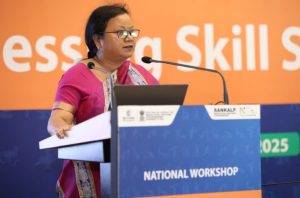
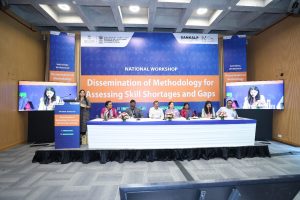
Prof. Bornali Bhandari, Professor, National Council of Applied Economic discussed the detailed methodological framework for the skill gap assessment in 7 key sectors.
