

 Events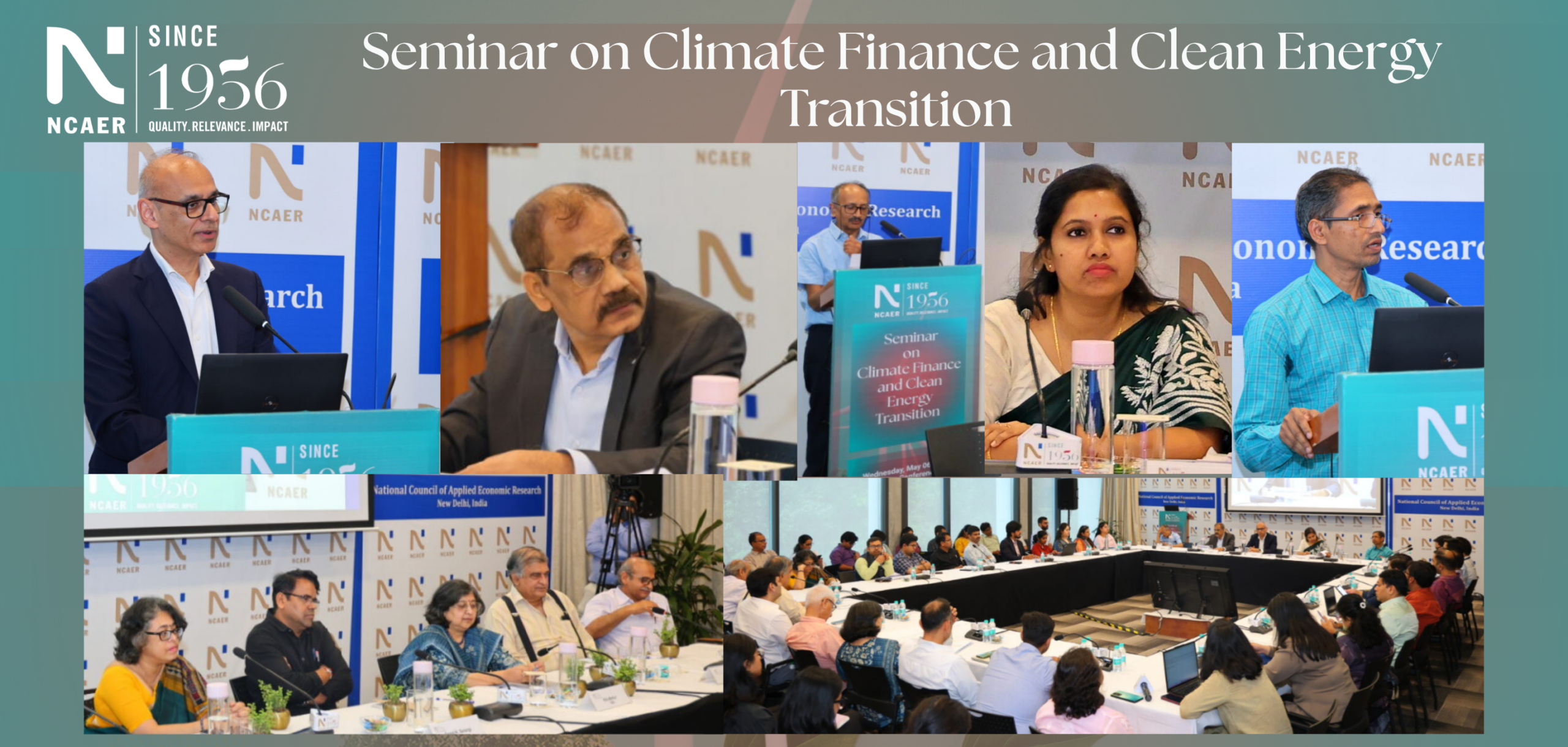
NCAER hosted a workshop on “Climate Finance and Clean Energy Transition” at its campus. The aim of the workshop was to bring together policymakers, researchers, industry representatives, and other stakeholders to deliberate on key issues shaping India’s renewable energy transition. The discussions focused on the role of public expenditure in renewable energy development, the impact of fiscal decentralisation on state-level investments on renewable energy, and outcomes from primary surveys capturing firm-level constraints, regulatory challenges, and supply chain bottlenecks.
It was pointed out that as India advances toward its ambitious targets of achieving 500 GW of non-fossil fuel capacity by 2030 and net-zero emissions by 2070, the transition to clean energy not only presents technological challenges but also raises critical questions related to finance, governance, and institutional coordination. While significant progress has been made in this direction, gaps remain in public financing, state-level capacity, and private sector engagement. It is important to understand that this transition is not merely a technological shift, but is fundamentally a question of financial and pragmatic systemic coordination among institutions and the public and private sectors.
Renewable energy has also received a massive push in Central planning and implementation, and the 16th Finance Commission has allocated Rs 50,000 crore for clean energy transition for five years through local bodies, especially because this remains a highly capital-intensive sector, requiring large upfront investments and long-term financing mechanisms. In this context, fiscal decentralisation plays a crucial role, as it enhances the autonomy of subnational governments, improves resource allocation efficiency, and enables locally tailored investments in green infrastructure and renewable energy projects. Since states are vital implementers of energy policies, achieving national climate targets requires them to scale up investments in renewable energy and related infrastructure.
However, structural challenges impacting the financial and sectoral implementation of green energy transition persist. There is a clear mismatch between the targets and the financial preparedness of the nation, with limited and uneven public expenditure on renewable energy across Indian states. It has been observed that the states tend to allocate only a marginal share of their budgets to renewable energy with a considerably higher portion going to revenue expenditure (salaries and maintenance) than capital expenditure (investment), which limits the creation of durable infrastructure and long-term asset creation. There are also significant variations in fiscal capacity, policy priorities, and institutional readiness across states, resulting in fragmented progress of India’s clean energy transition. It has been estimated that in order to meet the target of 500 GW of renewable energy capacity, the states need Rs 14,064 crore each year, that is, around Rs 72,000 crore over five years.
Further, the challenges in renewable energy development are not limited to government-led investment in the sector alone. Many barriers are context-specific, with issues such as regulatory bottlenecks, financing difficulties, land acquisition hurdles, and local acceptance varying across regions and stakeholders, necessitating field-level insights in addition to analysis of secondary data on the subject. By combining primary survey results with analytical tools, policymakers can design more targeted and effective interventions to accelerate renewable energy deployment across the country.
The technical session of the workshop, which was moderated and chaired by Professor Basanta Kumar Pradhan, Director, Indira Gandhi Institute of Development Research (IGIDR), featured the following three presentations based on research findings on the issues of climate finance, fiscal federalism, and renewable energy impacting green growth in India:
- Presentation 1: Public Financing for Renewable Energy Sector Development by Chetana Chaudhuri, Fellow, NCAER
- Presentation 2: Fiscal Decentralization and Renewable Energy Development in Indian States by Hrushikesh Mallick, Professor, Banaras Hindu University (BHU)
- Presentation 3: Binding Constraints in India’s Renewable Energy Transition by Chetana Chaudhuri, Fellow, NCAER
The workshop concluded with a panel discussion with the objective of fostering dialogue and policy recommendations on clean energy adoption. The panellists included:
- Professor Sunil Ashra, Professor of Economics and Co-Chairperson of the Centre for Ethics, ESG and Responsible Organizations, Management Development Institute (MDI)
- Professor V.P. Ojha, Director, Policy Modelling Association for Inclusive Development (PMAID)
- Dr Saon Ray, Senior Visiting Professor, Indian Council for Research on International Economic Relations (ICRIER)
- Dr Ritu Mathur, Senior Fellow and Director, Energy Assessment and Modelling, The Energy and Resources Institute (TERI)
- Dr Gopal Krishna Sarangi, Associate Professor, TERI University.
By coalescing empirical evidence and policy dialogue, the workshop sought to provide a platform for diverse perspectives and actionable insights, thereby contributing towards creation of more effective climate finance frameworks.