

Background:
The National Council of Applied Economic Research (NCAER) is India’s oldest and largest independent, non-profit, economic research institute. It does grant-funded research, commissioned studies for governments and industry, and is one of the few think tanks globally that also collect primary data. NCAER has set up a National Data Innovation Centre (NDIC) to serve as a laboratory for experiments in data collection, interfacing with partners in think tanks, Indian and international universities, and government. NDIC forms an important core of NCAER’s long-standing data collection activities. NCAER has partnered with the Universities of Maryland and Michigan for the NDIC. Initial funding for NDIC is provided by the Bill & Melinda Gates Foundation.
Current Request for Proposals:
Historically, household surveys in low- and middle-income countries (LMICs) have been carried out by conducting face-to-face interviews. Despite the advances in computer-assisted personal interviewing (CAPI) technologies, household surveys still tend to be costly and resource-intensive because of their complexity (Dabalen et al. 2016). The process of designing and implementing a survey and producing a clean dataset that is ready for analysis often takes several months. Moreover, to accurately capture certain rapidly changing conditions (e.g., seasonal employment or the outbreak of disease) and to reduce recall biases in certain types of data (e.g., consumption expenditure or more specifically, out-patient health expenditure), it becomes imperative to conduct more frequent surveys, which in turn, limits the use of face-to-face surveys. The widespread use of mobile phones in India offers a new opportunity to remotely conduct surveys with increased efficiency and reduced cost.
Therefore, the focus of the current RFP is to seek proposals on data collection experiments involving phone surveys across the following themes: household income and expenditure, labour force participation, financial inclusion, health insurance and out-of-pocket expenditure, gender equality and empowerment, other forms of social inequality, and agriculture.
The proposals on these themes should ideally focus on generating evidence in the context of the following specific areas relevant to phone surveys:
Sampling frame for mobile phone surveys: What would be an ideal sampling frame for mobile phone surveys that is representative of the target population? Can a random digit dialing (RDD) sampling frame, commonly used in developed countries, be a viable alternative in India? Or is a two-step approach entailing a face-to-face baseline survey combined with follow-up survey rounds conducted through mobile phones a better alternative? How can we address the issue of imperfections in the sampling frame, such as under coverage and duplication, in the analysis of phone survey data (Valliant, Dever and Kreuter 2013)? How can we reduce bias and adjust for selectivity due to mobile ownership?
Non-response bias and measurement bias in telephone surveys: How to evaluate the accuracy of different modes of data collection (face-to-face versus. telephone interviewing)? How to design a study that would allow for estimation of non-response bias and measurement bias separately leading to a more effective comparison?
Comparison between face-to-face surveys and phone surveys: In the case of certain types of data collection requiring high-frequency surveys, which of the two approaches, face-to-face surveys or phone surveys, produces better data in terms of data accuracy, timeliness, cost-effectiveness, and analysis of the attrition rate? Further, how can the attrition rates in phone surveys be reduced?
Appropriate length of survey questionnaire for phone surveys: One of the constraints of a mobile phone survey is the limited number of questions that can be asked over a phone. What is the ideal length of a questionnaire for phone surveys? How can the drawback of phone surveys be overcome in the case of long questionnaires?
Comparison between different phone-based modes of data collection: Compare the data quality and data collection efficiency of phone surveys using electronic forms, SMS, interactive voice response (IVR), and live voice interface (computer-assisted telephone interviewing) on the basis of attrition, data quality, and technical and logistical considerations.
Variation in mobile phone coverage across regions: How can the heterogeneity in mobile phone ownership and network coverage across states and districts in India be incorporated while drawing inferences based on a phone survey?
Impact of respondent and interviewer characteristics: Access to telephone may be limited by age and gender. How would this constraint affect the representativeness of the sample? Do attrition rates differ by respondent characteristics? Does the gender of the interviewer affect response rates?
Survey of sensitive behaviour: Can phone surveys reduce bias and improve reporting for sensitive behaviours (e.g., contraceptive use, domestic violence, and practice of gender-, caste- and religion-based discrimination) relative to face-to-face surveys?
Mixed-mode data collection methods: How can multiple modes of data collection be combined to reduce biases in a cost-effective manner, especially for geographical regions lacking optimal mobile phone access and network coverage?
Eligibility
Applicants affiliated to any academic or research institutes, non-profit organisations, and private companies that have experience in primary data collection and have offices within India are eligible to apply. We hope that the successful applicants will be able to collaborate with NCAER researchers in the future activities, allowing NCAER and the Centre to expand its network and the skill sets of professionals associated with it.
Funding
The Centre will support a budget of up to Rs. 20 lakh (inclusive of all applicable taxes) for a period of 12 months. The budget should clearly indicate the actual needs and modes of utilisation of the funding for the proposed project. There is a provision for two such grants. Only one grant from each applicant will be considered for funding.
Application Procedure
All applications must be emailed to Ms Arpita Kayal, Program Manager, NDIC (akayal@ncaer.org) in a single PDF document (font ‘Georgia’, size 12) with the following components:
A) The proposal (no longer than 6 pages in single space) on research work falling under the focus areas outlined above. The proposal should include the following sections:
1. Project Summary
2. Specific Aim(s)
3. Research Strategy, which would further specify:
a. Significance
b. Innovation
c. Approach and Implementation Plan
4. Expected Outcomes
5. Potential Challenges and Alternative Strategies
6. Timeline
7. Budget and budget justification
8. Institutional background
(The proposal page limit is exclusive of the budget and institutional background.)
B) Curriculum Vitae of the key research staff who will undertake the proposed work.
Last Date for Submission of Proposals has lapsed
Expression of interest
Applicants interested in participating in this RFP may let Ms Arpita Kayal (akayal@ncaer.org) know of their interest. We expect to set up an information sharing phone call with potential applicants during early August.
Selection Criteria
The selection of proposals will be based on the merit of the proposal and the CVs of the research team. And, the merit of the proposal will be judged on the basis of the following criteria:
- Alignment of the proposal with the RFP
- Innovativeness in methods
- Rigour and feasibility of approach
- Clarity of thought
- Clarity in writing
Expected Output
It is expected that a report on methodology and results will be submitted to the Centre to be placed on NCAER’s website. Successful applicants are encouraged to submit their results for journal publication. The study instruments and anonymised data set will be also placed in the public domain for free online download.
References
Dabalen, Andrew, Alvin Etang, Johannes Hoogeveen, Elvis Mushi, Youdi Schipper, and Johannes von Engelhardt. 2016. Mobile Phone Panel Surveys in Developing Countries: A Practical Guide for Microdata Collection. The World Bank.
Valliant, Richard, Jill A Dever, and Frauke Kreuter. 2013. Practical Tools for Designing and Weighting Survey Samples. Springer.
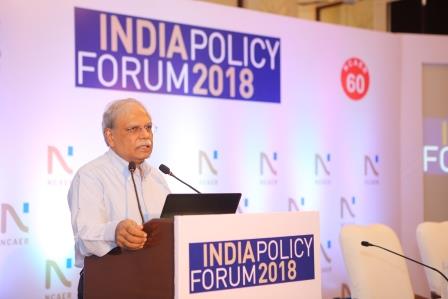 Dr Shekhar Shah, NCAER’s Director-General, welcoming Shri Prabhu, said: “This is the 15th India Policy Forum. Over the years we have addressed some of the most topical challenges facing the Indian economy. This year’s IPF is a good example, covering the range of macroeconomic and microeconomic issues that India faces. We are discussing India’s growth experience but also the issue of women in the labour force. What is unique about the IPF is that it is a place where research and policymaking meet, with each side benefitting from the discussions that happen. The Commerce Minister’s presence is testimony to the importance of such a forum for meeting the economic policy challenges that India faces.”
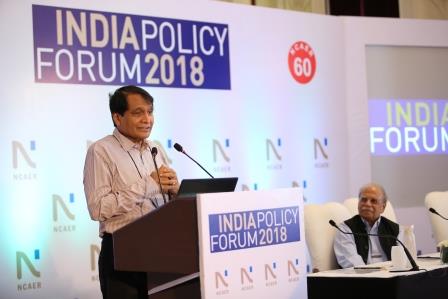 Shri Suresh Prabhu, Union Minister of Commerce and Industry, thanked the IPF delegates for their sustained contribution to Indian economic policymaking. He said, “I have to make policy as well as implement it. But policymaking shouldn’t be the sole domain of government. We should try to get as much input as possible from all stakeholders, and particularly from organizations like NCAER where experts can think about issues in a dispassionate manner, and therefore offer the appropriate policy advice. Policies if not framed rightly, even if we implement them in toto, will obviously give us disastrous results. So the first and most fundamental issue is how to frame policy, and I think we in the government are always looking for ideas so that we frame the right policies around those ideas.” Click
 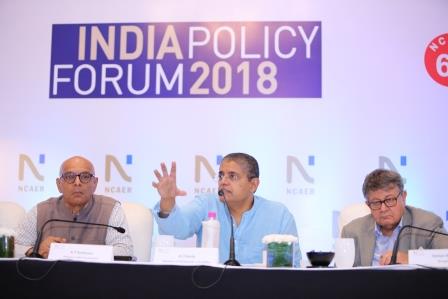 The aim of the India Policy Forum is to promote robust, original economic policy and empirical research on India. Five papers, representing a unique combination of intense scholarship and policymaker engagement, were presented at the 2018 IPF. On day one, the first session dealt with Impact of Tax Breaks on Household Financial Saving, followed by a discussion on India’s Growth Story built around an analysis of 50 years of macroeconomic data. The final session dealt with Quantifying India’s Climate Vulnerability. These three papers were followed by the IPF Policy Roundtable on “India’s Healthcare Reforms: Getting to Health For All,” involving a detailed discussion of the Ayushman Bharat National Health Protection Program. On day two, the first session dealt with Women and Work in India: Descriptive Evidence and a Review of Potential Policies, which investigates the key facts of women’s participation in workforce, followed by the last session on What Drives India’s Exports and What Explains the Recent Slowdown? New Evidence and Policy implications. This was followed by the IPF Roundup discussions in a session titled, Policy Priorities for 2019-24: What are these IPF papers telling us?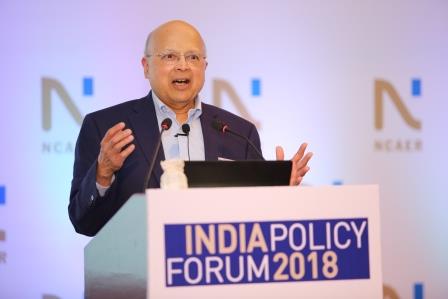
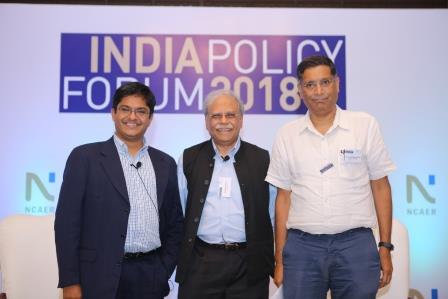 The 15th India Policy Forum ended with a special 15th Anniversary event on Wednesday evening featuring a conversation with Arvind Subramanian, Chief Economic Adviser to the Government of India, talking with NCAER Non-resident Senior Fellow and University of California, San Diego, Professor Karthik Muralidharan. Click