

 Events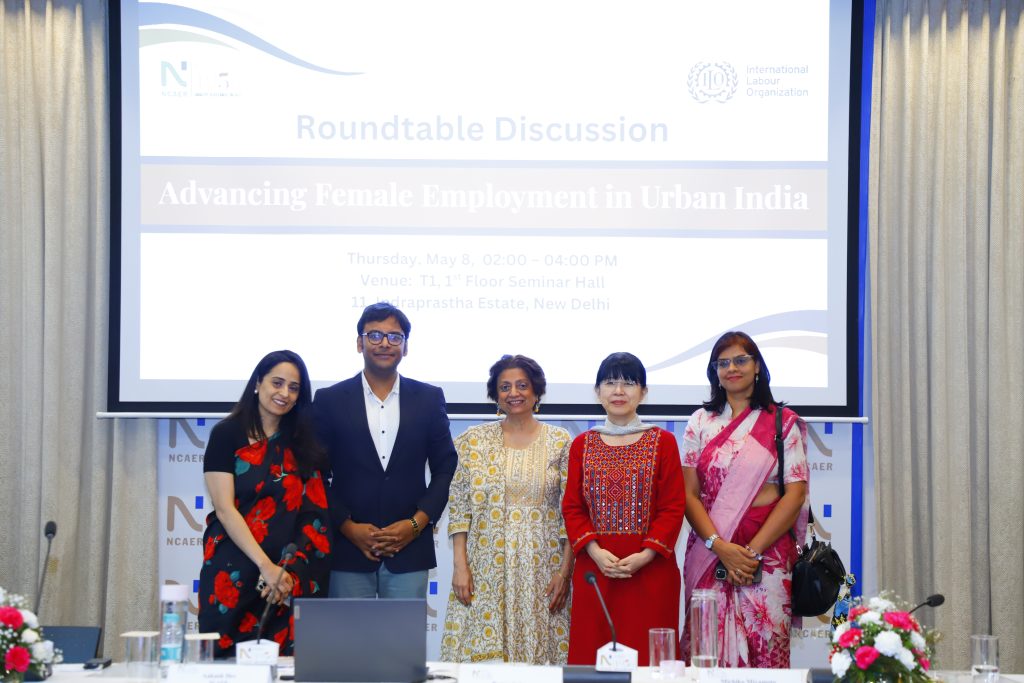
NCAER, in collaboration with the International Labour Organization (ILO), hosted a roundtable discussion on Advancing Female Employment in Urban India on 8 May 2025. The event brought together policymakers, researchers, and development practitioners to deliberate on the persistent barriers to women’s labour force participation in urban India and to explore strategies for ensuring inclusive employment growth.
 Dr Ratna Sahay, Head of NCAER’s Centre on Gender and Macroeconomy, and Ms Michiko Miyamoto, ILO Country Director for India inaugurated the roundtable. Dr Sahay underscored the transformative potential of formalising part-time employment for boosting female employment and economic growth in India. She also accentuated the importance of integrating gender considerations into macroeconomic policymaking and the often-overlooked value of care work, both within households and across the broader economy.
Ms Miyamoto emphasised the chronic neglect of the care economy in global economic discourse. She pointed out that strategic engagement from the government could unlock substantial opportunities within India’s care economy, benefiting both employment and social outcomes.
Presentations
 The first presentation at the event from Dr Aakash Dev of NCAER focused on the entrenched barriers to female labour force participation, particularly in urban settings. He identified unpaid care responsibilities, limited access to flexible work in the formal sector, restrictive gender norms, and inadequate training as major impediments to women’s labour force participation. Recent research at the Centre on Gender and Macroeconomy reveals that formalisation of part-time employment and equitable sharing of domestic care responsibilities can lead to a 6-percentage point increase in female labour force participation in India.
In the next presentation, Ms Aya Matsuura of the ILO made a compelling case for strategic investment in the care economy, not only for narrowing gender employment gaps but also for generating a huge number of decent jobs, especially in the formal education and healthcare sectors.
Key Discussion Themes
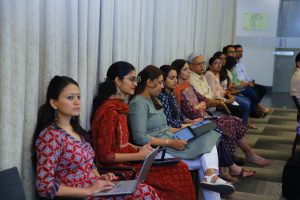 The roundtable discussions, moderated by Dr Sahay, centred on identifying actionable interventions to enhance women’s employment in urban India. The participants highlighted the need to bridge the gap between skills training and actual entry into the labour market to ensure that training translates into tangible job opportunities. It was suggested that guaranteeing safety, accessibility and fair remuneration in employment and promoting financial literacy for women would help address both the logistical and economic barriers faced by them.
The importance of strengthening transport infrastructure to ensure safe and convenient commutes and workplace safety for women to enable sustained female workforce participation was also highlighted.
The participants also noted the potential of technology to reduce physical labour, and sector-specific strategies—particularly in manufacturing industries such as automotive—to challenge gender stereotypes and bring more women onto shop floors.
The roundtable concluded with a recognition of the complex barriers limiting women’s labour force participation in urban India, and the need for coordinated multi-sectoral policy action to create a more gender-inclusive and equitable urban labour market.