Events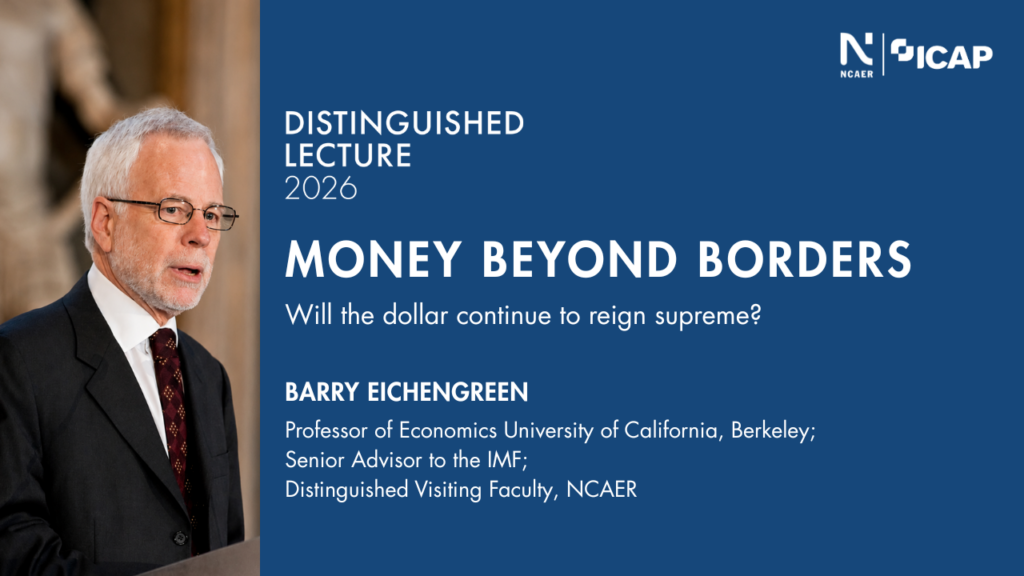
Distinguished Speaker
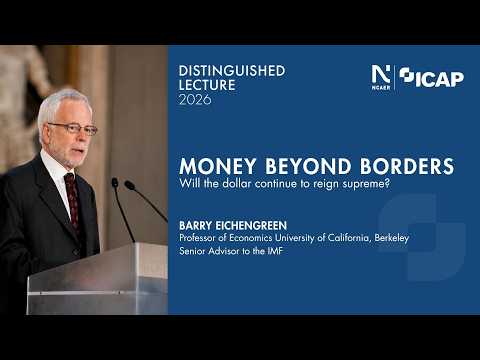
Professor Barry Eichengreen
Professor of Economics, University of California, Berkeley; Senior Advisor to the IMF; and Distinguished Visiting Faculty, NCAER
📖 Author of ‘Money Beyond Borders’
History casts a long shadow, Professor Barry Eichengreen told delegates at the inaugural NCAER-ICAP Lecture on ‘The Dollar and its Discontent’ on July 31 in Mumbai. The Professor of Economics, University of California, Berkeley, Senior Advisor to the IMF, and Distinguished Visiting Faculty, NCAER, framed his analysis of the much-debated destiny of the US dollar against the course and lessons of history.
Agreeing with broad concerns that the dollar’s supremacy is indeed eroding, Professor Eichengreen underscored his conviction that no single rival is poised yet to replace it. Instead, multiple alternatives—gold, euro, renminbi, smaller currencies, and digital platforms—will gain only marginal ground as countries hedge against dollar risk.
The dollar’s resilience against the pressures that beset it comes from its extraordinary global role, Professor Eichengreen said, noting that it dominates trade invoicing, international banking, and foreign-exchange markets – nearly 90% of FX trades involve the dollar and over half of central bank reserves are held in dollar assets. This dominance stems from America’s long-standing economic heft, deep and liquid Treasury markets, and powerful network effects that reinforce the dollar’s centrality in the international financial architecture.
This benefits the United States: it allows borrowing at lower rates, provides safe-haven benefits during crises, and strengthens the impact of U.S. sanctions. But it irks other countries that are dependent on the dollar, more so in the face of U.S. unilateralism. Alternatives have emerged since 1971, when the U.S. Treasury Secretary famously said at Bretton Woods , “It’s our currency, but your problem”, and Eichengreen noted that the euro and Chinese renminbi, as well as digital currency platforms such as Project mBridge do show technical feasibility for bypassing the dollar. However, he pointed out that their viability must be assessed in the context of political as well as economic governance challenges.
During the lecture which drew from his just published book ‘Money Beyond Borders’, Prof Eichengreen examined several alternatives to the US dollar:
- Gold: Offers diversification and historical legitimacy, but is volatile, illiquid for payments, and yields no interest.
- Euro: Despite initial promise, it has stagnated as an international currency due to fragmented capital markets, limited safe assets, and lack of unified foreign policy.
- Renminbi: China is the world’s leading trader, but its currency remains marginal in reserves. With just a few decades of financial market development compared to America’s centuries, it will take long to catch up.
- Non-traditional currencies: Canadian, Australian, New Zealand dollars, and Nordic currencies have gained ground, thanks to electronic trading, but their scale is too small for global leadership.
- Indian rupee: Local-currency settlement initiatives exist, but limited bilateral trade balance and capital controls inhibit the currency’s potential as an international currency of choice.
- CBDC networks: Project mBridge, now China-led, has processed US$55 billion in transactions, proving technical viability. Yet governance is unresolved: consensus can work for five central banks, not for hundreds. Weighted voting would likely favour China, suggesting regional rather than global adoption.
- Project Agora, the Western alternative remains on the drawing board.
The history of money underscores that credibility, rule of law, and political alliances have always underpinned monetary leadership, Prof Eichengreen said, tracing the long history of global currencies from Athenian “owls” and Roman coins to Florentine florins and Spanish silver.
Arguing that dollar dominance is eroding at a modest pace, he said that its share of global reserves has declined from over 72% in 2000 to under 60% today. Foreign holdings of US Treasuries are shrinking, and the yield advantage has disappeared. He attributed this to rising US debt, political polarization, questions about financial stability (e.g., the 2023 Silicon Valley Bank crisis), and threats to Federal Reserve independence. Prof Eichengreen warned that weakening US alliances may be the most critical factor: historically, allies like Germany, Japan, and Saudi Arabia have supported the dollar, but doubts about America as an ally could raise new questions.
Prof Eichengreen concluded with the hope that viable alternatives would mature over time, finding their way around prevailing constraints while the international monetary and financial system evolves away from the prevailing dollar-centric structure towards a multipolar, decentralized model.