

 Events
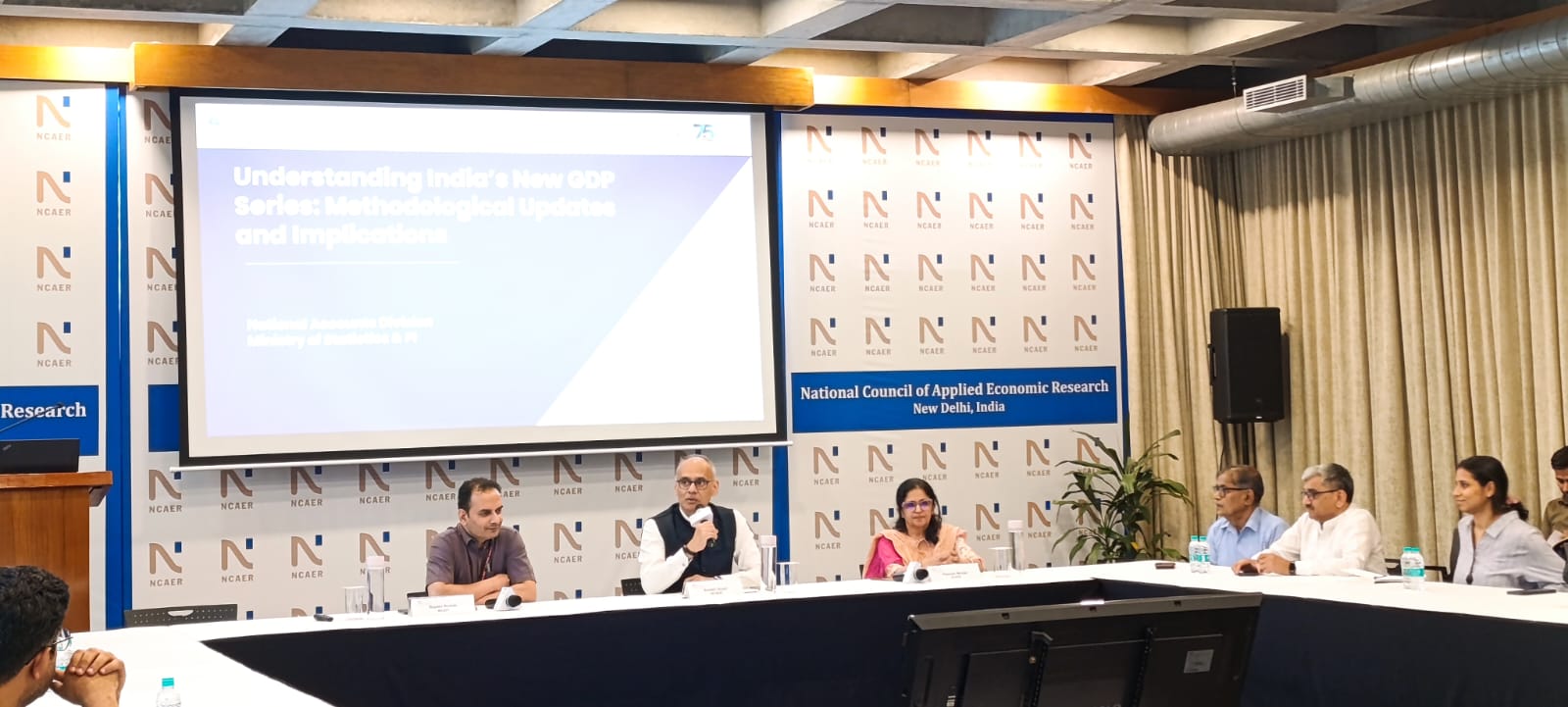
The NCAER Seminar Series is intended to highlight diversified perspectives and cutting-edge research insights by hosting external speakers from a wide array of academic fields. As part of this Series, NCAER hosted a talk on ‘Understanding India’s New GDP Series: Methodological Updates and Implications’ by Mr Rajeev Kumar, DDG, National Accounts Division, Ministry of Statistics and Programme Implementation (MoSPI), on 1 June 2026.
The talk was held in the context of the revision in India’s GDP series with 2022–23 as the new base year, incorporating improved data sources and methodological refinements. The session included a discussion on the key updates in the new series and their implications for measuring India’s economic growth and structure.
The event commenced with a welcome address by the Director General, NCAER, Mr Suresh Goyal, who pointed out that the concept of GDP was coined by Simon Kuznets in 1931. Mr Goyal alluded to Kuznets’ address to the U.S. Congress, wherein he had observed that “the welfare of a nation can scarcely be inferred from a measure of national income”, implying that GDP is fundamentally a measure of economic activity rather than a comprehensive indicator of societal welfare.
 Mr Rajeev Kumar noted that many changes have been made to the components included in both national production and expenditure to provide a more accurate estimate of economic activity. One of the major methodological improvements in the new GDP series is the introduction of the double deflation method for manufacturing, under which both output and intermediate consumption are deflated separately before deriving Gross Value Added (GVA) at constant prices, resulting in a more accurate measure of real economic activity. In addition, he highlighted several other improvements that have been made in terms of new data sources; benchmarking; more granular estimates; changes in deflators; and, alignment with changes in Annual National Accounts. The revised methodology, therefore, aligns more closely with the base-year production and consumption structure of the economy.
 In her closing remarks, Professor Poonam Munjal, NCAER, raised the question regarding the downward revision in the share of the services sector observed across two successive GDP base-year revisions. Mr Rajeev Kumar clarified that such revisions reflect improvements in data coverage and measurements. He cited the example of the use of GST data, EVAHAN, and PFMS data for enhanced quality of estimates for the services sector.