“The economic stability of India is intricately linked to climatic patterns. Our collaboration with IGSD will help us build robust models to predict and mitigate the adverse effects of climate change, particularly those stemming from Arctic ice melt, on our agriculture and economy.”—says Sanjib Pohit
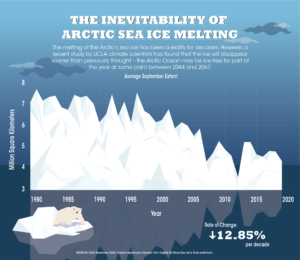 The Arctic is warming four times faster than the global average, primarily driven by a “cascade of feedbacks” that collectively amplify Arctic warming. Arctic amplification describes how the Arctic responds to global temperature changes more dramatically than lower latitudes. The mechanisms driving this amplification include reduced albedo from the loss of sea ice and decreased snow cover (known as the ice-albedo feedback), increased water vapour in the Arctic atmosphere, altered cloud cover, added heat in the newly ice-free ocean areas, a lowered rate of heat loss due to lower surface temperatures in the Arctic and reduced air pollution.
Arctic amplification can alter large-scale atmospheric flow and contribute to extreme weather events beyond the Arctic. Changes in the Arctic can influence weather systems passing through the mid-latitudes, increasing the incidence of cold spells over land. India is particularly impacted by these changes, which are likely to affect critical aspects of national development such as economic security, water security, sustainability, weather conditions, monsoon patterns, coastal erosion and glacial melting. Indian agriculture heavily depends on the monsoons, as it receives around seventy per cent of its annual rainfall during this season.
The principal aim of this study is to quantify the impact of Arctic ice melting on India’s agriculture in general and its pass-through effect on the Indian economy. The analysis will be based on a multi-sector CGE model of India with detailed agricultural sectors so that all the major crops are represented. Important agriculture-linked manufacturing sectors will also be incorporated to capture the two-way transmission mechanism of agriculture to non-agriculture sectors. The business-as-usual (BAU) scenario and policy scenario for future periods (mid-century) will be run on this model to understand the implications for the Indian economy. Multiple scenarios of impact analysis on agriculture and GDP will be undertaken based on climate change predictions (precipitation, temperature, etc.) provided by climate modellers. Thus, we expect to provide a range of estimates on the impact on India’s agriculture, food security and GDP depending on climate change predictability.
Principal Investigator/Point of Contact: Sanjib Pohit
COP28 emphasized that transitioning away from fossil fuels in energy systems is required in a just, orderly and equitable manner. Green transition is an imminent pressure on the economy as the global community is facing the challenge of sustainability, energy security and environmental protection. The target to achieve low carbon development growth for India requires investment in renewable energy resources, without hampering the economic growth. Recently, India’s energy policy path is adopting transition from fossil fuel energy sources to non-fossil fuel energy sources. The transition should also be aligned with India’s long-term development goals. The project aims to assess the economic implication of gradual transition to low carbon economy aligned with India’s developmental goals and to understand the framework and impact of alternative pathways of reaching the low carbon targets.

 The objectives of the study are to assess the empowerment of adult urban women in India who have passed Class X. The study will be implemented in several phases. In the first phase, the study will cover a total of 11 states across five different regions of India – North, East, West, South and Central. This will ensure a reasonable spread of coverage and will enable us to draw meaningful comparisons at the regional level. The outcome of the study will be an index of women’s empowerment, which will help in comparing the status of empowerment across the states, and will help in determining the absolute as well as relative status of the states.
The study will also present the factors which affect women’s empowerment, along with their relative importance. The larger vision and objective of this work is to generate real evidence on women’s empowerment using ground-level information among various social and economic strata of our society.
Under the aegis of “Smart Cities and Academia towards Action & Research (SAAR)” program, the Smart Cities Mission (SCM) directorate has started a joint initiative of MoHUA, National Institute of Urban Affairs (NIUA) and leading Indian academic institutions of the country for impact assessment for the experiments done in the Smart Cities.
One of these experiments has been to generate revenue for the smart city through mission project interventions. Additionally, the study will assess the impact of these interventions on additional revenue generation, employment generation, environmental sustainability and living conditions of the people of city in terms of health & education, infrastructure and transportation.
The study aims to evaluate the effectiveness of the small borrowing and its impact on the borrowing households with respect to economic, human capital and social capital aspects.

