17 September, 2026
Published in: The Economic Times


Published in: The Economic Times
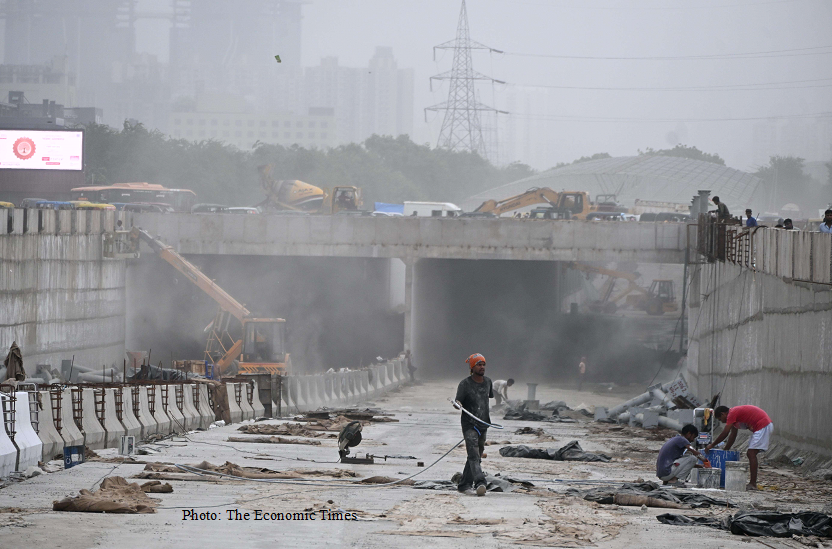
Rising public capital expenditure has supported growth, but weak private participation suggests India’s infrastructure investment cycle is yet to turn decisively.
Government data shows that India grew at a scorching pace of 7.8 per cent in the first quarter of FY 2026-27. This was the highest Q1 real GDP growth during the four years from 2023-24 to 2026-27. In July 2026, the IMF described India as one of the world’s fastest-growing economies and a key engine of global growth. India’s sovereign credit assessment was affirmed at ‘BBB/A-2’ with a Stable Outlook by S&P Global Ratings in August 2026.
The high Q1FY27 growth rate and associated accolades are indeed a major achievement, coming as they do amid persistent geopolitical tensions and uncertainty around global trade, while maintaining the 7 per cent+ Indian growth trajectory over the past three financial years.
One of the key enablers of growth is investment, as reflected in Gross Fixed Capital Formation, which grew by 11.9 per cent in Q1FY27. One of the crucial components of investment is infrastructure investment.
When infrastructure investment focuses on augmenting road, air, railway, and port connectivity, more electricity generation projects are set up, and there is better-quality water supply and sanitation, enabling more economic activity, with factories coming up and leading to more income and jobs.
For these reasons, in Budget 2026–27, the Finance Minister announced that the Central Government capital expenditure would be ₹12.2 lakh crore. She also referred to the massive increase in Central Government capex, which has increased manifold from ₹2 lakh crore in FY2014-15 to ₹11.2 lakh crore in FY 2025-26 (Budget Estimates).
But we need to distinguish between capital expenditure and infrastructure investment (as defined by the Department of Economic Affairs, Ministry of Finance through the Harmonised Master List of Infrastructure) for many reasons, including the fact that while capital expenditure constitutes about 34 per cent of GDP, infrastructure investment is only about 4.6 per cent of GDP (CRISIL 2023).
India’s infrastructure investment gap
The World Bank, in its Growth Report (2008), states that fast-growing East Asian countries during their fast-growth phases have spent about 7-8 per cent of their GDP on infrastructure, which was probably the right level for fast and sustained growth.
This was the basis for the $1.5 trillion infrastructure investment target for the six years ending FY25 in India’s first and only National Infrastructure Pipeline (2020). Since infrastructure investment is among the most important enablers of growth, this data should be officially monitored and released by the government.
However, the government has stopped collecting this data since 2015 (NITI Aayog, Appraisal Document of the 12th Five-Year Plan, 2012-17), thereby compromising evidence-based policy-making in this critical area.
One has to rely on other data sources, including private sources, which show that India’s actual infrastructure investment achievement is 4.6 per cent of GDP, well short of the target.
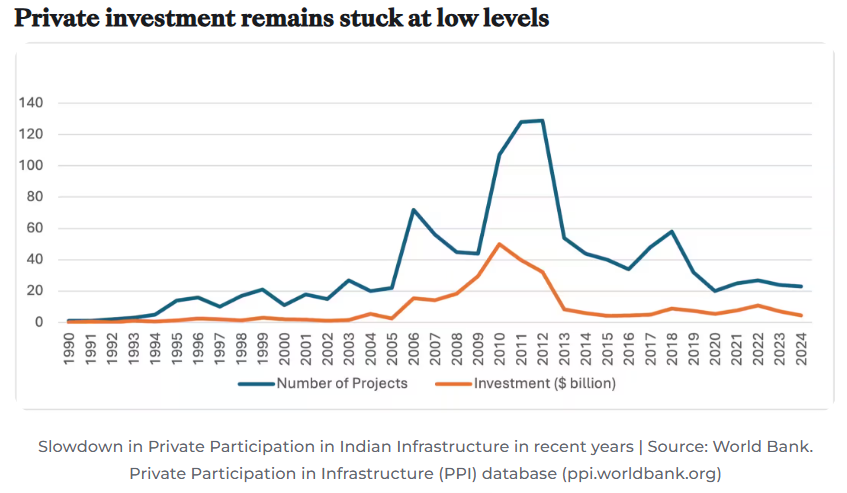
An important source of infrastructure investment data is the World Bank’s Private Participation in Infrastructure (PPI) database, which tells us that PPI in India has not recovered from the Covid-19 dip and has stagnated at a low level.
It also tells us that the peak PPI in terms of number of projects and investments happened in the five years from 2008 to 2012 (Eleventh Five-Year Plan period) – there was financial closure of 453 projects in the 2008-12 period accounting for an investment of $170 billion.
In the latest five years (2020-24) for which data are available in the World Bank’s PPI database, these numbers have dwindled to a paltry 119 projects, accounting for only $36 billion in investment.
So, it can be stated that what India did in terms of PPI over the latest five years was roughly a quarter of what it did during the Eleventh Five-Year Plan period.
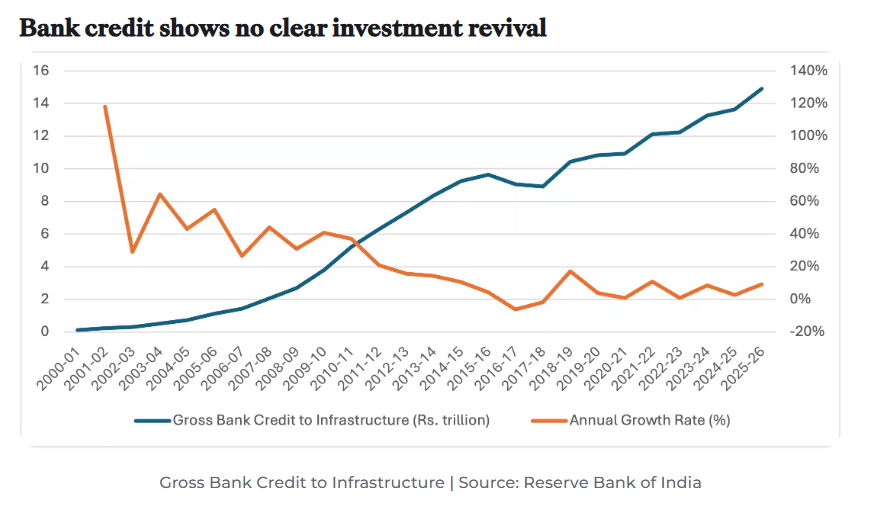
Reserve Bank of India, the country’s central bank, monitors the data on bank credit to infrastructure. As per the RBI data on Industry-wise Deployment of Gross Bank Credit, the total gross bank credit to infrastructure was ₹15.12 trillion as on 31 July 2026, and the annual growth rate (July to July) of this variable was 10.2 per cent, up from 3.4 per cent in the previous year.
The most important components of the gross bank credit to infrastructure are power (₹8.69 trillion) and road (₹3.42 trillion) sectors. The infrastructure projects, especially private ones, are highly leveraged, and it can be assumed that a major share of their debt funding came from the banking sector.
Positioning the current year’s data over a relatively long time period, Figure 2 below shows the deployment of gross bank credit to infrastructure over the last 25 years. The
figure shows that the growth rate of Gross Bank Credit to Infrastructure (the orange curve) has flattened out in recent years.
Analysis using Z-scores also shows that the recent 10.2 per cent year-to-year growth rate (July 2026 over July 2025), or the 9.2 per cent for the full FY 2025-26 (z-score -0.55), is not an outlier on the positive side.
So, what do the data from three sources (Government, World Bank and RBI) tell us about the Indian infrastructure investment story? That there is no turnaround in infrastructure investment in India in recent years. That private infrastructure investment has stagnated at a low level post-COVID.
That the massive upsurge in capital expenditure by the Central Government (not all of which is infrastructure investment) is only substituting for the low level of private infrastructure investment.
Finally, it is high time that the government started publishing official statistics on total infrastructure investment (from the Central Government, State Governments, and the private sector) in the country, as it did until 2015, to facilitate evidence-based policymaking in this critical area.
[This article is authored by Kumar V Pratap. He is a Professor of Practice at Shiv Nadar University and a visiting Professor at National Council of Applied Economic Research (NCAER). He served as Joint Secretary (Infrastructure Policy and Finance, Government of India, from 2017 to 2020. The views are personal]