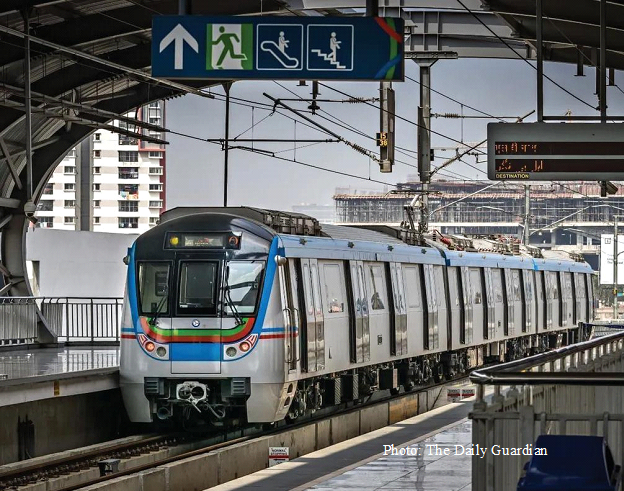
In May 2025, Hyderabad Metro Rail implemented its first major fare revision in over seven years. While the initial increase—based on recommendations of the Fare Fixation Committee—was announced mid-month, public concerns led to a subsequent 10 per cent discount being applied within days. The episode highlights a recurring challenge in India’s urban transport systems: how to adjust fares in a politically and socially acceptable manner while ensuring the financial sustainability of capital-intensive metro projects.
The fare revision is particularly significant because it follows years of fare rigidity, despite rising operating costs and repeated institutional reviews. Hyderabad Metro had not revised fares since operations began in 2017. During this period, energy prices, staffing expenses, and maintenance costs increased steadily, while fare revenues remained constrained by an unchanged fare structure. The eventual correction—followed by a partial rollback—illustrates the difficulty of implementing large, delayed adjustments after prolonged inaction.
This challenge is examined in detail in a study by the National Council of Applied Economic Research (NCAER), submitted in early 2023 as part of an assessment supporting the Fare Fixation Committee’s recommendations. Based on primary surveys of metro users and non-metro commuters, the study analysed commuter willingness to pay, fare acceptance thresholds, and the widening gap between operating costs and revenues when fare revisions are deferred. The Hyderabad case thus offers timely empirical insight into the consequences of postponing fare rationalisation.
Despite a strong post-pandemic recovery in ridership, Hyderabad Metro continued to report persistent operating losses prior to the fare revision. The reason lay not in insufficient demand, but in a structural mismatch between fares and costs. While fare revenues fluctuated with ridership cycles, operating costs followed a more rigid upward path, eroding financial resilience over time. The eventual fare hike—and the public response it triggered—underscores the risks of allowing this gap to widen unchecked.
The key policy question, therefore, is not whether fare revisions are necessary, but how they can be designed and timed to balance commuter affordability with long-term system viability.
The Cost–Fare Mismatch
Metro systems are characterised by high fixed costs. Energy expenses, staffing, routine maintenance, and safety obligations do not decline proportionately when ridership falls. In Hyderabad, operating costs have followed a steady upward trajectory over time, driven by rising electricity tariffs, wage bills, and maintenance requirements. Fare revenues, on the other hand, have been far more volatile—closely tracking ridership fluctuations rather than reflecting any change in fare policy.
An indexed comparison of operating costs and revenues (with FY2018 as the base year) reveals a crucial insight. While fare revenues occasionally outpace operating costs in indexed terms during high-ridership years, this does not indicate fare adequacy. Revenues rise primarily because more passengers are travelling, not because fares are aligned with the underlying cost structure. This distinction becomes clear when operating profitability is examined. The Hyderabad Metro has reported persistent operating losses and negative post-tax profitability, even during periods of ridership recovery.
Deferred fare revisions thus create a structural problem: costs continue to accumulate, while fares remain anchored to an earlier cost environment. Over time, this erodes the financial resilience of metro systems and increases dependence on debt restructuring, cross-subsidisation, or public support.
Are Commuters Willing to Pay More?
A common concern in fare revision debates is affordability. Higher fares are often assumed to deter ridership and push commuters back to private or informal modes of transport. Survey evidence from Hyderabad, however, paints a more nuanced picture.
Among existing metro users, a substantial majority indicate willingness to accept moderate fare increases. Acceptance rates remain high for fare hikes up to 30–40 per cent, suggesting that commuters value the metro’s time savings, comfort, and reliability. Importantly, this willingness is observed across income groups. Even among households earning below Rs. 50,000 per month, acceptance rates for higher fares exceed 75 per cent. This challenges the notion that fare revisions are inherently regressive, especially when metro travel substitutes for costlier or less reliable alternatives.
The income distribution of metro users also matters. Survey data show that over half of metro commuters belong to middle-income households, with monthly incomes between Rs. 30,000 and Rs. 70,000. For these users, the metro competes not just with buses, but with two-wheelers, autos, and app-based cab services. In this context, modest fare increases may still leave metro travel competitive on a generalized cost basis, once time savings and reliability are accounted for. The eventual fare revision in May 2025 broadly aligns with acceptance thresholds identified in the NCAER survey, though the initial magnitude may have exceeded what many commuters perceived as gradual or predictable.
Scope for Mode Shift
Fare policy also influences mode choice beyond existing metro users. Among non-metro commuters surveyed in Hyderabad, more than half reported that they would consider shifting to the metro at existing fares. Even when higher fares are assumed, a significant share—around 45 per cent—remain willing to shift.
Auto users and four-wheeler commuters show particularly high willingness to transition, reflecting the metro’s advantage in terms of travel time and predictability for medium-distance trips of 10–12 km. This suggests that fare rationalisation, if calibrated carefully, need not lead to a loss of ridership. Instead, it may still support modal substitution away from private and para-transit modes, reinforcing congestion and environmental benefits.
Rethinking Fare Policy
The Hyderabad experience underscores a broader policy lesson: fare freezes are not a sustainable affordability strategy. By postponing fare revisions, operators accumulate financial stress that eventually necessitates sharper adjustments or greater fiscal support. Gradual, predictable fare indexing—linked to input costs or inflation—can reduce this risk while providing transparency to users.
At the same time, fare policy should not operate in isolation. Targeted concessions for vulnerable groups, integration with feeder services, and improvements in first- and last-mile connectivity can preserve inclusivity even as average fares rise. Importantly, public communication matters. When commuters understand that fare revisions are tied to service continuity and quality, resistance tends to be lower. The Hyderabad experience shows that even when fare revisions are institutionally approved, political transitions can delay implementation, turning a technical pricing issue into a recurring fiscal risk. The partial rollback following public feedback reinforces the case for phased, predictable fare revisions rather than infrequent, sharp corrections.
The Way Forward
India is investing heavily in urban metro systems, with projects underway or planned across multiple cities. As networks expand, the question of financial sustainability will become even more pressing. The Hyderabad Metro’s experience shows that affordability and sustainability need not be opposing goals—but balancing them requires timely fare rationalisation, evidence-based policy, and transparent engagement with users.
Ignoring cost realities does not protect commuters in the long run; it merely postpones the adjustment. A financially sustainable metro system, priced rationally and supported by complementary policies, is ultimately the most affordable option for cities seeking efficient, inclusive, and resilient urban mobility. Hyderabad’s experience shows that delaying fare revisions does not eliminate political resistance—it merely concentrates it when adjustments finally become unavoidable.
Saurabh Bandyopadhyay is Senior Fellow and Isha Dayal is Fellow at NCAER. Views are personal.