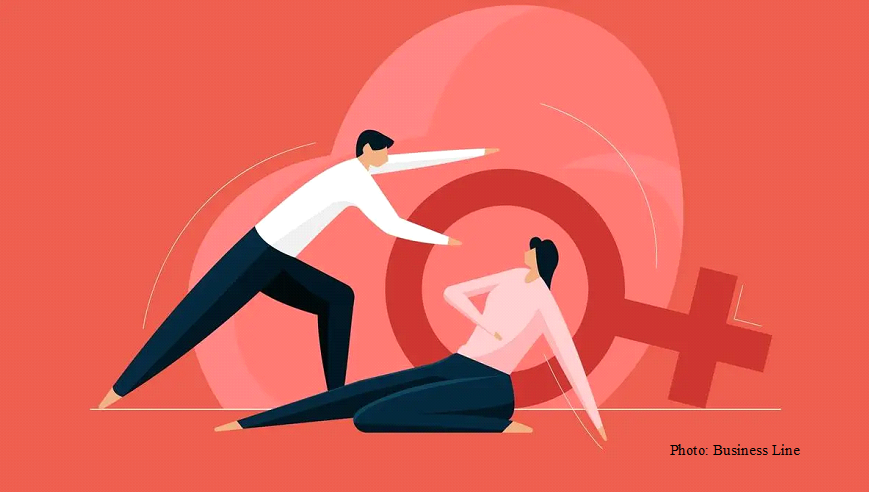
Law will remain powerless, unless women speak up.
The Constitution guarantees equality, dignity, and protection from violence, and the Protection of Women from Domestic Violence Act (2005) provides a legal framework. Yet, when women do not name their suffering, these protections lose their power. Until women can speak up fearlessly — in homes, workplaces, and streets — laws and policies will remain hollow words wrapped in moral pride.
In countless Indian homes, silence speaks louder than words. It is not the quiet of peace, but the silence that follows hurt — the silence of women who have been taught that obedience is virtue, that endurance is strength, and that a husband’s anger is an expression of care. The National Family Health Survey (NFHS-5) exposes the depth of this belief. Nearly half of Indian women (45 per cent) and men (44 per cent) believe a husband is justified in beating his wife under certain circumstances — if she argues, neglects duties, or disobeys elders.
These are not just statistics; they are reflections of how culture shapes conscience. When violence becomes commonplace, law becomes ornamental. Given how deeply violence is normalised in Indian homes, many women may not even identify what they experience as violence. NFHS, for all its rigour, measures what women dare to disclose — not what they are conditioned to endure.
When culture outruns law
In my fieldwork across Assam during 2023-24, I met women who spoke of violence as routine, not as a violation. When asked about coercion or control, some smiled nervously, calling it “part of married life.” To name it as violence, they said, would be dangerous — both emotionally and socially. “He hits only when angry,” one woman told me, as if that were a kind of restraint.
Across the world, women remain quiet not because they accept abuse, but because they fear stigma, economic ruin, or ostracism. Silence be-comes a strategy for survival. The Constitution guarantees equality, dignity, and protection from violence, and the Protection of Women from Domestic Violence Act (2005) provides a legal framework. But culture quietly cancels out constitutional rights. NFHS-5 data show that 32 percent of ever-married women aged 18-49 have experienced physical, sexual, or emotional spousal violence, yet only 14 per cent have ever sought help. Patriarchy, in its most enduring form, operates not through overt control but through habit — through jokes, rituals, and silence.
In India, women begin to speak only when others — especially celebrities — begin to speak. When a public figure names violence, thousands of ordinary women find a language for what they have long felt. Why must women wait for someone powerful to speak first? The deeper change must be one that allows every woman, whether in a city office ora rural courtyard, to say without hesitation, ‘this is not acceptable’.
Education and economic independence are essential, but they are not sufficient. Educated women can still be silent, and economically independent women can still be controlled. The true transformation must go beyond material empowerment to cultivate social courage — the courage to challenge norms that glorify female endurance and condemn resistance as rebellion.
This courage must be nurtured from the family outward. Homes must teach boys that respect is strength, not weakness. Schools must include empathy, consent, and equality as part of civic learning. The media must portray women who resist without ridiculing them, and and men who accord respect should not be mocked. Institutions must treat women’s testimonies not with suspicion but with solidarity. Above all, society must learn to listen when women speak — not to question their motives, not to doubt their pain, and not to dismiss their words as exaggeration. True freedom will flow not from the letter of the law but from thevoice of women who resist silence.
The writer is Fellow, National Council of Applied Economic Research(NCAER). Views are personal.