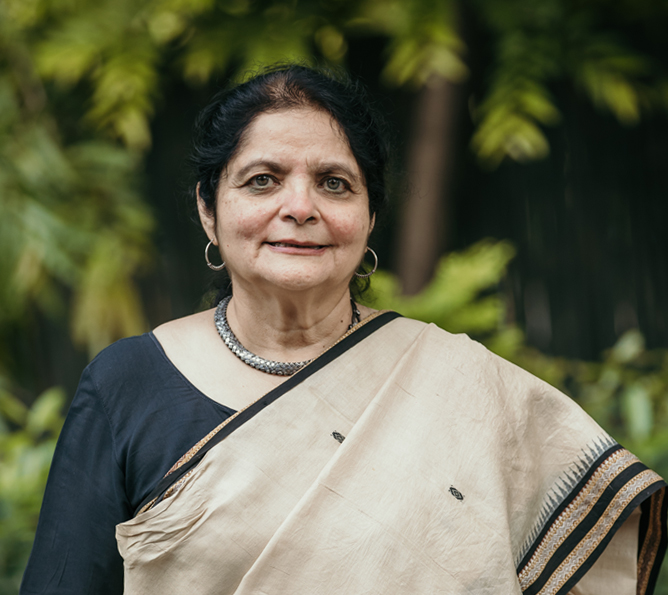
 Professor Sonalde Desai is Distinguished University Professor at University of Maryland
Sonalde Desai, Professor at NCAER, who holds a joint appointment at University of Maryland, USA, has recently been appointed as Distinguished University Professor (DUP) at the University. DUP status is a permanent honorific title that recognises exceptional records in research, teaching, and service. It is the highest academic honour bestowed by the University, awarded to less than 7 per cent of tenured faculty.
Professor Desai was conferred this honour on the basis of her work with the India Human Development Survey (IHDS), and research on gender and class. The IHDS is a panel survey conducted 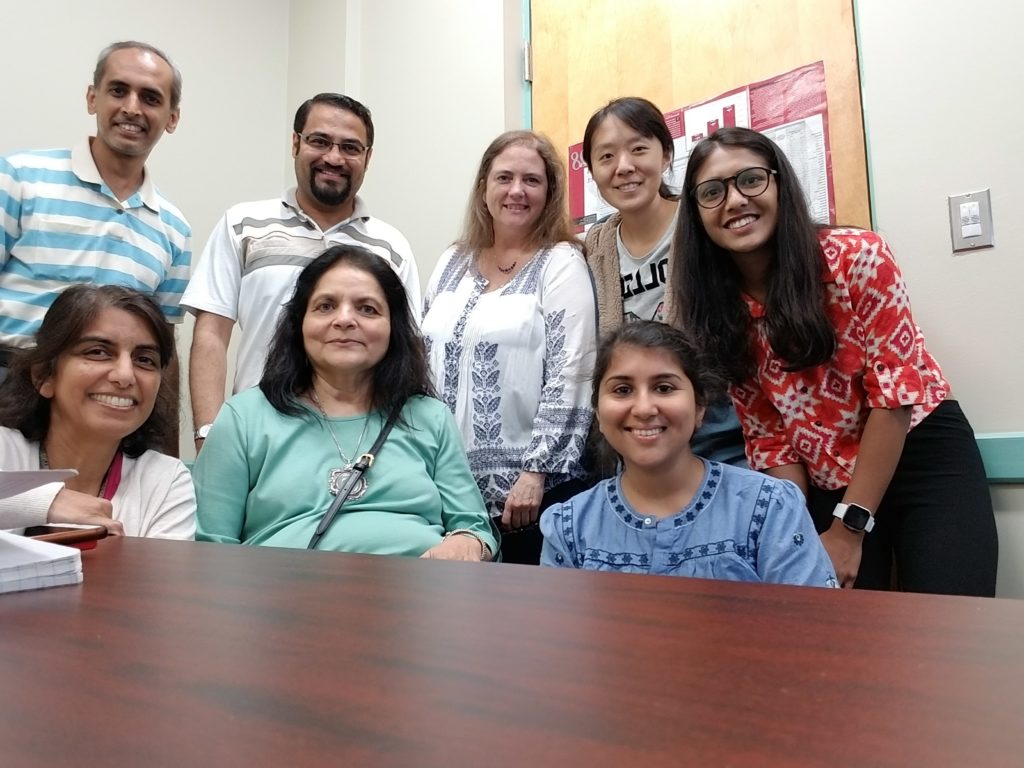 jointly by NCAER and University of Maryland in two rounds in 2003-04 and 2011-12. The third round of the survey is on the anvil and slated to start soon. This survey is used by more than 11,000 researchers worldwide.
Lauding Professor Desai on the appointment, Professor Jeff Lucas, Chair, Department of Sociology, University of Maryland, said, “…The letters we received from external evaluators, highly esteemed sociologists and demographers, showed just how respected Sonal is in the discipline and how widely her research, training, and service have reached. They noted a remarkable breadth of research and a near unparalleled impact on the field.”
Hearty congratulations to Professor Desai on this unique achievement!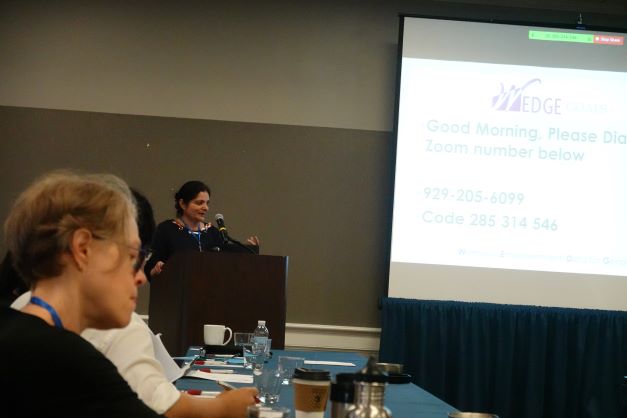
The poor land records and lack of access to these records adversely impact both the land markets in India and financialisation of land assets. The digitisation of land records is a critical first step in addressing this issue. In this context, NCAER’s Land Records and Services Index (N-LRSI) has the potential of offering a reality check to the public on the ongoing digitisation efforts and highlighting matters requiring greater attention by policymakers. The N-LRSI study also highlights the potential benefits of the government’s Digital India mission. One of the positive outcomes of the Index is that it will encourage competition among States, which will foster an improvement in the digitisation of land records.
In this policy brief, authors discuss the key drivers that account for this recent improvement shown by many States and UTs. The discussion is mainly focused on the digitisation of land records and the registration process.
Agriculture plays a significant role in the economic development of the underdeveloped regions. Bihar in eastern India remains the poorest State despite the introduction of various policy reforms in the agricultural sector since the mid-2000s. We develop a growth diagnostics framework for the agricultural sector in order to identify the most binding constraints on its growth. Our results show that poor functioning of agricultural markets and a low level of crop diversification are the reasons for lower agricultural growth in Bihar. A rise in the level of instability in the prices of agricultural produces indicates that price transmission across the markets is very weak even after repealing of the Market Committee Act. Weak market linkages and non-functional producer collectives are two important constraints responsible for the low level of crop diversification. Our policy suggestions include the state provision of basic market infrastructure to attract private investment in cold storage/warehousing facilities, strengthening of the functioning of ground-level institutions such as farmer producer organisations, and preparation of a comprehensive policy on crop diversification including contract farming.
The IHDS Forum is a monthly update of publications, op-eds and data news based on the India Human Development Survey (IHDS), which was jointly conducted by NCAER and the University of Maryland in two waves, in 2004-05 and 2011-12. Preparations are underway for launching the third wave soon.
India is among the many countries that have been worst affected by the pandemic. Its tourism activity by all forms – inbound, domestic and outbound – stood for a near-halt for several months. This makes it critical for policy-makers to assess the economic repercussions of the pandemic in real time to facilitate policy initiatives for restoring and supporting livelihoods for households engaged in tourism activities. It is in this context that NCAER has conducted this study with the objective of measuring the actual impact of the pandemic on the tourism sector in India in terms of loss of income and employment both overall in the sector as well as in individual households. The study also provides a roadmap for recovery of the sector, outlining various policy recommendations that would enable the sector to achieve its pre-pandemic status.

