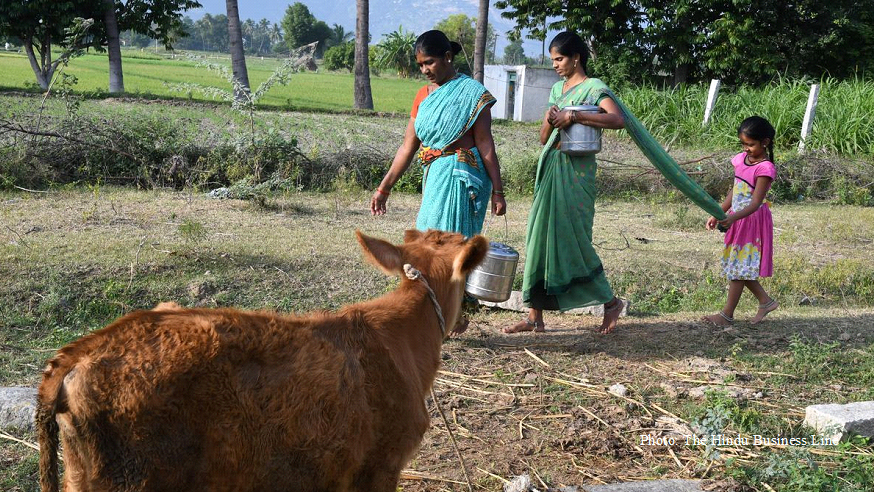
Training, targeted support can make a difference.
India’s livestock sector is experiencing a transformation, and women are at its core. The Ministry of Skill Development and Entrepreneurship (MSDE) and NCAER (2025) study titled, ‘National Skill Gap Study for High Growth Sectors’, assessed the skill shortages and gaps in the sector, ‘raising cattle and buffaloes’.
The MSDE-NCAER study used the Periodic Labour Force Survey (2022-23) data to show that the employment in the livestock sector increased at a compound annual growth rate of 20.8 per cent between 2017-18 and 2022-23. This sector employed 5 per cent of the country’s workforce. And 82 per cent of the workers engaged in ‘raising cattle and buffaloes’ were women.
Despite their dominance in this sector, more than 80 per cent of the female workers were ‘animal workers’ and were employed either as self-employed workers (79 per cent) or unpaid family workers (20.7 per cent). Only 0.13 per cent of the women workers were Business Services and Administration Managers and 0.01 per cent of the female workers were Managing Directors and Chief Executives.
Low-paid labour
Essentially, women are mostly engaged in low-paid, labour-intensive jobs such as feeding, milking, and cleaning. The MSDE-NCAER study also found minimal female representation in skilled or managerial roles. Majority of the female workers in this sector were low-skilled (51 per cent) characterised by illiteracy or literacy below primary education.
As per MSDE-NCAER (2025) computations from the PLFS, 79.2 per cent of female workers in this sector were concentrated in eight States in 2022–23: Uttar Pradesh, Gujarat, Bihar, Tamil Nadu, Madhya Pradesh, Rajasthan, West Bengal and Maharashtra. Uttar Pradesh alone accounted for nearly a third of female workers in raising cattle and buffaloes. However, women’s participation and the nature of their roles vary significantly across States. Women in Rajasthan, Uttar Pradesh, and Haryana are heavily involved in cattle care but are seldom part of cooperatives. Karnataka and West Bengal witness women’s participation mostly in household-based dairy activities with limited commercial engagement.
Essentially, the problem in this sector is two-fold. First, female workers in the sector are stuck in a low-equilibrium trap. Milk production is also characterised by low productivity. Second, the MSDE-NCAER (2025) study shows that there are skill shortages in formal job roles like veterinary technician/assistant, mechanic-refrigeration and air conditioning, dairy technologists, and managers of dairy farms.
For the first problem, the Gujarat model shows a way out, where women run dairies supported by financial assistance and leadership training have elevated their incomes and roles within the value chain (NDDB Annual Reports). Women-led cooperatives and self-help groups (SHGs) offer promising models that can be replicated across States. However, several structural barriers remain. Limited access to land, financial credit, and market linkages prevent women from scaling up dairy operations. The following measures can address the dual nature of the skilling problems:
Recognition of prior learning, re-skilling and upskilling of women milker/animal workers/dairy farmers: Literacy programmes can be combined with vocational skilling programmes like Jan Shikshan Sansthan (JSS) programmes in specific blocks;
Mobile training units — delivering on-the-ground technical and business skills in rural areas;
Women-only training centres — equipping women with practical knowledge in AI techniques, fodder conservation, and dairy technology;
Impart knowledge of animal husbandry
Financial inclusion schemes — providing microcredit, subsidies, and insurance for women entrepreneurs (NABARD 2018).
Gender-sensitive dairy policies — ensuring equal cooperative membership, land rights, and leadership representation (FAO 2009).
Provide entrepreneurship skills for workers likely to be engaged in self employment
Scholarships for women in dairy science: Incentivising higher education for women in veterinary and dairy-related disciplines (U-DISE+ 2022-23).
Scholarships for women in dairy management The future of India’s dairy sector depends on how well we empower women — through education, training, and targeted support.
Bandyopadhyay is a Senior Fellow, Sahu is a Fellow, and Bhandari is a Professor, at NCAER. Views are personal