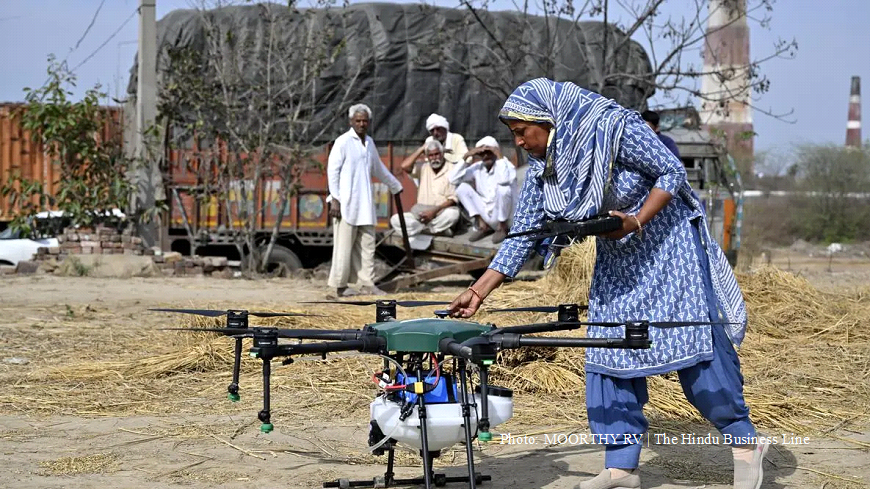
Women form close to 42% of farm workers. Skilling schemes specifically designed for women is imperative to not only raise their productivity but also to empower them.
India’s agriculture stands at a critical crossroads. On the one hand, rapid technological transformation — from drones and digital platforms to precision farming — is reshaping how crops are grown, managed, and marketed. On the other, the backbone of this vast ecosystem — the millions of women who toil in the fields — remains under-recognised, underpaid, and under-skilled.
A recent NCAER Skill Gap Study on High Growth Sectors (2025), which analysed the workforce in the sub-sector “Growing of Cereals (including Rice), Leguminous Crops and Oilseeds”, reveals a striking reality: women constitute 41.4 per cent of the workforce, yet the majority are concentrated in low-skilled, low-paying, and informal roles. While men dominate mechanised and market-oriented operations, women are often confined to manual, repetitive, and unpaid family labour.
Women are mainly engaged in a few key occupational roles within this sector. Most jobs (about 70 per cent) are in market gardening and crop growing, where women make up roughly one-third (33.7 per cent) of the workforce. Another 20 per cent of workers are employed as agricultural, forestry and fishery labourers, and in this group women form a majority, accounting for about 52 per cent. A smaller share of workers (around 9 per cent) are subsistence crop farmers, within which women constitute about 40 per cent.
Overall, women’s participation is especially high in labour-intensive roles, highlighting their strong presence in physically demanding and lower-paid activities.
This imbalance is not just an issue of fairness — it is a matter of national productivity and resilience. If India’s agriculture is to modernise and compete in the 21st century, women must not only be included but empowered as skilled contributors and decision-makers in every stage of the agricultural value chain.
The invisible workforce
Females account for 41.4 per cent of the workforce engaged in the growing of cereals (including rice), leguminous crops and oil seeds. A large concentration of these workers is found in nine States, with notable variation in female participation — female workers constitute as high as 52.4 per cent in the highest-ranking State, while West Bengal records the lowest female share at 25.4 per cent. In terms of education, the sector is characterised by low educational attainment among women, with about 50 per cent of female workers being not literate.
Nearly half of all women in this sub-sector are not literate, and their access to training remains extremely limited. Close to 99 per cent of female agricultural workers report having no technical education, while only about 0.5 per cent have received any formal vocational training.
Even non-formal vocational training reaches only around one in five women, far below the one in three rate observed among men, who are significantly more likely to possess medium-level skills or experience with modern machinery.
This pronounced skills gap is further compounded by women’s heavy concentration in unpaid roles, with about 63 per cent of female agricultural workers engaged as unpaid family labourers, compared to just 21 per cent of men. These patterns underscore the deep structural invisibility of women’s work-critical to household and farm economies, yet largely excluded from wage records, productivity measurements, and policy frameworks.
Technology without inclusion
As agriculture becomes more technology-intensive, from satellite-driven crop planning to drone-based precision spraying, women risk being left behind. Most of the skilling programmes remain heavily male-centric, with training modules in farm machinery, irrigation systems, and AI-based applications rarely tailored for women.
The government’s Drone Didi initiative, which aims to train women to operate agricultural drones, is a step in the right direction. However, this needs to expand from pilot projects to a national gender-sensitive skilling movement. Technology in agriculture should not merely replace manual work; it should democratise access to opportunities. Women farmers and workers must be trained to handle drones, manage soil health data, lead FPOs, and engage in digital marketplaces. Empowering them with financial, digital, and entrepreneurial literacy can bridge both the productivity gap and the gender gap.
Clusters and gendered skill needs
NCAER’s mapping of agricultural clusters — States and regions where production, infrastructure, institutional networks, and workforce capacities are concentrated — provides a useful framework for designing location-specific, gender-responsive skilling programmes. The analysis shows that Uttar Pradesh, Maharashtra, Rajasthan, Madhya Pradesh, and Gujarat rank among the strongest agricultural clusters overall, supported by robust institutional systems, better-than-average infrastructure, and relatively well-developed human resources.
These ecosystems are already positioned to support specialised agricultural services, making them ideal candidates to evolve into gender-inclusive training hubs.
Building on this foundation, such States can open pathways for women farmers to enter new and emerging agri-professional roles — for example, as drone operators and agri-tech advisors, who combine traditional field knowledge with data-driven decision-making; farm machinery service technicians, trained to operate and repair modern equipment, expanding opportunities for both self-employment and wage work; and agronomic consultants or community advisors, who deliver field-level support, crop management insights, and market intelligence to farmer groups.
These emerging occupations, underscore the significant potential for women to transition from traditional, low-paying farm labour into skilled, higher-value roles — but only if targeted skilling, mentoring, and institutional support reach them where agricultural capacity is already strong.
From skill gaps to skill justice
To realise this potential, however, skill development policies must move beyond generic capacity-building and directly address the structural barriers that keep women out of training and higher-value roles. As the NCAER study notes, women’s access to training institutes is often limited because centres are located far from villages or operate at times that clash with domestic responsibilities.
Cultural norms further restrict women’s mobility and discourage their participation in trades such as welding, irrigation, or mechanised operations, which are commonly perceived as male domains. Even where training is available, many vocational curricula are designed with male participants in mind, overlooking the socio-emotional, confidence building, and entrepreneurial skills that are crucial for enabling women to step into skilled agricultural jobs.
Addressing these constraints is essential if the stronger agricultural clusters are to become genuinely inclusive hubs for women’s skilling and economic mobility.
A call to action
Bridging these gaps will require a focused, three-pronged strategy. First, skilling programmes under the Pradhan Mantri Kaushal Vikas Yojana and State Skill Missions must reorient their curricula to include socioemotional skills, entrepreneurship, and digital literacy-capabilities that equip women to take on leadership roles in modern agriculture.
Second, training infrastructure needs to be decentralised by using district level agricultural clusters and Krishi Vigyan Kendras as community-based centres that offer flexible, short-term, and locally relevant courses for women. Third, gender-linked incentives — such as weighted funding for institutions that train and place more women in agri-tech roles-can help shift institutional priorities toward inclusion.
If India’s next Green Revolution is to be truly inclusive, gender equality must be embedded at every stage — from curriculum design and certification to placement and entrepreneurship support. The aim is not simply to bring more women into agriculture; they are already there.
It is to shift them from the margins to the centre of productivity, policy, and innovation because the future of Indian agriculture depends as much on equity and inclusion as on technology and infrastructure. Empowering women with the skills they need is not just a social goal — it is an economic imperative for India’s growth and food security.
This article draws upon findings from the National Council of Applied Economic Research (NCAER) report on “National Skill Gaps for High Growth Sectors,” 2025.
Joshi and Sahu are Fellows at NCAER; Bhandari is Professor at NCAER. Views are personal.