
Public Health Data for Action: 10 Questions to Focus on for the Next Decade to Address the Most Pressing Health Issues in India
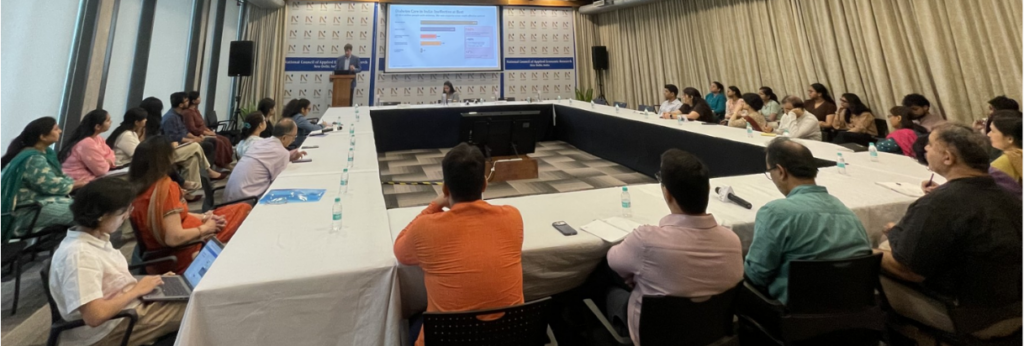
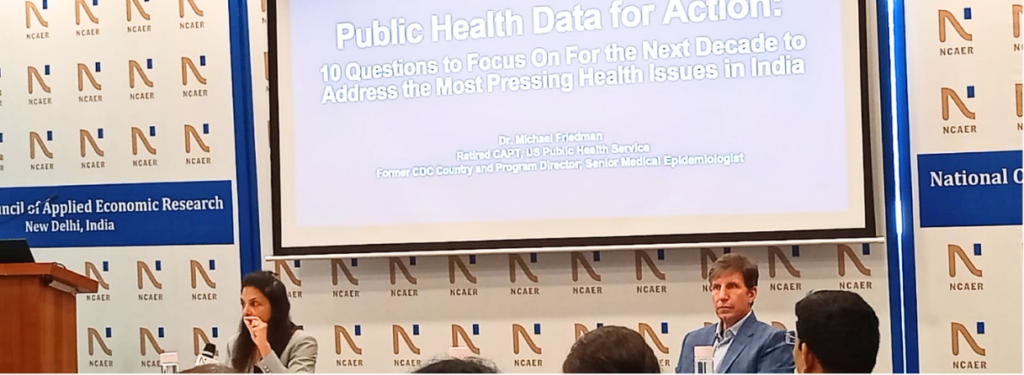
NCAER organised a lecture on 1 July 2026, delivered by Dr Michael Friedman, who recently joined as a consultant for NCAER’s Centre for Health Economics (CHE).
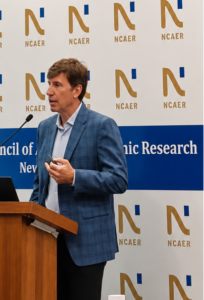 Dr Friedman is a dual-board certified physician in Paediatrics and Internal Medicine with diverse experience of 30 years in the US and globally, including 25 years as a US Public Health Service medical officer. He has lived and worked in four continents, encompassing the Amazon jungles, tribal areas of Jharkhand state in India, southern India, the Zuni Indian reservation in New Mexico, Atlanta Georgia, Indonesia, Sierra Leone, Bangladesh, and Singapore.
In his lecture, he discussed the most pressing health challenges facing India today, and raised ten primary questions for addressing these challenges. The lecture aimed to bridge the gap between these questions and investments in public health research and surveillance/monitoring systems, explore how the next generation of leaders and researchers can be nurtured; and consider how NCAER, through the Centre for Health Economics, could address these questions and the concomitant challenges through its own work. The ten questions and the associated discussions are delineated below.
- Why Is It Hard to Maintain a Healthy Lifestyle These Days?
Dr Friedman argued that unhealthy lifestyles have become a major public health concern despite increased awareness about health issues, aggravated by urbanisation, sedentary lifestyles, consumption of processed foods, inadequate sleep, smoking, alcohol consumption, and weakening social connections. He emphasised that lifestyle interventions can increase life expectancy by almost ten years, but the real research challenge is understanding why people struggle to adopt healthy behaviours and identifying policies, behavioural interventions, and economic incentives that can encourage healthier choices. Existing longitudinal datasets can help researchers analyse changes in health behaviour over time and evaluate effective interventions.
- How Can India Best Prepare for and Address the Epidemic of Mental Health Disorders?
Mental health is fast emerging as one of India’s leading public health priorities. Rising cases of depression, anxiety, ADHD, autism, bipolar disorder, schizophrenia, and other disorders are imposing increasing pressure on the healthcare system, which are exacerbated by excessive smartphone and social media usage and lifestyle issues. Dr Friedman questioned whether India has an adequate number of mental health professionals, infrastructure, financing mechanisms, and research capacity to address these challenges, while noting the significant economic costs associated with poor mental health.
- What Should Be the Appropriate Balance between Public and Private Healthcare?
Without advocating either exclusive public or private healthcare, Dr Friedman questioned whether India’s current mixed healthcare system is achieving the best outcomes. He argued that governments must determine whether they should primarily provide healthcare services directly or instead regulate and finance private providers. Future research ought to evaluate the efficiency, quality, and sustainability of different healthcare delivery models, especially with the country facing the alarming rise of chronic diseases and mental health challenges.
- How Can the Investment in Health Insurance Schemes Achieve Better Outcomes?
It is a moot point as to whether the expansion of health insurance schemes has actually improved healthcare in India. While the provision of insurance aims to reduce catastrophic health expenditure and protect households financially, it is important to examine whether it has helped in lowering out-of-pocket expenditure, improving the quality of healthcare, and producing better health outcomes. While discussing the different methods of financing healthcare, Dr Friedman highlighted the need for rigorous evaluation of insurance programmes to determine whether they were achieving their intended objectives.
- How Can India Reduce the Over-use of Antibiotics?
Excessive antibiotic use is increasingly becoming a serious public health concern while contributing to the risk of drug-resistant infections. Dr Friedman noted that since antibiotics are relatively inexpensive in India as compared to other countries, financial disincentives alone may not help reduce their misuse and counter the challenge of prescription of antibiotics much more frequently than necessary. It is imperative to instead focus on behavioural interventions and public awareness campaigns to encourage more responsible and controlled use of antibiotics.
- How Can Artificial Intelligence Transform Healthcare?
Artificial Intelligence (AI) is rapidly fostering one of the most transformative developments in healthcare in view of its enormous potential to facilitate more precise diagnoses, clinical decision-making, efficient health system management, incisive data analysis, and better access to healthcare. However, the healthcare community needs to explore how AI should be integrated into health systems, whether it genuinely improves patient outcomes, and what governance and regulatory frameworks are required to ensure its safe and effective use.
- How Should Medical Education and Healthcare Training for Doctors, Nurses and Other Health Personnel Evolve?
Does the medical education currently being imparted adequately prepare healthcare professionals to propagate and implement modern healthcare systems? Traditional education relies heavily on memorisation, whereas future healthcare professionals will require stronger critical thinking, communication, leadership, and data literacy skills. Dr Friedman noted that with AI providing greater access to information, medical training should move away from memorising and rote learning to focus on honing the analytical and decision-making abilities of healthcare professionals.
- Why Does India Lag behind in Adopting Advanced Health Innovations for Disease Prevention and Management?
Despite the prevalence of strong pharmaceutical and vaccine manufacturing capabilities in India, many advanced medical technologies still remain under-utilised in India due to a number of factors, including regulatory barriers, limited scientific innovation, funding constraints, weak public demand, and implementation bottlenecks. Intuitive and focused research is needed to mitigate these challenges and design policies promoting innovation and wider adoption of effective technologies.
- What Are India’s Major Public Health Blind Spots?
Although health professionals regularly highlight critical health threats facing the country and their economic and health impacts on the population, these continue to receive insufficient policy attention. Among these, the main challenges include antimicrobial resistance, air pollution, lead poisoning, and use of microplastics, all of which contribute to broader environmental health concerns. Dr Friedman pointed out that even as governments often fail to prioritise these issues, research needs to examine both the economic costs of these neglected problems and the barriers preventing effective policy action.
- How Can India Better Prepare for Future Health Security Threats?
The final question raised by Dr Friedman pertained to preparedness for dealing with future pandemics, climate-related health emergencies, and biological threats. Drawing lessons from the COVID-19 pandemic, he argued that while achieving absolute preparedness may be impossible, better planning can significantly reduce economic and social disruption caused by pandemics. Research, therefore, needs to lay down a blueprint for the investments needed to ensure preparedness, evaluate their cost-effectiveness, and develop strategies for strengthening India’s ability to respond to future health crises.
Bonus Question: How Should the Performance of a Health System Be Measured?
The lecture concluded with the overarching question of whether the efficiency of health systems should be evaluated primarily in terms of the number of healthcare services and public access to the latter. The crucial interventions should instead usher in improvements in life expectancy, quality of life, and overall health outcomes, even though these indicators are more difficult to measure. This reflects a broader shift from merely measuring healthcare inputs to evaluating the real impact of health systems on the well-being of the population.
Dr Friedman’s lecture was followed by a discussion and engagement with the audience, which foregrounded the following broad issues:
- Insurance may create unintended incentives: Hospitals may over-prescribe tests or treatments for insured patients. Insurance can increase healthcare costs without necessarily improving outcomes.
- Private healthcare is not always better or of higher quality than public healthcare: Evidence from India suggests that private healthcare often increases expenditure without guaranteeing better outcomes, and consequently, high costs may contribute to impoverishment among the underprivileged population.
- Primary healthcare should receive greater emphasis: It was widely noted that India has focused too much on hospital-based care. In contrast, strong primary care systems, such as those seen in Thailand and Costa Rica, for example, achieve better outcomes at lower costs.
- Rise in ageing population will increase healthcare costs: As India ages, the burden of chronic diseases will rise while long-term and palliative care will assume increasing importance.
- Expansion of infrastructure alone is insufficient: Although infrastructure needs attention, this should not preclude attention towards other key challenges, such as inadequacy and uneven distribution of doctors, poor quality of medical training, lack of focus on digital health systems, and shortage of medical professionals in rural and under-served areas.
- It is imperative to generate public awareness: People often lack awareness about key issues such as healthy lifestyles, pollution risks, and preventive healthcare. Improving health literacy should therefore become a research priority.
The broad agenda of the Centre for Health Economics at NCAER will be focused on addressing the above questions while considering the issues of chronic disease prevention and management; efficiency of health systems; health financing; state capacity and governance; health security and pandemic preparedness; the role of AI in healthcare; digital health or cross-collaboration with the upcoming NCAER Centre on AI/DPI; and biotechnology investments and scale.

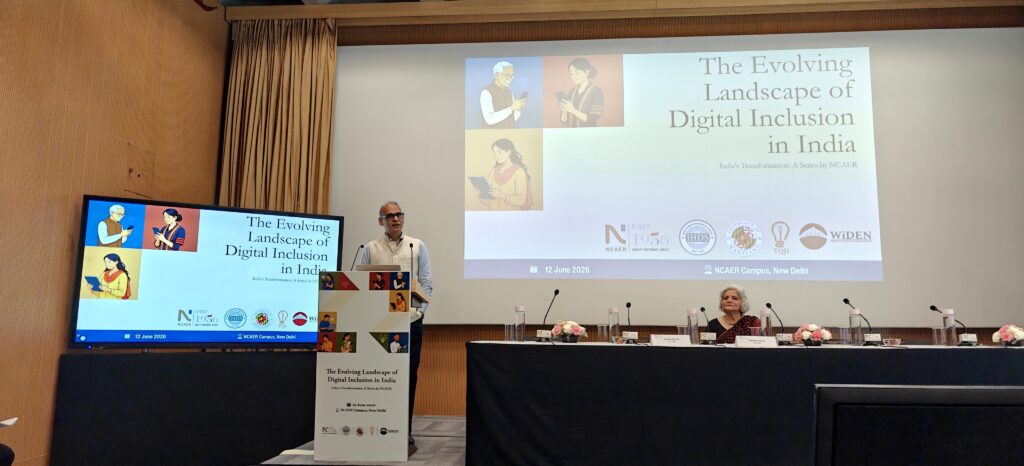

 The report moves beyond conventional measures of digital access to examine how Indians access, use, and benefit from digital technologies, highlighting the ways in which age, gender, education, geography, and socioeconomic circumstances continue to shape digital participation.
 The convening featured presentations on the report’s key findings by Dr Dibyasree Ganguly (Associate Fellow, NCAER) and Ms. Garima Agarwal (Analyst, Public Policy, The Quantum Hub), followed by a keynote address by Dr Deepak Mishra (Distinguished Visiting Professor, ICRIER), who situated India’s digital inclusion journey within a broader global context.
 The event concluded with a panel discussion on “From Access to Meaningful Digital Participation”, moderated by Ms. Aparajita Bharti (Founding Partner, The Quantum Hub), featuring Ms. Andrea Wojnar (Representative, UNFPA India), Ms. Anupriya Mohta (Manager, Government Affairs & Public Policy, YouTube), Dr. Bornali Bhandari (Professor, NCAER), and Mr. John Khiangte (Director, Public Policy & Government Affairs, Microsoft India & South Asia). Drawing on the report’s findings, the discussion explored pathways for advancing more meaningful and equitable participation in India’s digital economy.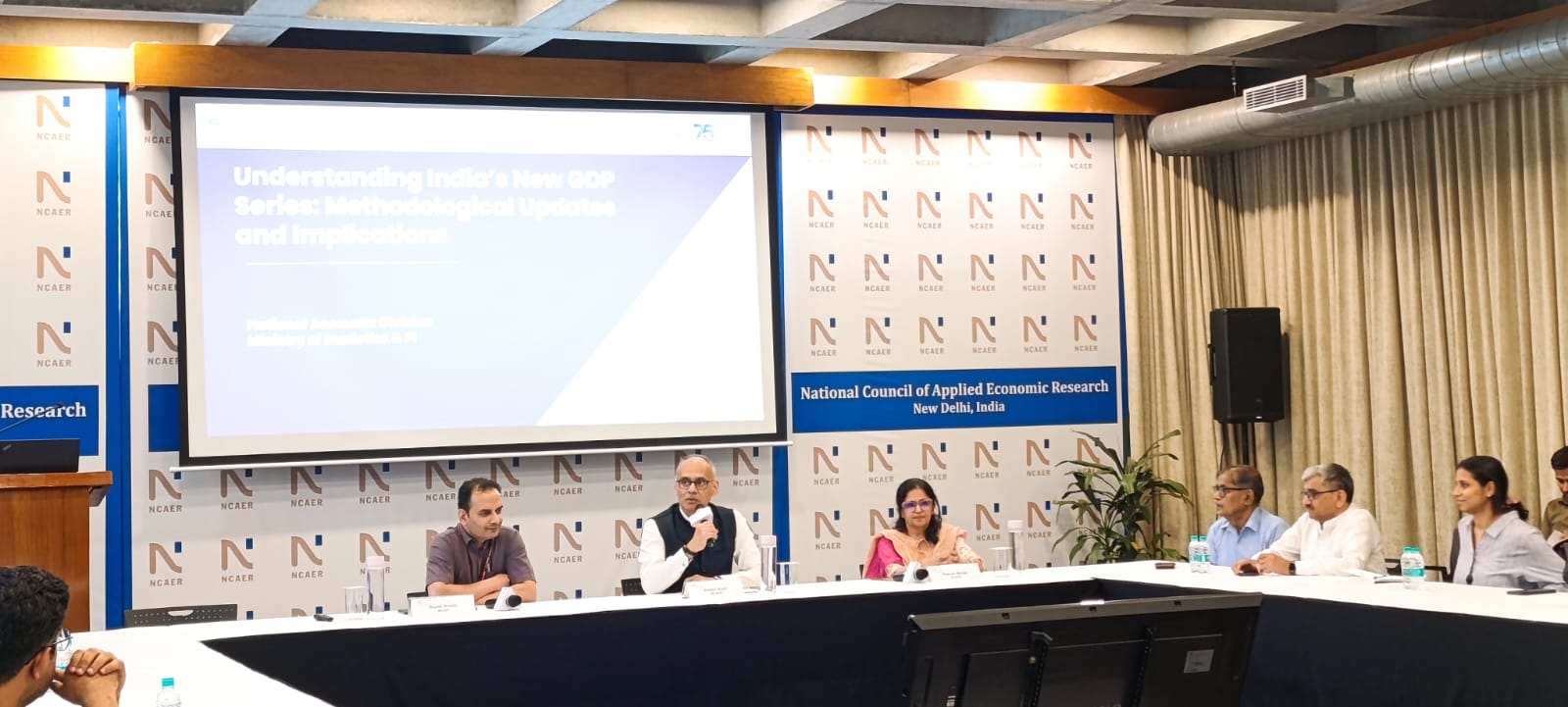
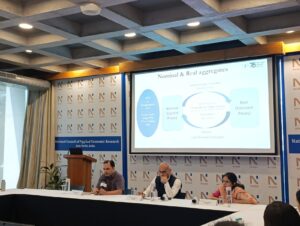 Mr Rajeev Kumar noted that many changes have been made to the components included in both national production and expenditure to provide a more accurate estimate of economic activity. One of the major methodological improvements in the new GDP series is the introduction of the double deflation method for manufacturing, under which both output and intermediate consumption are deflated separately before deriving Gross Value Added (GVA) at constant prices, resulting in a more accurate measure of real economic activity. In addition, he highlighted several other improvements that have been made in terms of new data sources; benchmarking; more granular estimates; changes in deflators; and, alignment with changes in Annual National Accounts. The revised methodology, therefore, aligns more closely with the base-year production and consumption structure of the economy.
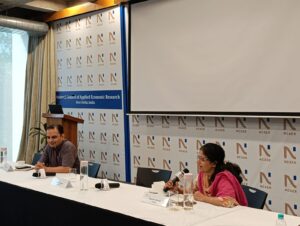 In her closing remarks, Professor Poonam Munjal, NCAER, raised the question regarding the downward revision in the share of the services sector observed across two successive GDP base-year revisions. Mr Rajeev Kumar clarified that such revisions reflect improvements in data coverage and measurements. He cited the example of the use of GST data, EVAHAN, and PFMS data for enhanced quality of estimates for the services sector.