NCAER and IEPFA, Ministry of Corporate Affairs, Government of India, in collaboration with Pondicherry University, organised a conference on “Criticality of Digital Financial Literacy and Behavioural Skills: Key Enablers of Investor Education and Protection” on 20 July 2026, at the Cultural-Cum-Convention Centre, Pondicherry University, bringing together policymakers, academicians, economists, regulators, and financial sector experts to deliberate on digital financial literacy, behavioural capabilities, informed financial decision-making, and investor protection in an increasingly digital economy.
Professor A. Balakrishnan, Head, Department of Banking Technology, Pondicherry University, welcomed the distinguished guests and participants. Professor Y. Venkata Rao, Dean, Students’ Welfare, Pondicherry University, highlighted the scope of the conference. IEPF Chair Professor, NCAER, Dr C. S. Mohapatra, in his special address, appreciated the collaborative efforts of Pondicherry University and also highlighted the efforts of IEPFA and the IEPF Chair Unit at NCAER for taking financial awareness initiatives to the last mile. In his special address, Professor P. Natarajan, Dean, School of Management, Pondicherry University, stressed that management institutions play an important role in developing financially aware and ethically responsible citizens equipped to make informed financial decisions. Delivering the inaugural address, Professor P. Prakash Babu, Vice Chancellor, Pondicherry University, underscored the importance of integrating financial literacy with higher education to spread awareness about financial behaviour and potential risks among young investors.
In her keynote address, Ms Anita Shah Akella, Joint Secretary, Ministry of Corporate Affairs, Government of India, highlighted the Government’s continued commitment towards strengthening investor protection and promoting responsible financial decision-making through awareness, education, and technology-enabled grievance redressal mechanisms.
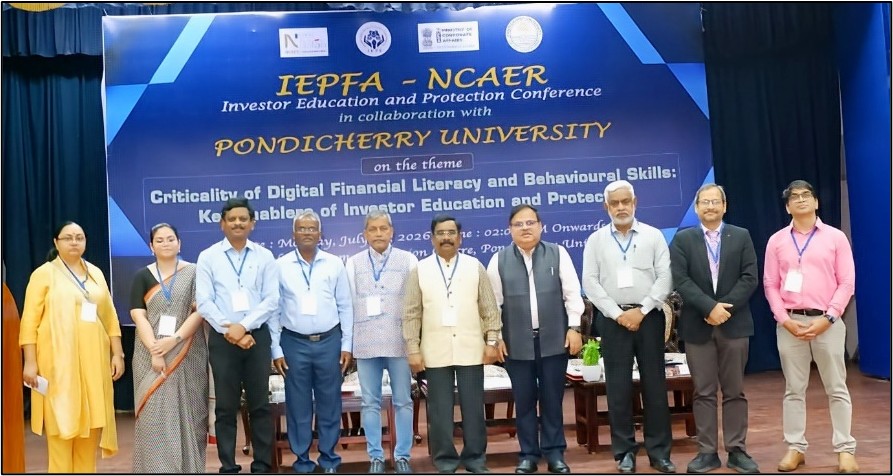
Moderating the panel discussion, Dr C. S. Mohapatra highlighted that India has witnessed an unprecedented transformation in its financial ecosystem, driven by rapid digitalisation, expanding access to formal financial services, and increasing participation of first-time investors. While these developments have democratised financial opportunities, they have also exposed citizens to new forms of digital fraud, misinformation, impulsive investment decisions, and behavioural biases. Dr Tirthankar Patnaik, Chief Economist, NSE India Ltd., provided a macroeconomic perspective on India’s economic growth and evolving financial ecosystem along with the opportunities for wealth creation resulting from increasing participation in capital markets and use of digital platforms. Professor Amaresh Samantaraya, Professor, Department of Economics, Pondicherry University, pointed out that the use of technology has facilitated the provision of customer-friendly faster and convenient services by banks. Prof. P. Natarajan, Dean, School of Management, Pondicherry University, highlighted the importance of integrating financial literacy into higher education curricula, allowing institutions to impart practical financial knowledge.
The panel discussion was followed by an interactive question-and-answer session, and distribution of participation certificates to the attendees.


 Depannita Ghosh, Senior Research Analyst, made a presentation on the three key dimensions of capital market development, viz., depth, breadth and inclusiveness. While depth refers to strengthening the market’s capacity to absorb a wider range of financial instruments, participants and orders, breadth entails bringing in more investors into the capital market; and inclusiveness presupposes access, protection, opportunities, and financial confidence for various categories of investors.