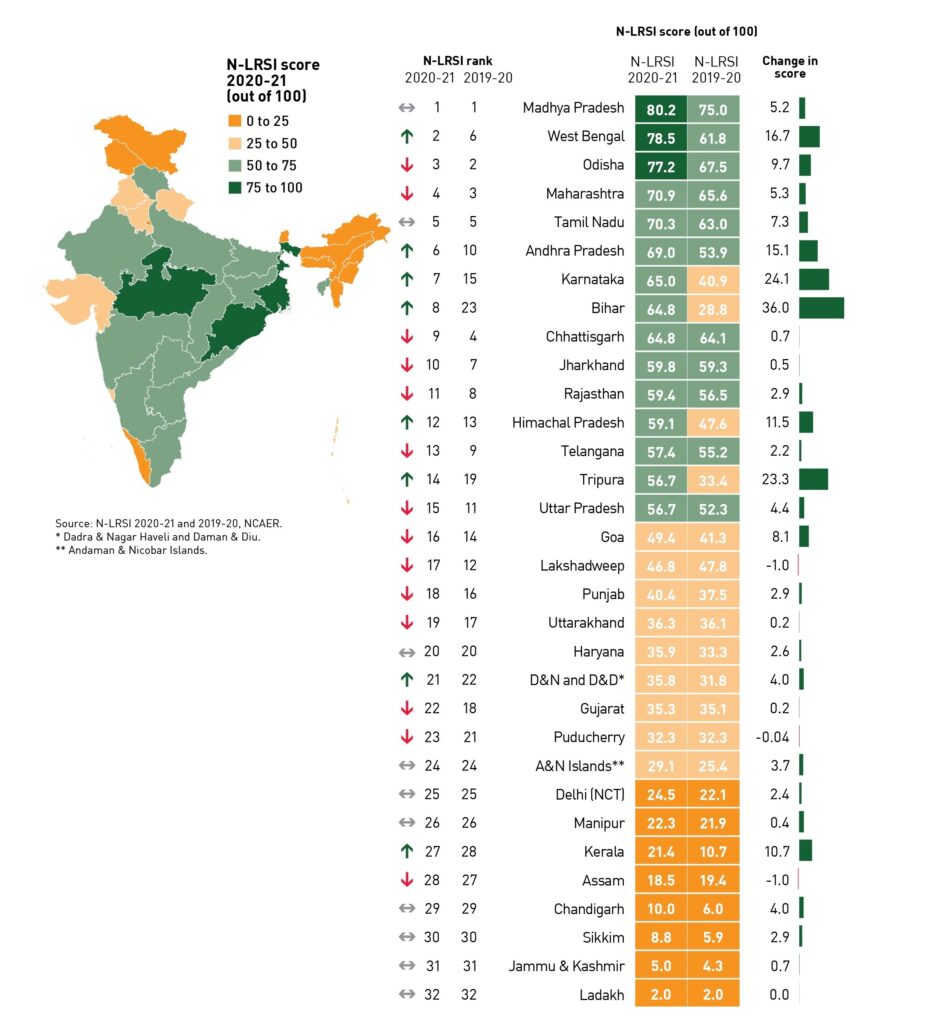
 NCAER released its second Land Record and Services Index (N-LRSI) 2021, revealing that almost all States/Union Territories have shown an improvement in their efforts to digitize land records compared to the previous year. Madhya Pradesh has emerged as the top performer for the second year in a row, followed by West Bengal, Odisha, Maharashtra and Tamil Nadu. While Madhya Pradesh and Tamil Nadu have maintained their positions, West Bengal has moved up four ranks, from rank six to two. Odisha and Maharashtra, which ranked second and third in N-LRSI 2020, has fallen by one rank each to take up rank three and four in this year’s index.
This is the second edition of the Index, which has been supported by Omidyar Network India, through its Property Rights Research Consortium initiative which aims to enable evidence-based solutions for securing land, housing and property rights in India. The N-LRSI 2021 is based on data collected over 2020-21 on two aspects of the supply of land records—the extent of digitisation of land records and the quality of these land records.
Access to land is a critical factor for economic growth and poverty reduction. For government, industry, and citizens to be able to use this asset effectively and to minimise disputes, it is important to have access to reliable land and property records. Digitizing these land records is critical for ensuring India’s economic growth, as accessible, high quality records not only helps increase the visibility and availability of land for large-scale investment opportunities, but at an individual level, also makes it possible for the public to transact land and use it for seeking credit in a dispute-free environment.
Over the years, different states have made significant progress in making their land records digitally available to citizens. The N-LRSI aims to understand the extent of this progress and existing gaps and to identify measures to improve land records in each state. The N-LRSI 2021 is an integral part of the NCAER Land Policy Initiative (N-LPI) launched in 2019 with the aim of filling the gaps in economic research, policy analysis, and systematic data on land.
 Speaking at the launch, Shilpa Kumar, Partner, Omidyar Network India said “Accurate and reliable data with regards to the ownership and details of land and property can help every Indian to ascertain their land assets and enable easier transfer and access to credit. Given that land & property is the largest asset class in the country, the impact of accessible property records can have a substantive impact on improving lives. We hope that this index will continue to nudge state governments to focus on digitisation of records, as well as provide policymakers a tool that will provide them evidence-based insight to create more effective and targeted approach towards property rights.”
 Team leader Deepak Sanan at NCAER noted that “It is a matter of great satisfaction that objective of the N-LRSI has fructified to a considerable extent. Mean scores on the index have risen by more than 16% in one year. The N-LRSI has clearly demonstrated potential as a credible instrument that can enable progress in the goal of creating more comprehensive, accurate, accessible and user-friendly land records and processes across the country.”
Talking about the next steps for the N-LRSI, project co-leader Professor Devendra B Gupta said, “The first two round construction of the N-LRSI primarily used supply-side data during 2019-20 and 2020-21, including proxies for measuring access for citizens, for assessing the extent of digitisation and gauging the quality of land-records services offered. For the next round, we envisage a demand-side survey of citizens to gauge the level of public awareness and satisfaction in using digital land records and associated services.”
Dr Shekhar Shah, Director General at NCAER said, “The latest edition of the N-LRSI emphasises on accessibility of the land records through the Accessibility Index, which reveals a concerning gap between the quality of records and user access to the same. With States increasingly focusing on improving the ease of land markets transactions, the future editions of the N-LRSI will aim to adjust the components and the weights assigned to them to ensure that the Index can incorporate these indicators.”
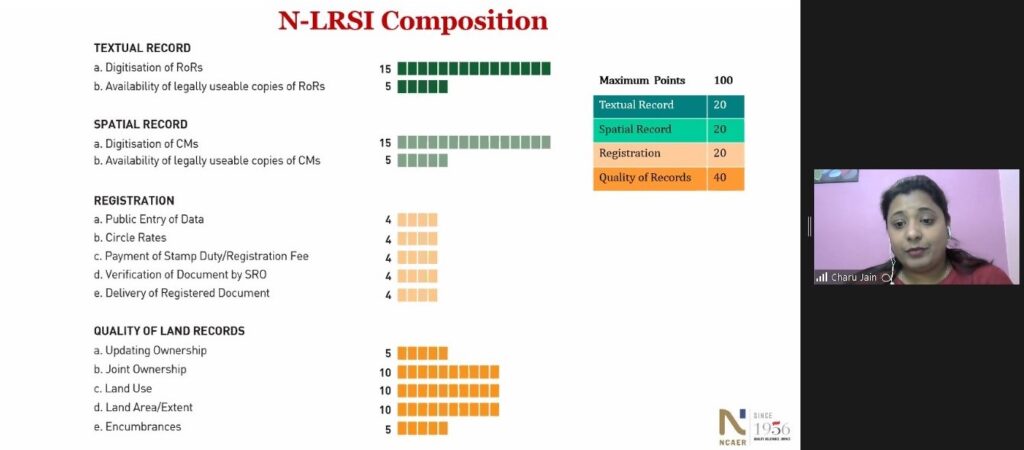 N-LRSI was first launched in February 2020 to gauge the performance of all states and UTs on the extent of its digitisation process for land records and services, and the overall improvement in the quality of the record as a result of the digitisation process. This edition of the N-LRSI, conducted a year later, offers an opportunity to measure the progress made by the various states/UTs on the parameters that formed the basis of N-LRSI 2020. It also assesses the extent to which the recommendations made to various states/UTs in N-LRSI 2020 were considered for implementation.
Key findings from the Index:
- The Index, which measures the performance of 32 states and UTs across four broad parameters—digitisation of textual and spatial records, computerisation of the registration process, and the quality of land records—finds that 29 states and UTs have shown positive change or retained their scores in 2020-21. As a result, the mean N-LRSI score across the 32 States/UTs has shown an increase of 16.6% in 2020-21, from 38.7 in 2019-20 to 45.1 in 2020-21 (out of the maximum score of 100 points). While in 2019-20, only one state scored more than 70 points, there are now 5.
- Among the states which have reported an improvement in its N-LRSI scores, seven of them have recorded an improvement of over 10 points, five have noted an increase between 5 to 10 points, and 16 states have shown an improvement of less than 5 points. The states of Bihar, Karnataka, Tripura, West Bengal, Andhra Pradesh, Himachal Pradesh and Kerala have reported the most improvement.
- Factoring for the ‘extent of digitisation’ alone, Bihar shows maximum improvement, followed by West Bengal, Tripura, and Karnataka. While the scores for Puducherry and Chhattisgarh have shown a decline owing to the decline in rate of digitisation as seen on the Department of Land Resources’ portal, the scores for Assam have shown a decline as the few digitised copies of RORs that were available in 2019-20 are not available online now.
- In terms of the ‘quality of land resources’, Karnataka is the leading state in terms of improvement over 2019-20, followed by Bihar, Tripura and Goa. However, eight states have reported a decline in this parameter, which includes the Andaman and Nicobar Islands, Uttarakhand, Gujarat, West Bengal, Rajasthan, Lakshadweep, Tamil Nadu, and Jharkhand.
N-LRSI Scored 2020-21 and 2019-20
Another key performance indicator includes Accessibility, which evaluates states and UTs based on the ease of access, comprehensiveness of the information available, the design and user interface, and the efficiency of the help and assistance functionalities on their respective land records related web platforms. Odisha, West Bengal, Karnataka, Bihar and Uttar Pradesh are the top performing states in this Index.


 However, many investors are generally not well-informed about the products they are about to buy. It has been observed that when given full disclosures, consumers are 80-90% less likely to buy high-risk financial products. Although financial managers are expected to act as securers of consumer interests, they are often guided more by incentive structures rather than the needs of investors. Consequently, consumers may end up buying financial products that do not meet their goals. The result is usually mis-selling, wherein consumers with little-to-no knowledge about the risks involved are left feeling short-changed.
 Professor Presser is interested in the interface between social psychology and survey measurement. His research focuses on questionnaire design and testing, the accuracy of survey responses, non-response, and ethical issues stemming from the use of human subjects. His journey as a social science researcher exemplifies the title of his talk: how methodology and substance are inextricably interwoven. His books on the subject, as co-author and Chief Editor, include Questions and Answers in Attitude Surveys (with Howard Schuman), Survey Questions (with Jean Converse), and Methods for Testing and Evaluating Survey Questionnaires (as Chief Editor). He has served as Editor of Public Opinion Quarterly, and as President of the American Association for Public Opinion Research, and is an elected fellow of the American Statistical Association. He was Director of the Maryland Survey Research Center from 1989 to 2000.
 Rukmini S. is one of India’s few data journalists and was the first Data Editor of an Indian publication while at The Hindu. She was most recently Editor—Data and Innovation at HuffPost India. Rukmini writes mainly on gender, crime, law, caste, inequality and is passionate about engaging storytelling. She studied in Mumbai and London, worked in Delhi, and now lives and works in Chennai.