The Challenge of Vaccinating a Billion Indians: How to meet it?

The world is on the brink of winning the fastest vaccine race in history. As of this writing, two mRNA vaccines have been approved for emergency use in some countries and are being administered. An end to the Coronavirus pandemic appears to be in sight. But questions loom about large countries like India being able to buy, distribute and deliver the vaccine in an orderly and equitable way. And larger questions are emerging about the differential vaccine access between high-income countries and others, despite attempts by WHO and the Global Vaccine Alliance GAVI to build distribution protocols that are fair.

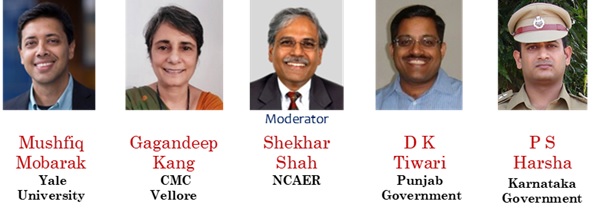
NCAER  hosted policymakers, economists, and public health specialists in a special, end-of-the-year, extended NCAER Coronavirus Briefing to discuss how India will vaccinate its billion plus people. The event opened with Indu Bhushan, CEO of Ayushman Bharat, and Ajay Shah, former Professor at NIPFP, laying out of the issues from a public health and public economics perspective. Renu Swarup, Secretary, Department of Biotechnology, Srinath Reddy, President, Public Health Foundation of India, Keshav Desiraju, Former Secretary, Ministry of Health and Family Welfare, and Mohammed Suleman, Additional Chief Secretary, Directorate of Health Services for Madhya Pradesh, then offered their comments and insights. Finally, Junaid Ahmad, India Country Director for the World Bank and Harish Iyer, Senior Adviser for Scientific Programs, Bill and Melinda Gates Foundation, offered a global perspective. NCAER Director General Shekhar Shah  moderated the discussion.

Panellists sought to answer questions such as: Whether imported or produced at facilities like the Serum Institute of India, how will the vaccines be stored, distributed and ultimately administered? In what way can the private sector participate, in what capacity, and in which part of the supply chain? Or should it be a state monopoly? What will be the regulatory regime? Can individuals or private firms import vaccines freely? Are the vaccines a “public good” or a “private good,” as economists think of these terms?

Who will get which vaccine, when, and what will be the implications? There is consensus to first target health and other essential workers and priority groups such as the elderly with co-morbidities. Initial estimates suggest a priority group of 300 million, requiring at least 600 million doses, assuming a two-dose vaccine. This is roughly equivalent to the entire US demand for the vaccine. By when will such scale be reached? How will priority targeting be done? How will Aadhaar help?

What will be the price? Or prices? How can the Centre and States prepare for the cost of import, production and roll-out when fiscal resources are already strained? What role will international agencies like the World Bank, WHO, GAVI, and the Gates Foundation play in India? More immediately, how will these preparations and costs be reflected in the upcoming FY2021-22 Union Budget, due in just over a month’s time?

Whichever way we see it, India’s COVID-19 vaccination strategy and its implementation and monitoring will be India’s grand public health challenge of the century — met hopefully by the right vaccines, made available on a priority basis to the right people and at the right price. It will also be an opportunity to fill gaps in our health policy and regulatory capacities, our information and data systems, our health infrastructure, including cold chains and personnel, and in our consultations with communities and beneficiaries.

The presentation is available on this webpage

First workshop | Investing in Investor Education in India: Priorities for Action

Five investor education workshops with financial regulators

Workshop I: Investor Education and Protection in the Securities Markets

NCAER’s newly established Investor Education and Protection Fund (IEPF) Chair Unit’s organized the first of its series of five workshops on Investor Education and Protection with financial regulators. This session, focusing on the securities markets, was held virtually and was attended by more than 60 participants.

India’s 2014 Pradhan Mantri Jan Dhan Yojana programme helped create robust digital financial services, increasing the proportion of those above the age of 15 with a bank account to nearly 80% in 2017, compared to just about 35% in 2011. Digitization has brought banking to many more during the pandemic. But many are first-time users and don’t trust unfamiliar ways of handling their money. At the same time, the demand for entry into investment markets has surged. This surge in interest in India’s financial markets places a big responsibility on the financial regulatory authorities to demystify finance and encourage informed and safe investing. The National Strategy for Financial Education 2020-25 recognizes the unique challenges of creating a financially aware and empowered India, and the need for convergence of efforts by multiple stakeholders that regulate and manage India’s financial resources.

Even as the Strategy lays out the broad contours for protection and education, there is a need to understand its coverage of specific operations in the securities markets. Besides its large retail participation, the securities market is also perhaps the most ‘reformed’ markets of India. It is endowed with a regulatory architecture that is recent, and it operates through institutions like exchanges, clearing corporations and depositories that are based on the most contemporary design. It has intermediated impressive sums of finances, whether that be through Initial Public Offerings, or in secondary market volumes. Depending on the segment of the market that is being discussed, both inadequate retail participation (in bonds, gold exchange traded funds and others) and excessive retail participation (in derivatives, for example) reflect likely absence of widespread information about different market segments among participants. Assessing the design and implementation of the strategies for investor education and protection are the key goals of the workshop series.

This workshop featured insights from leading securities markets experts, as well as the regulators. Manoj Pandey, Joint Secretary, Ministry of Corporate Affairs & CEO, IEPFA, delivered the keynote address and the workshop was chaired by G Mahalingam, Whole-Time Member, Securities and Exchange Board of India.

Inaugurated on December 21, 2020 with a keynote address by RBI Governor Shaktikanta Das, this series of five NCAER workshops covers investor education issues in securities market, insurance, pension funds and credit markets. These workshops with key regulators are an opportunity for participants to both learn from key regulators about their strategies for investor education and to contribute to refining the priorities for action and for creating relevant further research and knowledge base in this area.

The NCAER 2020–21 Mid-Year Review of the Indian Economy

NCAER, the National Council of Applied Economic Research, presented  the 2020-21 Mid-Year Review of the Indian Economy on December 21, 2020, in cooperation with the India International Centre (IIC), New Delhi. The NCAER Mid-Year Review (MYR) carries on the tradition started by Dr Malcolm Adisheshiah at the IIC in 1976.  The NCAER macro team led by NCAER Distinguished Fellow Sudipto Mundle presented its latest analysis of the economic situation and its growth forecasts to an audience of policymakers, analysts, and others. More than 270 participants registered for the webinar which was also live streamed.

Dr Adiseshiah, one of India’s most distinguished economists and educationists, a Life Trustee of IIC, recipient of the Padma Bhushan, and founder of the Madras Institute of Development Studies, was a key architect of UNESCO’s work on education and technical assistance.

NCAER’s MYR 2020 comes at a critical juncture. The Coronavirus pandemic led to an unprecedented contraction of the economy by nearly 24% in Q1 of 2020-21. Though the pandemic is still continuing, the progressive unlocking of the economy supported by stimulus policies has led to a strong recovery during Q2 2020-21. However, this recovery may be flattening.  The challenge now is to accelerate and sustain the pace of this recovery over the medium to long term. This will require wide ranging structural reforms in addition to conventional macro-economic stimulation policies.

In addition to Sudipto Mundle, the NCAER MYR 2020 featured NCAER Senior Fellow Bornali Bhandari, and NIPFP Assistant Professor Rudrani Bhattarcharya.  Aditi Nayar, Vice President and Principal Economist, ICRA and Tirthankar Patnaik, Chief Economist at National Stock Exchange of India Limited  provided expert comments and a market perspective to round out the discussion. NCAER Director General Shekhar Shah moderated the discussion.

The Review and presentation is available on this webpage. The Video recording is available here.


Inaugural workshop | Investing in Investor Education in India: Priorities for Action

The Economist Intelligence Unit’s 2019 Global Microscope Report on Financial Inclusion ranks India as one of the most conducive countries for financial inclusion. This was made achievable by India’s commitment under the 2014 Pradhan Mantri Jan Dhan Yojana that expands financial services to every unbanked household, especially to the poor and the underprivileged.

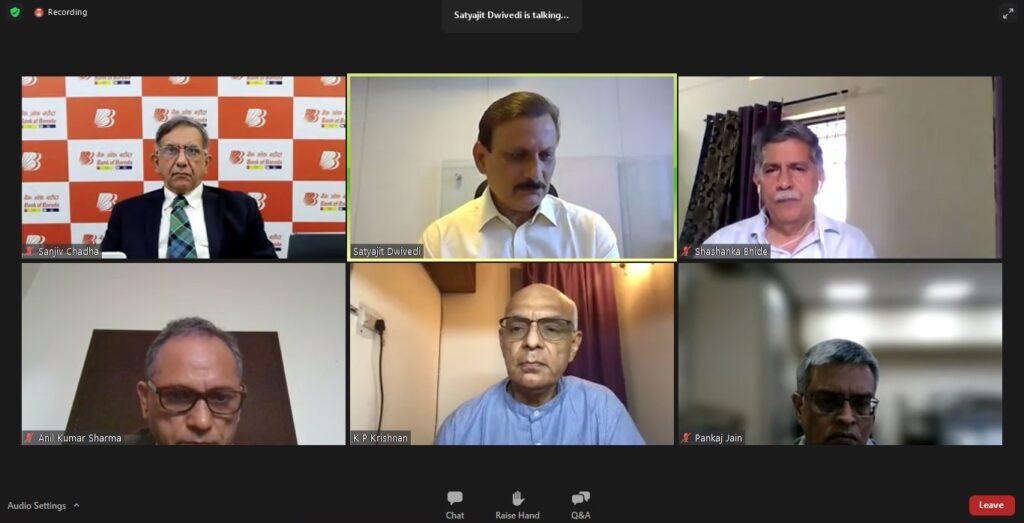
On December 16, NCAER’s newly established Investor Education and Protection Fund (IEPF) Chair Unit hosted its inaugural event for a five-part virtual workshop series on investor education and protection with financial regulators. The event was attended by more than 70 participants.

RBI Governor Shaktikanta Das delivered the keynote address, articulating the government’s vision and strategy for investor education. This inaugural workshop benefitted from insights by G P Garg, Executive Director, SEBI, and Chairman, National Centre for Financial Education (NSFE), Shashank Saksena, Senior Economic Adviser at the Department of Economic Affairs and Secretary, and Secretary, Financial Stability and Development Council, and Manoj Pandey, Joint Secretary, Ministry of Corporate Affairs and CEO, Investor Education Protection Fund Authority (IEPFA NCAER’s IEPF Chair Professor K P Krishnan shared NCAER’s proposed research program on consumer protection in finance and also chart the course for these NCAER workshops. NCAER’s Director General Shekhar Shah moderated the discussion.

India’s growth and pandemic recovery story will be paved by financial inclusion and participation in an increasingly digital financial space. With its robust digital financial services, the proportion of those with a bank account above the age of 15 in India has been reported to be nearly 80% in 2017, as compared to just about 35% in 2011. The gender gap in account ownership has also reduced to 6% (World Bank Group, The Global Findex Report, 2017). Connecting the world’s second largest population to a formal banking system is a Herculean task for this decade. Channeling savings from hard-earned money to safe and efficient channels of investment is another.

Digitization has opened up the doors of banking for hitherto untapped segments of the population. Many are accessing the formal banking system for the first time and lack trust in systems that they may not understand. Simply put, finance is an unchartered territory for many, including weaker sections and low-income groups, rural populations, and those who are new entrants into the formal labour market. On the other hand, there is an increased demand for entry into the investment market by newer populations. The past 3-5 years have seen greater equity investments from Tier 2-and-3 cities through different investment avenues. India has seen a 20% rise in demat accounts in the past six months during the pandemic, largely by those aged 24-39. This increased demand and interest in investments places an enhanced responsibility on regulatory authorities to demystify finance, encourage informed investments and channel assets into productive uses for the economy. The National Strategy for Financial Education 2020-25 recognizes the unique challenges of creating a financially aware and empowered India, and the need for convergence of efforts by multiple stakeholders that regulate and manage India’s financial resources.

The series of five NCAER workshops will cover investor education issues in securities market, insurance, pension funds and credit markets, following discussion in this inaugural workshop. These workshops will be an opportunity for participants to both learn from key regulators about their strategies for investor education and to contribute to refining the priorities for action and for further research and data collection in this area.

The next workshop in the series is scheduled for December 28, 2020, and will be chaired by SEBI full-time member, Mr G Mahalingam.

India Land Forum 2020

Data-driven Research & Evidence for Land Policy in India

NCAER organised its first India Land Forum 2020 (ILF 2020) during November 24-27, 2020.  Subtitled “Data-driven Research & Evidence for Land Policy in India”, the four-day, virtual ILF 2020 featured original papers on India by land researchers and NCAER’s own research based on a unique, state-wise data set that NCAER has put together in compiling the N-Land Records and Services Index released in February, 2020. The N-LRSI database is available on NCAER’s Land Portal.

The ILF 2020 was organised by the NCAER Land Policy Initiative with the aim of highlighting the gaps in economic research, policy analysis, and systematic data on land.  The keynote speech for ILF 2020 on November 24 was delivered by Professor T. Haque, Distinguished Professor at the Council for Social Development and former Chairman of NITI Aayog Special Cell on Land Policy and of the Commission of Agricultural Costs and Prices.  Setting the tone for the conference, Professor Haque noted that: “nothing could be better than when your policies are research and evidence based so that they are more acceptable to policymakers and to people at large…Absence of appropriate land policies and land management practices come in the way of land improvement, infrastructure development, as well as technological innovations.”

Earlier, in opening the ILF 2020, Dr Shekhar Shah, NCAER Director General, stated that the event is the first major airing of the work that the NCAER team has been pursuing for the past three years. The Coronavirus pandemic has heightened the need for greater attention to issues around land policy and land markets as migrants have returned home to rural areas and possibly the only asset they could fall back on.  It is important to think about how to improve land records and the ability to generate cash flows using land as collateral or through leasing.”

Ms. Shilpa Kumar, Partner at Omidyar Network India, welcomed participants and noted that “the Omidyar Network India was focusing on land and property rights with the motivation that if every Indian had secure property rights, they would be able to more meaningfully leverage the rights for their economic and social wellbeing…There has been a growth in the body of knowledge in this space and at forums like this, so the dialogue becomes all the more exciting.

Over 4 days, the ILF 2020, had sessions on “Modernizing India’s Land Records”, “Evaluating Title Records and Property Valuation Systems in India”, “India’s Land Records Data shows Women are far behind”, “Land as Collateral for Access to Credit in India”, and “Urban Housing and Land”.  The ILF 2020 also featured two panel discussions.  The first roundtable titled “Making Land Leasing Work for Transforming Indian Agriculture” was held on November 25  and the second on November 27th  focused on the  “Experience with Innovative Technology including drones for Cadastral Mapping and Titling Programs” reviewing examples of these initiatives in India and Ukraine.

Mr Deepak Sanan, NCAER Senior Advisor and N-LPI project co-lead, noted that “Understanding issues in land is critical for realizing the potential that land holds for sustainable and equitable development.  This workshop has helped advance the goal of assisting evidence-based policy in land matters, much like our previous work on the N-LRSI, which led many states to focus even harder on improving the access to and quality of their land records.

Talking about the importance of data-driven research, the NLPI Team Leader Professor Devendra B Gupta said, “Land is a critical asset for governments, industry, and citizens alike.  It is important to have access to reliable data relating to land and property records.  Many States in the past few years have made significant progress, especially in creating and updating digital data repositories for their land records.  This pace has to accelerate, and we can help that process with discussions of the type we have had at ILF 2020.”

The ILF 2020 ended on Friday, November 27th with a concluding address by Dr K.P. Krishnan, IEPF Chair Professor at NCAER and former Additional Secretary, Department of Land Resources.  Krishnan noted that “the ILF had touched upon all five aspects of land policy in India that I have considered important for quite some time.  First, the question of the state vs the market in land policy and transactions; second, state capacity for handling land matters;  third, technological advances and their impact; fourth, legal and regulatory changes in the field; and fifth, questions of Centre vs State in making progress on land policy and property rights. ILF 2020 has provided discussion space and data and evidence sharing in all these areas in some measure or the other.” Over 100 participants attended the virtual conference on all four days.

    Get updates from NCAER