India & the Coronavirus: How to protect and rebuild the economy

As we approach May 3rd and the end of the second lockdown in India, and as the reported Covid-19 case-load and the number of daily new cases appear to be declining, attention is increasingly turning to the need for rapid action on the economy to protect livelihoods and enterprises, including the most vulnerable MSMEs that provide employment for the majority of India’s labour force. The Government announced a relief package for the poor of Rs 1.7 lakh crore on March 27, but much more has been eagerly awaited over the past month. Policymakers have the unenviable but critical task of making difficult choices on how much and where they are willing to spend. India’s fiscal situation was not great to start with, but is now under even more pressure with sharply declining revenues and with estimates of the additional pandemic-related expenditures as high as 5 percent of GDP or Rs 10 lakh crore, according to Arvind Subramanian and Devesh Kapur when they spoke at a recent NCAER webinar. Developments in financial markets in the past few days add further concern. With each passing day, the cost of an eventual recovery and the revival of large and small businesses is likely to rise, while urgent action and funding are needed to protect the most vulnerable whose livelihoods and lives have been deeply impacted by the Coronavirus and the lockdown.

On April 30, NCAER hosted the next in its Coronavirus Briefings webinar series to discuss how to protect and rebuild the Indian economy out of the deepest recession it will have fallen into in its history. The second in this series dealing with the Indian macro economy, the webinar was moderated by Shekhar Shah and featured four leading financial sector India Chief Economists—Neelkanth Mishra, Pranjul Bhandari, Samiran Chakraborty, and Devendra K Pant. The panelists also responded to write-in questions from webinar participants. The discussion was attended by over 100 participants

India & the Coronavirus: Towards a safe, sensible, and clear exit strategy to allow us to rebuild the economy

The Great Lockdown has taken the global economy to the brink of its deepest recession since World War II. As India copes with its own, largest lockdown in human history, the cost to our economy continues to mount even as the Coronavirus curve is surely being flattened and its peak pushed out. With each passing day, the cost of an eventual recovery and the revival of businesses is rising, while urgent action and funding are needed to protect the most vulnerable whose livelihoods and lives have been deeply impacted. The choice of an exit strategy in the face of much epidemiological uncertainty will be critical to sustained success in curbing the virus and promoting a strong economic recovery.

How deep and broad will the hit to activity be around the world and in India? Can the recovery be as strong on the other side of the pandemic? Is the policy response around the world sufficient? What are the implications for India? What will this do to our economy, industry, banking sector and households? How should we think about the policy response? What should we be doing on the economy during the second lockdown to prepare us for a safe, sensible and clear exit strategy that will allow us to rebuild rapidly? Is there a silver lining to the cloud?

To discuss these questions, NCAER brought together four leading industry India Chief Economists in its NCAER Coronavirus Briefings webinar series—Sajjid Chinoy at J.P. Morgan, Sonal Varma at Nomura Holdings, Santanu Sengupta at Reliance Industries, and Abheek Barua at HDFC. The remarks and insights of these market-focused experts were followed by a discussion moderated by NCAER Director General Shekhar Shah during which the panelists also responded to write-in questions from webinar participants. The discussion was attended by over 120 participants.

India and the Coronavirus: Averting economic collapse and building economic resilience–What are the fiscal options?

In the third of its webinar series on the Coronavirus, NCAER hosted Arvind Subramanian, and Devesh Kapur to talk about their ideas on how to pay for the massive increases in public expenditure needed to shield the Indian economy and the millions of workers who have lost their jobs and incomes due to the Coronavirus pandemic. Subramanian is a former Chief Economic Adviser to the Government of India, Nonresident Senior Fellow at Petersen Institute for International Economics, and currently at the Harvard Kennedy School. Kapur is the Starr Foundation South Asia Studies Professor and Asia Programs Director at the School of Advanced International Studies, Johns Hopkins University. The discussion attended by over 160 participants was moderated by NCAER Director General Shekhar Shah.

As India enters the first day of the second Coronavirus lockdown, on present plans it will be an unheard of 40 days by the time this lockdown ends. India’s bold action on March 25 was necessary to avert a health disaster, but must be matched by even bolder economic measures by the Centre and States to protect the poor with little access to food and incomes and to buffer businesses facing financial collapse. Do the Union and State governments have the fiscal means to fight the Coronavirus on both the health and economic fronts? What are the bold but viable funding options we should be looking at? How can imaginative, rapidly put-together, bipartisan cooperative federalism between the Centre and the States help? Can government policies, funding, and programmes be a bridge between meeting pressing, urgent needs and reconstructing the Indian economy onto a more resilient, healthier, and faster development path?

In this very engaging NCAER webinar discussion, Kapur and Subramanian pursued answers to these pressing questions and then joined a Q&A session with the participants. Both Kapur and Subramanian are part of the Research Panel for NCAER’s India Policy Forum and frequent contributors to this apex annual policy conference held in the summer in New Delhi.

First Results: NCAER’s Delhi NCR Coronavirus Telephone Survey

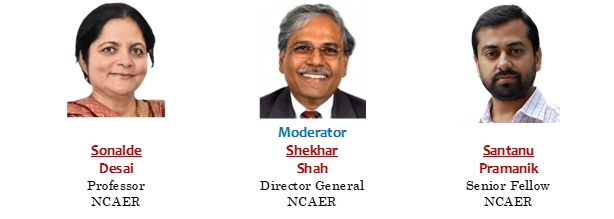
NCAER hosted a webinar by Sonalde Desai, Santanu Pramanik, and Dinesh Tiwari from its National Data Innovation Centre to share the results of its rapid response representative telephone survey in the Delhi NCR. The survey launched on April 3, 2020, 10 days after the lockout started was completed on April 6, 2020. The discussion attended by over 150 participants was moderated by Shekhar Shah.

Three weeks into the world’s biggest lockdown, the Coronavirus pandemic continues to pose moral, ethical and practical dilemmas for India. Epidemiologists rightly want to continue the lockdown to push out the peak and flatten the curve, buying time to prepare for peak hospitilisations with more personnel, beds and ventilators. Others are deeply concerned about the lives and livelihoods that will be lost from starvation, poverty, and other diseases, and from the destruction of farms, enterprises, and supply chains.

Policymakers are grappling with questions about how social distancing can be combined with safety nets for the vulnerable. How can the blow to informal workers and industry be softened? How do people perceive the dangers of the pandemic, and how are they adapting to the physical, social and emotional challenges of the lockdown?

To begin to answer some of these question, the NCAER National Data Innovation Centre launched its Delhi NCR Coronavirus Telephone Survey (DCVTS) to understand:

  • people’s knowledge of the Coronavirus
  • people’s attitudes and perceptions towards the risk of a Coronavirus infection
  • preventive and control measures, especially social distancing, and the feasibility of adhering to them
  • the impact of the Coronavirus pandemic on people’s livelihoods, income, social life, and access to essential items
  • and their support for extending the lockdown.

Round 1 of the DCVTS, completed in four days, interviewed a representative random sample of 1,750 adults in Delhi NCR comprising 31 districts in Delhi, Rajasthan, Uttar Pradesh, and Haryana. The DCVTS will be repeated roughly every three weeks with the questions chosen to reflect key issues that seem important for this fast moving pandemic.

The DMAS study provides detailed background data on the DCVTS Round 1 households making possible further in-depth study of these households

NCAER DCVTS Round 1 results and the Press Release is available on this webpage.

Dr Santanu Pramanik from NCAER spoke with Shereen Bhan of the CNBC TV18 to discuss the results of this survey. The recording of this television interview can be viewed here.

India & the Coronavirus: Modelling the Trajectory of Covid-19

The Coronavirus pandemic presents India, and the rest of the world, with difficult, painful public policy choices. The Economist magazine calls it a “A grim calculus. Covid-19 presents stark choices between life, death, and the economy.” These choices will become harder as India approaches the end of his historical, 21-day national lockdown, unprecedented in the history of mankind for its scale and urgency.

On Friday, April 10, NCAER hosted Professor Bhramar Mukherjee from the University of Michigan and members of the COV-IND-19 Study Group at its first NCAER Coronavirus Briefings Webinar to examine the threat to India posed by the Coronavirus and COVID-19, the disease it causes. The Group presented their modelling work and their findings that seek to answer questions of grave concern to India during and post the national lockout.

The COV-IND-19 Study Group at the Michigan University, an interdisciplinary group of scholars and data scientists, are using data and modelling to generate timely reports and recommendations about Covid-19 in India. Using daily Indian data on cumulative Covid-19 cases, recoveries and deaths, the Group is using an extended version of the SIR— susceptible, infected, and removed (recoveries & deaths) — model.  Their model incorporates time-varying transmission rates that help predict the impact of the lockdown compared to other possible interventions on the number of cases over time. A Markov Chain Monte Carlo model implementation provides predicted proportions of cases over time with credible intervals.  The Group has issued two briefings: pre-lockdown and post lockdown.  The Group has put out an interactive app at covind19.org which shows short and long-term projections updated daily.

Professor Mukherjee was joined by members of the Study Group, Debashree Ray  from the Departments of Epidemiology and Biostatistics, Johns Hopkins University, and Rupam BhattacharyyaMaxwell Salvatore, and Lili Wang, all at the University of Michigan.

The webinar touched upon questions also addressed by the Group in their post lockdown brief:

  • With the 21-day lockdown period in place, how many cases can we expect in India? How many fatalities can we expect in the next few weeks?
  • Italy has been under lockdown since March 9, but as of April 4 had not seen an appreciable reduction in mortality or the number of cases. When can we expect to see a reduction in India?
  • What will success under a lockdown look like?
  • What can we expect after the lockdown is lifted — will the number of cases go back up? Number of deaths?
  • Will the 21-day lockdown be long enough? Would a longer lockdown be more effective?
  • How vulnerable are India’s healthcare/frontline workers with medical resources stretched?
  • What should the Central and State governments be doing during and after the lockdown?
  • What can people do during and after the lockdown?
  • Why are there so many models and so many projections around, and why do they vary so much? How much should we rely on these projections?

For measuring this pandemic’s pulse, the Group talked about the role of data and data transparency, itself dependent on massive Coronavirus testing to generate the data and then on the regular, rapid release of accurate, credible data on susceptible, exposed, infected and removed (recoveries and death) cases.  Over 170 participants from India and overseas joined the NCAER webinar. After the discussion, Mukherjee and colleagues answered questions from the participants.

Speakers:

Bhramar Mukherjee is the John D. Kalbfleisch Collegiate Professor and Chair, Department of Biostatistics, Professor, Department of Epidemiology, and Research Professor and Core Faculty Member, Michigan Institute of Data Science, all at the University of Michigan. Mukherjee is a fellow of the American Statistical Association and the American Association for the Advancement of Science.  She is the recipient of several awards, including the Gertrude Cox Award from the Washington Statistical Society in 2016 and the 2020 L. Adrienne Cupples Award from the Boston University School of Public Health.

Debashree Ray is an Assistant Professor of Epidemiology and Biostatistics in the Johns Hopkins Bloomberg School of Public Health.

Rupam Bhattacharyya and Lili Wang are PhD candidates in Biostatistics at the University of Michigan.

Max Salvatore is a research area specialist in the Department of Biostatistics at the University of Michigan.

    Get updates from NCAER