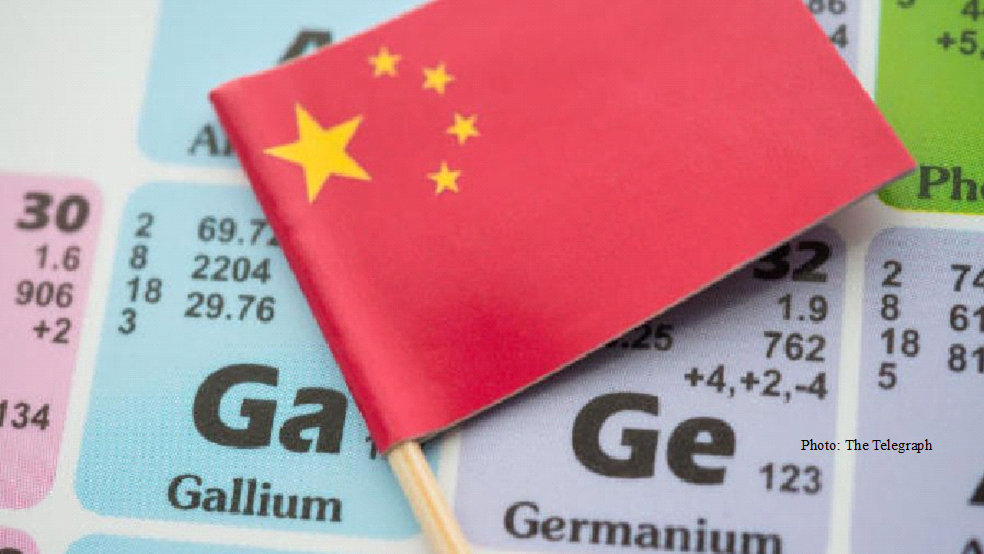
Gallium and germanium may never command the political attention accorded to oil or lithium. Yet they are indispensable to the industries that will define future economic competitiveness
Empires were once forged in iron, fuelled by coal, and secured by oil. Today, strategic power increasingly rests on materials so obscure that few outside scientific circles can even pronounce their names. Among them, gallium and germanium occupy a unique position. They rarely feature in policy debates, command no headlines unlike lithium or rare earths, and are traded in relatively small quantities. But without them, much of the modern digital economy would cease to function.
For India, these two minerals represent both an opportunity and a vulnerability.
Germanium is indispensable for fibre-optic cables, infrared optics, thermal imaging devices, satellite systems, and advanced solar technologies. Gallium forms the backbone of gallium nitride and gallium arsenide semiconductors that power 5G telecommunications, electric vehicles, radar systems, aerospace electronics, and high-performance computing.
As India expands its ambitions in semiconductor manufacturing, AI, telecommunications infrastructure, and defence modernisation, demand for these materials is expected to rise sharply. Yet the country remains heavily dependent on external sources for their supply.
Trade data reveal a concerning reality. In 2024, India imported more than US $36 million worth of germanium oxide-related products, with China accounting for nearly 40% of these imports. For several germanium products and refined gallium compounds, India remains almost entirely dependent on foreign suppliers.
Such dependence would be manageable in a stable world. But today’s geopolitical environment is increasingly defined by strategic competition, technological rivalry, and supply-chain fragmentation.
The global debate on critical minerals often centres on mining. Yet mining is only the first step. The real source of strategic leverage lies in processing and refining, the stages that convert raw materials into ultra-high-purity inputs for semiconductors, defence electronics, and advanced manufacturing. China recognised this reality long ago. Today, China controls roughly 80% of global refined gallium production and remains one of the leading processors of germanium.
India is not without advantages. It possesses substantial bauxite reserves, ranks among the world’s leading aluminium producers, and has significant zinc refining capacity. The industrial streams from these sectors already contain the raw material from which gallium and germanium can be recovered. But India currently lacks commercial-scale, ultra-high-purity zone-refining facilities required to produce semiconductor-grade gallium and germanium. Zone refining is a highly specialised process that removes microscopic impurities from metals. Consequently, India’s challenge is not one of geology but metallurgy. The country possesses the feedstock but lacks the complete processing ecosystem needed to convert industrial by-products into globally competitive strategic materials.
The priority should be establishing recovery facilities linked to existing aluminium refineries and zinc smelters. Second, India must invest in advanced processing capabilities, including solvent extraction systems, chlorination-distillation facilities, high-purity refining infrastructure, and zone-refining technologies. Third, recycling and urban mining must become integral components of India’s critical mineral strategy. Finally, improved trade intelligence and material tracking are essential.
Gallium and germanium may never command the political attention accorded to oil or even lithium. Yet they are indispensable to the industries that will define future economic competitiveness, military capability, and technological leadership.
Sanjib Pohit is a Professor and Sovini Mondal a Research Associate at the National Council of Applied Economic Research. Views are personal.