Budget 2023-24: Even Post-Covid, India Needed Health Budget Hike

India’s expenditure on health budget is a smaller share of the GDP than assured.

Budget 2023-24 can be seen as the first Union budget since the recovery from the pandemic, in which the health sector did not receive much focus, unlike the previous two years. We can note a marginal reduction in the share of health in the aggregate Union budget, which was 3.6% in 2021-22, fell to 2.7% in 2022-23 and stands at 2.4% in 2023-24. The fact that draws even more attention is the 15% decline in the revised estimate of the Union health budget for 2022-23 compared with the budgeted amount for that year.

In India, the total Union health budget is allocated through the ministries of AYUSH, health and family welfare and finance. Considering the allocation through all three ministries, Rs 1,06,654 crores has been allocated to health for 2023-24. This is a slight decrease from last year’s budgeted allocation of roughly Rs 1,07,433 crores. But it is important to note that despite this budgeted allocation in 2022-23, the revised estimate for health sector was slashed to Rs 91,90,000 crores for the financial year 2022-23 (Table 1).

Table 1: Allocation for Health care in Indian Federal Budget (Figures are in Rs. Thousand Crore)
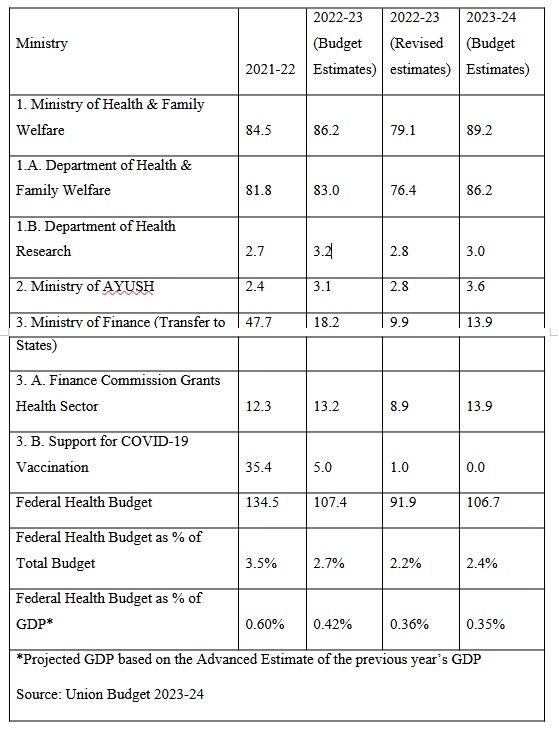
The reduction in allocation in the revised estimate as compared to the budgeted estimate is in all three ministries: by 10% in AYUSH, 8% in Health and Family Welfare and 46% in Finance. The huge reduction in the allocation through the Ministry of Finance in the revised estimate for 2022-23 stems from the reduction in the temporary grant to support COVID-19 vaccination, and in the health grant for the 15th Finance Commission. The probable reasons are that more than 70% of the Indian population is fully vaccinated against COVID-19 and government considers it a diminished threat.

India’s COVID-19 emergency response and health system preparedness package was discontinued in the previous Union budget (for 2022-23) and now we have a drastic cut in budget for in the revised estimate for 2022-23 and the budget estimate for 2023-24.

The 15th Finance Commission grant for health is supposed to be spent through local bodies. The release of this grant also needed substantial coordination among the federal, state and local governments. The low capacity of local bodies to spend what is allocated is often argued as a crucial factor behind the poor utilisation of finance commission grants executed through local bodies. However, 93% of the funds budgeted as 15th Finance Commission health grants were utilised (as reflected in the actual spending for the financial year 2021-22). A 33% decline in 15th Finance Commission health grants in the revised estimate for budget for 2022-23 in this context is quite surprising.

In the ministries of health and family welfare and AYUSH, the revision in budget allocation for 2022-23, is due to the reduction in fund allocated for Central Schemes and Centrally Sponsored Schemes (CSS). The government has undertaken several efforts to improve the financial management system and reduce efficiency losses in fund transfers. The Ministry of Finance revised the system of Centre-to-State fund flows after introducing the PFMS or Public Finance Management System in 2022 to enhance transparency in use the of CSS funds and improve the Union government’s cash management.

The Ministry of Finance mandates every State to designate a Single Nodal Account linked with the PFMS for each CSS. It directs each State to deposit all its unspent balance parked in different bank accounts for every particular CSS to the scheme-specific SNA. With full implementation of PFMS, the Ministry of Finance would be able to monitor the utilisation of every amount spent by the Union government and release the share of States from State treasuries under each CSS. Under this new system, the Union government will release funds only after the utilisation of 75% of the funds in SNA. The funds cannot be parked in accounts, as was often done earlier. This has reduced the allocations to Central Schemes and CSS in the revised budget as compared to the proposed budget in 2022-23, as the majority of States suffer from low utilisation.

Besides, the Union health budget is 0.35% of GDP in 2023-24, and it was 0.42% in 2022-23 and 0.56% in 2021-22. The 11th Five Year Plan had recommended scaling up government health spending to at least 2% of the GDP by 2012. The National Health Policy, 2017, recommended raising public health spending to 2.5% of the GDP by 2025.

India is far behind the target level. Assuming the Centre and State governments spend 30% and 70% of total government spending on health care, respectively, in 2023-24, the combined budgeted expenditure on the health sector would be 1.18% of GDP. But surprisingly, Economic Survey 2022-23 claims that the combined budgeted expenditure on the health sector by the Centre and State government reached 2.1% of GDP in 2022-23 (Budget Estimate) and 2.2% in 2021-22 (Revised Estimate), against 1.6% in 2020-21. This is not likely to be achievable in immediate future.

In the nutshell, India is lagging far behind reaching the target set for the share of health budget as percentage of GDP. However, utilisation is also important to translate budget allocation to actual spending. One must keep a careful watch on how resource-poor States are balancing their priorities, managing funds and maintaining fiscal autonomy in the new PMFS. Revisions in allocation to improve efficiency should not tighten the fiscal situation, which would strain the development process of poorer States, further widening inequality.

Pritam Datta is a fellow at the National Institute of Public Finance and Policy (NIPFP), New Delhi and Chetna Chaudhuri is a consultant at the National Council of Applied Economic Research (NCAER), New Delhi. The views are personal.
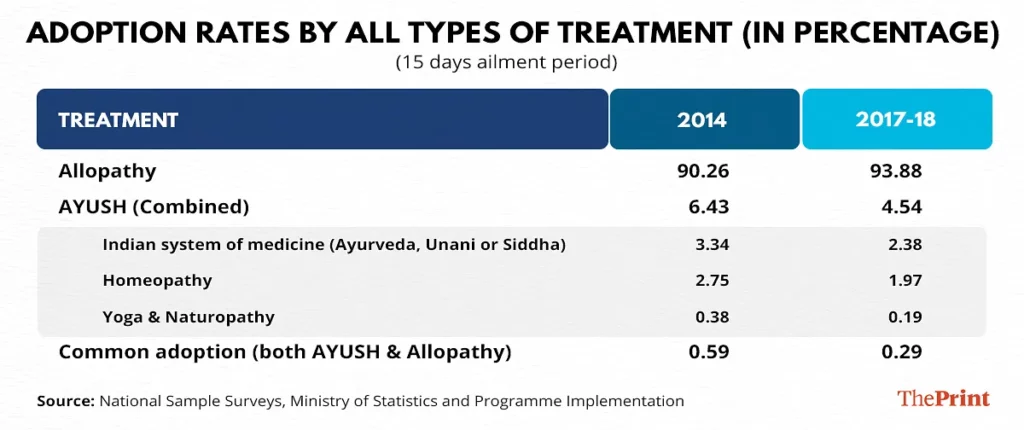
AYUSH medicine usage declining, NSS data shows. Integrate with allopathy for better reach

The decline in AYUSH medicine adoption was prevalent in most states and Union territories. It was constant across all economic groups.

The recognition of 21 June as the International Day of Yoga by the United Nations has significantly elevated the relevance of AYUSH systems, which encompass Ayurveda, yoga and naturopathy, Unani, Siddha, and homoeopathy.

With the increasing efforts of the government and various organisations to promote the use of traditional Indian medicine, also known as AYUSH, it has become an important tool in improving health. The Covid-19 pandemic has further demonstrated the potential of AYUSH systems as an effective solution. The National Health Policy, 2017 supported its integration into mainstream healthcare, and the positive push has led to the increased recognition of AYUSH systems.

But available data shows that these initiatives have not changed the mindset of people. The National Sample Survey (NSS), conducted by the Ministry of Statistics and Programme Implementation, shows low adoption and acceptance of AYUSH systems by the majority of the population. This was observed in surveys conducted under the 71st round titled “Social Consumption: Health” in 2014 and the 75th round titled “Household Social Consumption: Health” survey in 2017-18.

This analysis is exclusively limited to outpatient settings as the proportion of inpatients in total is extremely low. As per the survey findings, among outpatients seeking treatment, a small proportion of 6.43 per cent adopted AYUSH systems of medicine in 2014 compared to the overwhelming majority of 90.26 per cent who preferred allopathic medicine. What is more alarming is that the adoption rate of AYUSH decreased to 4.54 per cent in 2017-2018. The data also shows that the population co-opting both AYUSH and allopathic systems as a form of treatment is negligible.

State-wise analysis of AYUSH adoption
The decrease in AYUSH adoption was prevalent in most states and territories, with the exception of Bihar, Jammu & Kashmir, Madhya Pradesh, Manipur, Punjab, Uttarakhand, Delhi, Sikkim, Assam, Karnataka, and Pondicherry. These states recorded an increase in the use of AYUSH systems as a form of treatment. The data also indicated that the decline and the increase in adoption was consistent across all economic groups, regardless of socioeconomic status.

Several data-related issues may have contributed to the survey findings on the limited acceptance of AYUSH systems of medicine. One such reason is that the respondents of these surveys are those who suffered from an ailment in the 15 days prior to the date of the survey. The survey covers expenditure on allopathy or AYUSH systems of medicine only if an ailment is reported. The routine expenditure on AYUSH medicines, which is largely incurred for preventive care or even out of habit, is not covered in these surveys.

Moreover, significant adoption of AYUSH is likely to bear no cost at all, like practising yoga, consuming self-grown plants such as tulsi and aloe vera, drinking turmeric milk, ginger tea, etc. The adoption of such traditional practices is also not reported in any government or non-government data.

In conclusion, despite the efforts to promote AYUSH, hard data from government surveys shows a decline in the adoption of these systems compared to allopathic medicine.

It is mainly because these surveys are not designed specifically to capture the adoption of AYUSH.
Factors such as a lack of regulation, standardisation of these alternative medicine systems, and limited scientific evidence to support their efficacy may also have contributed to their limited usage.

The data collected through such large-scale surveys have important policy implications in healthcare, its provisions, usage, and potential benefits. They highlight the need for better efforts to increase awareness and address the challenges that prevent wider adoption.

If the available data is to be believed, there is a need to promote greater integration of AYUSH systems with allopathic medicine to provide a more holistic and integrated approach to healthcare. With the right policies in place, it may be possible to reverse the declining trend and ensure that AYUSH systems play a more significant role in improving the health and well-being of the people of India.

It is important to continue promoting the benefits of these systems while also working to address the challenges to ensure they are accessible and accepted as effective forms of treatment.

Palash Baruah is Associate Fellow and Poonam Munjal is Professor at National Council of Applied Economic Research (NCAER), Delhi.

Measuring women’s work participation: why it is important to get it right

By valorising women’s diverse activities, we may treat their vulnerabilities as strengths and fail to acknowledge the lack of access to income-generating activities for women

The 2022-23 Economic Survey (ES) should be credited for acknowledging that official statistics may have inadequately captured the true nature of women’s work in India. This inadequacy affects both how we perceive women’s economic contributions and the policies we develop to enhance women’s economic participation.

The Economic Survey has listed three sources of measurement error: (1) using very broad categories that club productive economic activity with domestic unpaid work (such as in activity code 93 in NSS, or National Sample Survey, employment surveys); (2) asking single-shot questions without probing to categorise women’s work; and (3) not capturing expenditure- saving work that contributes to household wellbeing. The Economic Survey further recommends revising labour force surveys (for example, the Periodic Labour Force Survey) to bring them in line with methodologies recommended by the International Labour Organization (ILO), listing a pre-defined set of activities, to eliminate underreporting.

A clearer picture
This attention to improving measurement of women’s labour market activities is welcome. The National Council of Applied Economics Research’s (NCAER’s) National Data Innovation Center carried out an experiment in 2019 under the Delhi Metropolitan Area Study (DMAS) in the Delhi National Capital Region. The experiment compared a one-shot questionnaire following the National Sample Survey Organisation (NSSO) method of enumerating usual principal and subsidiary activity status. These questions were followed by more detailed questions. In the latter, respondents were asked about engagement in a predefined and exhaustive set of activities, along with the time spent in each of these activities. The results from the DMAS survey indicated an underestimation of women’s work by five percentage points following the activity listing method when including work on the family farm/leased-in land, self- employment, and daily wage work. Underestimation was to the tune of 16 percentage points when including livestock care. This was primarily driven by estimates from the rural area, where underestimation was 34 percentage points, but only 2 percentage points in urban areas. Note that these comparisons are for the same women, allowing us to get precise estimates of measurement error.

While it is difficult to generalise based on urban and rural areas surrounding Delhi, these results highlight deep-rooted challenges in measuring women’s work. Interviewers as well as respondents tend to overlook women’s work, particularly work in family-based enterprises. Our observations from field visits suggest that while male farmers think of themselves as employed in farming, women farmers see farm activities as simply extensions of their household duties.

From a policy perspective, ignoring measurement errors can lead to a focus on the declining labour force participation rate (LFPR) of women with low education whereas the focus needs to be on moderately educated women as indicated in a study by Esha Chatterjee, Sonalde Desai, and Reeve Vanneman (2019), which shows that occupational sex segregation along with lack of demand for moderately educated women could have contributed to low LFPR. Moderately educated Indian women are less likely to opt for manual labour in family farms or in wage work, but at the same time remain excluded from non-manual semi-skilled jobs such as bus driving or masonry work as well as some of the white collar jobs such as sales. This has implications for targeting skilling programmes for women in non-traditional sectors. Measurement issues also have implications for designing social protection measures, with undercounting economically active women translating into lesser budgetary allocation for informal women workers.

While the Economic Survey should be commended for recommendations to improve measurement of women’s work, its proposal to expand the definition of what counts as employment is somewhat ingenious. The 2019 Time Use Survey shows that women often engage in a variety of activities that can be classified as “expenditure-saving”. This includes the collection of firewood, fetching water, and preparing atta from wheat to reduce purchasing costs. It also includes tutoring children and cooking. The Economic Survey suggests that we should recognise this “work” along with “employment” and collect this information through redesigned surveys.

Proceed with caution
Politically this is quite appealing, and consistent with one stream of feminist activism. Expanding the definition of work immediately expands the number of women workers — including almost the total adult female population in India — and softens the stigma of low female work participation rates in India. It also dovetails with the feminist advocacy that has sought recognition of women’s unpaid work. However, this approach has two shortcomings. One, it conflates activities within and outside of the System of National Accounts (SNA) production boundary where own-use production of goods such as growing vegetables or caring for livestock is seen as being within the production boundary while tutoring children is generally considered outside the production boundary. Two, activities that are undertaken due to a shortage of infrastructure are suddenly seen as being valuable rather than classified as “domestic drudgery”. Women’s participation in these activities (for example, fetching firewood) may be necessary for household survival, but few women would choose to rely on cooking with wood if they can easily get access to gas stoves. Our research has shown that women’s engagement in salaried work provides an impetus for households to switch away from such domestic drudgery and invest in time-saving infrastructure such as LPG cylinders.

This, perhaps, is the reason that the 19th International Conference of Labour Statisticians (ICLS) in 2013 recommended that labour force surveys capture data on a variety of activities such as the production of goods and services for own use, work for pay or profit, unpaid trainee work, and volunteer activities, but only count production of goods and services for pay or profit as employment.

By valorising women’s diverse activities, we may treat their vulnerabilities as strengths and fail to acknowledge the lack of access to income-generating activities for women. Perhaps the most curious case of taking women’s contributions for granted is reflected in the debate generated by an article in the Economic and Political Weekly, wherein Arun Gupta and Jon Rhode valued the economic contributions of mother’s milk at $2,300 million in foreign exchange in 1993. This article generated a debate, leading Mina Swaminathan to argue that this instrumental approach to women’s contributions to family welfare leads us to ignore nutritional costs to mothers and develop a stereotype of “good” mothers that ignores the constraints under which working mothers operate.

As India aspires to achieve inclusive economic growth and provide avenues of decent work conditions for all workers in line with SDG (Sustainable Development Goals) 8, getting measurement of women’s economic activities right is of utmost importance.

Pallavi Choudhuri is a Senior Fellow at the National Council of Applied Economics Research. Sonalde Desai is Distinguished University Professor, University of Maryland and Professor and Centre Director, NCAER-National Data Innovation Centre. Views are personal

Investments in transport corridors should pay off

The viability of long-gestation transport projects hinges on rightly projecting future revenue flows. Big Data can help in this.

The successive Budgets of the NDA government have emphasised on increased investments to upgrade infrastructure. This is a thrust area in Budget 2023 as well. Roads, transport and the Railways continue to remain in focus, with the Railways receiving the highest ever outlay of ₹2.4-lakh crore in FY24, nearly nine times of that in FY14.

Finance Minister Nirmala Sitharaman has allocated ₹75,000 crore for 100 critical infrastructure projects which will improve regional connectivity and boost domestic air links. The Rail Budget outlay will no doubt improve rail connectivity, speed, and passenger traffic.

Among the infrastructure segments, investment in transport corridors (land, water, rail, air) has been the focal theme of the government for successive years. This is in tune with the government’s objective to build an efficient logistics ecosystem to make India a hub of the global value chain.

No doubt, investing in transport corridors is a high-cost exercise with returns coming in only after a long gestation period. This is more so, if the planning of corridors goes off target in respect of future streams of revenue. This is an issue with many of the country’s corridors. The revenue stream from toll seldom matches, or close to, what is specified in the project document. As a result, the government’s or private sector’s resources get locked in for a long duration resulting in shortage of funds to investment in much-needed new corridors .

Road transport
As for greenfield inter-State road transport corridors, hey are either 4/6/8 lanes along the entire stretch, without taking into account the variation in freight demand across the corridors. Surely, it makes sense to vary the carrying capacity of the corridor, depending on the prospective traffic. This needs to be looked into as there’s a clamour for resources from other sectors of the economy as well.

If this be the case, why is not much attention paid to correctly project the future stream of traffic (freight, passenger)? In most project documents, the methodology is not spelt out clearly. If a survey is the tool to make projections, often it is based on a thin sample to cut costs; theoretically sound statistical/survey tools are seldom applied. It is not surprising, therefore, that projections of revenue from transport corridors go awfully off-target.

In developed countries, this probably does not happen as sufficient attention is paid to projecting traffic volume at the planning stage itself. They make use of Big Data to understand existing volume of traffic on a corridor. Some developing countries use Google Traffic data for estimating traffic volume. India apparently does not make use of such data for transport planning.

By contrast, India stands apart. The country generates Big Data (24×7) on freight transport movement — that is, GST/E-way bill — which are not released by the government for planning purpose. These data can provide information and insights on: (a) the busiest trade corridors; (b) the volume of freight traffic from point A to point B; and (c) where more investment on transport corridors are required.

Ideally, the government can anonymise and release this data. This is probably the best data currently available for any inter/intra-State transport corridor planning exercise. To the bidders for transport corridors, the government should make this data available for more accurate demand projections. Also, the data must be made available to independent researchers as this will facilitate in more accurate estimation of logistics cost which policymakers are planning to measure on a regular basis.

The writer is Professor, NCAER. Views are personal.

Faculty News: Professor Sonalde Desai Appointed as Fellow by American Association for the Advancement of Science

NCAER Professor and Director of the National Data Innovation Centre (NDIC) at NCAER, Sonalde Desai, who holds a joint appointment as a Distinguished University Professor at the University of Maryland College Park, has been named as a Fellow by the American Association for the Advancement of Science (AAAS). In a tradition dating back to 1874, election as an AAAS Fellow is a lifetime honour, as it recognises members whose efforts on behalf of the advancement of science or its applications in service to society have distinguished them among their peers and colleagues. Professor Desai has been honoured for “distinguished contributions to the demography of South Asia, with particular attention to the impact of development on economic and gender inequalities.”

She was elected president of the Population Association of America for 2022 and has published extensively in Indian and international journals, and frequently contributes to Indian English-language newspapers. She leads the India Human Development Survey (IHDS), a unique public resource for Indian and international researchers interested in understanding India’s social and economic transformation over the past two decades.

    Get updates from NCAER