India’s commitment to achieving net-zero emissions by 2070 requires state-level strategies for low-carbon economic transitions. This study develops a state-specific macroeconomic framework linked to an energy system model to assess the investment needs and employment impacts of decarbonization. Focusing on Odisha, an eastern coastal state producing 23% of India’s coal and 44% of mineral output, with a high industrial GDP share, we construct a 49-sector computable general equilibrium (CGE) model and soft-link it with a bottom–up MESSAGEix model. Studies utilizing integrated CGE–MESSAGEix models at the subnational or regional level in India remain limited. The integrated approach evaluates the economic and employment impacts of alternative low-carbon pathways, capturing inter-sectoral and national-global linkages. The findings indicate that fossil-fuel taxation with revenue recycling and renewable energy investment, if applied in isolation, may dampen growth. However, combining renewable energy development policies with energy efficiency and productivity gains mitigates adverse effects, supporting a sustainable transition. In the policy scenario, while coal sector jobs decline, overall employment rises, highlighting opportunities for a just transition in resource-dependent states.
Article highlights
Uses top–down regional recursive dynamic CGE model with a bottom–up energy model.
Assesses the economic, energy, employment impact of decarbonization and investment need.
Development of renewable sector by taxing fossil fuels hampers economic growth.
Improvement in energy efficiency & productivity enhances economic growth.
Overall employment even in coal-rich state is not affected by the transition.
In the third part of our series on India’s new labour reforms, Afridi and Smruti focus on the Industrial Relations Code, 2020 – in terms of its rationale, the key legislative changes that it entails, state-level implementation, and what the existing theoretical and empirical literature says about potential impacts. They contend that the Code may improve allocative efficiency by easing constraints where regulatory thresholds are binding and economies of scale matter.
India’s manufacturing sector has long been characterised by the “missing middle” problem – a dominance of small firms alongside a relative absence of mid-sized enterprises. Data from the 2023-24 Annual Survey of Industries (ASI) show that about 65% of factories have fewer than 50 employees, while only a small fraction scale beyond 100 workers (Figure 1). This skewed firm-size distribution has important implications for productivity, employment quality, and structural transformation. In most industrialised economies, firms grow through intermediate size categories, gradually benefiting from economies of scale, improved access to finance, and greater technology adoption. In contrast, firms in India remain concentrated at the lower end of the size distribution, with limited transition into medium-sized firms that can realise these gains.
One commonly cited explanation for this pattern lies in regulatory thresholds embedded in labour laws. Historically, firms employing 100 or more workers faced stricter requirements related to retrenchment and layoffs, including prior government approval. As a result, firms had strong incentives to remain just below these thresholds, even when business conditions would otherwise justify expansion. This phenomenon, often described as “bunching”, reflects strategic firm behaviour in response to regulatory discontinuities.
Figure 1. The “missing middle” in Indian manufacturing
Source: Authors’ compilation based on ASI 2023-24 Summary Statistics.
Note: The raw data were available for the employment size 200-499 category, which has been bifurcated assuming a uniform distribution within the bin.
The Indian labour market, therefore, sits at the intersection of two competing priorities: enabling firms to grow and adapt in a rapidly changing economic environment, while ensuring adequate security and protection for workers. With the introduction of the Industrial Relations (IR) Code, 2020, policymakers have attempted to recalibrate this balance.
Key legislative changes under the Industrial Relations Code
The IR Code, 2020 seeks to address these concerns by rationalising and consolidating existing provisions into a more unified framework, while also introducing several substantive policy changes. A key reform is the expansion of thresholds for prior government approval for layoffs, retrenchment, and closure, which has been raised from 100 to 300 workers. This change is intended to provide firms with greater operational flexibility and reduce regulatory frictions associated with scaling up employment.
The Code also introduces Fixed-Term Employment (FTE) as a formal category of hiring. Under this provision, firms can employ workers for specified durations while ensuring parity in wages and statutory benefits – including social security and pro rata gratuity – with those of permanent employees. This is designed to increase hiring flexibility while maintaining a baseline level of worker protection.
From an ease-of-doing-business perspective, the Code significantly simplifies compliance requirements. The number of rules has been reduced from 105 to 51, and the number of prescribed forms from 37 to 18. In addition, firms employing fewer than 300 workers are exempted from the requirement of certifying employment conditions through standing orders, thereby reducing procedural obligations for a large segment of enterprises.
On the industrial relations front, the Code introduces the concept of a “Negotiating Union” or “Negotiating Council” as a single bargaining agent, intending to reduce inter-union rivalry and lower transaction costs in collective bargaining. In the area of dispute resolution, it establishes a unified Industrial Tribunal, replacing multiple adjudicating bodies and allowing workers to approach the Tribunal directly after the failure of conciliation proceedings.
Finally, the reforms incorporate transitional safeguards through the creation of a Worker Re-skilling Fund, under which employers are required to contribute an amount equivalent to 15 days’ wages of retrenched workers. This provision is intended to support retraining and facilitate smoother labour market adjustment in the event of job losses.
State-level implementation
However, the effectiveness of such reforms depends not only on legislative change but also on how firms and states respond in practice. Labour regulation in India is deeply heterogeneous, with significant variation in enforcement capacity and administrative interpretation across states. As a result, the impact of the reforms is likely to be uneven, both across regions and across sectors.
This variation is already evident in the pace of implementation of the IR Code across states (Figure 2). States can be broadly categorised based on their progress in notifying rules under the Code. Early adopters – such as Bihar, Gujarat, and Karnataka – had notified the rules by 2021. A second group of states, including Tamil Nadu and Delhi, followed later, with notifications issued between 2022 and 2025. In contrast, West Bengal, has yet to notify the rules, reflecting continued divergence in the operationalisation of the reform framework.
Figure 2. State-wise adoption of rules under the IR Code
Source: Authors’ compilation based on state government gazette notifications issued by state labour departments.
Notes: Where both draft and final rules were notified, the year of the first notification is reported. As of April 2026, final rules have been notified by Arunachal Pradesh and Gujarat.
Literature review
The industrial relations code is expected to increase employment and productivity at the intensive margin by reducing compliance costs, enabling faster dispute resolution, strengthening collective bargaining mechanisms, and improving allocation efficiency. However, gains at the extensive margin remain uncertain and depend critically on how binding the expanded regulatory thresholds are, the intensity of implementation, and prevailing market conditions. Hence, the overall magnitude of impact may be constrained without complementary policies that enable smaller firms, especially those below the 100-worker level, to expand.
Potential impact on employment
Theoretically, the impact of the IR Code on employment varies depending on firm behaviour and the structural characteristics of the labour market
Table 1. Theoretical impact of the IR Code on employment
Predictive employment effect
Model
Mechanism
Positive
Threshold Convergence and Principal-Agent Models (Jensen and Meckling 1976)
Firms facing additional fixed compliance costs above the threshold of worker counts have a strong incentive to reduce headcount below the threshold. This causes bunching at the margin and can happen through contract worker substitution, increased capital usage, or firm splitting. Hence, by reducing fixed compliance costs firms are given incentive to expand in scale.
Insider-Outsider Problem (Blanchard and Giavazzi 2003)
Already employed (insiders) use their bargaining power to secure higher wages and job protection. Firms are discouraged from hiring outsiders due to anticipated future bargaining rents and firing costs. Thus, reducing these frictions lowers the effective insider-outsider divide, encouraging firms to hire more freely from the pool of outsiders and expanding formal employment opportunities.
General Equilibrium (GE) Model (Helpman and Itskhoki 2007)
Strict Employment Protection Legislation (EPL) constrains formal activity and induces a massive reallocation of labour toward unregulated, less productive sectors. Thus, the deregulation of EPL reduces distortions in labour allocation, encouraging reallocation of workers toward more productive formal-sector employment and improving overall efficiency.
Negative or Neutral
Institutional Mediation(Aghion et al. 2008)
Effects of EPL depend heavily on enforcement, judicial interpretation, and state-level variation.
New Keynesian model with labour market frictions and endogenous producer entry (Cacciatore et al. 2015)
Firms adjust to regulatory changes cautiously, as hiring involves sunk costs and uncertainty, while layoffs can be implemented quickly. This asymmetry dampens immediate employment expansion despite deregulation.
Costly exit traps labour and capital in unproductive firms. Even if hiring becomes more flexible, weak exit mechanisms limit reallocation and dampen aggregate employment gains.
Dynamic Demand with Two-Tier Reform (Bouis et al. 2012)
Partial deregulation shifts distortions to new margins. Initial employment gains may be offset as firms adjust strategically, recreating segmentation.
Source: Authors’ compilation.
Empirically, the impact in India is likely to be positive with downside risks. The 1982 tightening of firing restrictions reduced manufacturing employment by 27% (Kotia et al. 2025), suggesting that easing such constraints under the new Code may support employment gains by lowering barriers to expansion. At the same time, more recent evaluations of the 2014 Rajasthan deregulation, where the threshold for retrenchment was expanded, found that firms utilised increased flexibility primarily to shed surplus labour, resulting in a 3% decline in total employment within existing plants (Goswami and Paul 2021), reflecting transitional reallocation as firms adjusted to greater flexibility.
Beyond market structure, the employment impact of the IR Code in India depends on several key factors:
Binding of thresholds: The reform’s immediate benefits may be concentrated in states with high shares of mid-sized firms; for instance, Bihar and Tripura have 20-24% of firms in the 50-99 worker band, while Andhra Pradesh has only 4-6%. (Figure 3)
Figure 3. Factories in operation with 50 to 99 workers for each state/UT
Source: ASI 2023-24, Summary Statistics; Authors’ compilation.
Judicial mediation: The impact of labour laws depends heavily on enforcement and interpretation; research suggests firms in states with pro-worker judicial regimes employ roughly 9% fewer workers than those in pro-employer states (Sofi et al. 2022).
Complementary reforms: Gains are more likely when labour reforms are synchronised with broader market-friendly measures, such as industrial delicensing, which creates the growth opportunities necessary for firm expansion (Aghion et al. 2008).
Potential impact on productivity
The impact of the IR Code on productivity is primarily mediated through changes in allocative efficiency and incentives for human capital investment
Table 2. Theoretical impact of the IR Code on productivity
Predictive Productivity Effect
Model
Mechanism
Positive
Worker Effort and Signaling Theory (Engellandt and Riphahn 2003)
Temporary workers exert higher effort to improve their chances of retention or contract renewal, leading to productivity gains at the firm level. However, effects may not persist if the turnover rate is high.
Moral Hazard (Insurance Models) (Shapiro and Stiglitz 1984)
Strong protection against firing reduces workers’ incentives to exert effort or invest in productivity (that is, it reduces dismissal risk). Thus, easing excessively rigid protections can strengthen effort incentives and encourage higher productivity investment by making job continuity more closely tied to performance.
Negative or Neutral
Labour composition adjustments (Ramaswamy 2013)
Firms substitute away from more productive permanent workers toward relatively less productive contract, temporary, or informal labor to avoid EPL constraints.
Human Capital Theory (Becker 1964)
If turnover is high, firms may potentially not invest in general training because employees can leave and take that value elsewhere. Consequently, firms only invest in firm-specific training, and high turnover discourages even that, leading to an overall reduction in training investment.
Job Polarisation and Task-Based Models (Acemoglu and Autor 2011)
Firms may reorganise production toward easily replaceable tasks under flexible contracts, potentially reducing overall skill intensity and long-term productivity growth.
Source: Authors’ compilation.
Empirically, the IR code may have a positive impact on productivity. Greater flexibility improves firm selection and allocative efficiency. More recent evidence points in the same direction. Evaluations of Rajasthan’s 2014 deregulatory reforms – closely aligned with the logic of the new Code – find an increase of about 3% in both total factor productivity (TFP) and value added among affected plants (Goswami and Paul 2021).
Beyond allocative efficiencies and skill formation, the productivity impact of the IR Code in India depends heavily on the composition of the workforce and ultimately worker effort:
The introduction of FTE under the IR Code represents a strategic attempt to create a hybrid employment category that balances firm flexibility with worker protection (Table 3).
Table 3. Comparison of employment contracts under the IR Code, 2020
Parameter
Permanent employment
Fixed-term employment (FTE)
Contract employment
Separation costs
High
Low-moderate
Low
Benefits
Full statutory benefits
Same as permanent (pro-rata)
Limited/variable
Job security
High
Low
Very Low
Expected productivity
Moderate-high
High (performance-linked)
Low-Moderate
Source: Authors’ compilation.
While permanent employment continues to build essential institutional knowledge and skills, its high separation costs have historically created rigidities that misallocate labour. Conversely, contract labour maximises flexibility but often constrains productivity because workers hired through intermediaries typically receive minimal training and show lower task efficiency. FTE addresses these gaps by ensuring parity in wages and benefits with permanent employees. There can be a possible increase in productivity through improved worker effort and better matching of labour to specific firm needs.
Ultimately, the net impact on productivity will depend on labour composition adjustments. If firms shift from informal contract labour to formal FTE, productivity is likely to rise. However, if FTE primarily replaces permanent roles, long-term productivity may be hampered by weaker incentives for broader skill development.
Summary of potential impact
The Industrial Relations Code, 2020 is a structural reform aimed at simplifying India’s fragmented industrial relations framework to support firm growth while maintaining worker protections. Based on theory and evidence, it may improve allocative efficiency by easing constraints where regulatory thresholds are binding and economies of scale matter. Regulatory uncertainty is also expected to decline with the consolidation of multiple statutes into a unified framework.
The impact on employment may be positive, with dampening associated with adjustment effects. Raising the retrenchment threshold from 100 to 300 workers may reduce incentives for firms to “bunch” below regulatory cut-offs. However, constraints from the existing firm-size distribution mean that stronger gains may require complementary reforms to fully unlock scaling effects.
Labour productivity is expected to improve through greater flexibility and the introduction of FTE, which may strengthen effort incentives and improve worker–firm matching, though outcomes depend on how employment structures adjust in practice.
Overall, the impact will depend on implementation and complementary reforms, which will determine whether India can move beyond the “missing middle” constraint and support sustained firm scaling.
The views expressed in this post are solely those of the author and do not necessarily reflect those of the I4I Editorial Board.
Data shows that young Indians spend an extraordinarily long time waiting for the right job opportunity to show up. The rise of AI will probably elongate the wait. This is a worry. Who’ll support them till they find suitable employment?
India’s unemployment debate is missing a crucial dimension: time. Time spent waiting is a loss at any age, but especially so in one’s youth. For both the individual and the country, it is a loss of prime productive years.
Last year, 11.6 million Indians in their 20s were unemployed and about 6.8 million of them had been job hunting for over a year. The long wait may not necessarily reflect a shortage of jobs, but a mismatch between the jobs on offer and what young Indians aspire to.
These numbers understate the full picture: another 78 million in the same age group were not looking for work at all as per our estimates based on the Periodic Labour Survey data for 2025.
In Rajasthan, Assam, Jharkhand, Odisha and West Bengal, two-thirds or more of unemployed young adults in their 20s were looking for work for over a year. In Bihar, Punjab, Uttar Pradesh, Andhra Pradesh and Telangana, more than half of unemployed young adults were in the same category.
In Maharashtra, Tamil Nadu and Gujarat—states with diversified manufacturing and services economies—unemployment durations under and over a year split roughly evenly. Kerala shows a similar pattern, though possibly for different reasons: many young people may have already migrated to other states and abroad.
In terms of the overall unemployment rate, about 10% of young Indian adults in their 20s were unemployed last year. This does not include around 40% who were not even looking for a job.
Unexpectedly, states like Uttar Pradesh, Bihar and West Bengal have lower-than average unemployment rates among people in their 20s. However, this does not necessarily reflect labour market success. Poverty forces people to take up whatever work is available.
The states with the highest young adult unemployment are not the poorer northern states, as one might expect. They include Tamil Nadu, Telangana, Andhra Pradesh, Punjab and, unsurprisingly, Kerala, all with 13-18% of young adults unemployed. Also, some prosperous states such as Gujarat, Maharashtra and Karnataka have lower young adult unemployment rates, with Gujarat recording the lowest at 2%.
In states where a higher proportion of young women are looking for work, the labour market fails them most visibly. For example, in Kerala, 41.5% of young women are in the labour force, and about 30% of them were unemployed last year, compared with just over 12% for men, among whom labour force participation is higher.
Other southern states such as Tamil Nadu, Andhra Pradesh and Telangana show double-digit gender gaps in unemployment rates. In Bihar, Haryana and Uttar Pradesh, where female economic participation is lower (less than 25%), the gender gap in unemployment is narrow, only because so few women are seeking work.
The most concerning fact, set to get worse with the advent of AI, is that as education levels rise, so does the unemployment rate. The wait is set to get longer as well. This is also the main reason for higher rates of joblessness seen among young adults in some of India’s relatively prosperous states.
Among the young adults who are not currently in education, graduates account for one fourth. However, they account for two-thirds of the unemployed. The graduate unemployment rate is 23.6%, more than twice the overall rate of about 10% in this age bracket and five times the secondary-educated joblessness rate of 4.3%. Among those with engineering degrees, the largest group among highly educated young adults, 25% were unemployed in 2025.
In an AI world, what kinds of jobs will be created and what skills should young people acquire?
In an article in 2023 in Mint, one of the authors of this article wrote, “The ability to code is a top-rated skill today. It will soon be replaced by skills that are more challenging to acquire… Resourcefulness, integrative thinking and articulation are likely to become far more valuable and necessary than basic coding and programming.” This remains true. The same will hold for skills such as marketing, sales and negotiation, areas where judgement and persuasion matter more than the process.
Young people will need to acquire more than a degree. Building genuine expertise in a core discipline—pure sciences, mathematics or psychology—demands skills of understanding that a degree does not provide. Employers today have little patience for the gap between the two. They may well hire experienced people in these fields.
The structure of most Indian schools and colleges lets students choose only narrow streams, leaving combinations such as mathematics with psychology or marketing largely out of reach. What the evolving labour market will ask for, however, is precisely the kind of integrative thinking that rigid disciplinary boundaries work against.
The employment outlook is sobering. The availability of decent-paying jobs, entry-level coding and similar work is shrinking, which will push down wages. Young women will likely be hit hardest. In households where someone must give up the job search, it is rarely the man. If the financial return does not justify the effort and time, women will be the first to stop looking for a job.
Returning to where we began: the length of the job search, already long, is set to grow longer and not only for women. As the wait extends, perseverance and patience will become essential virtues. The big question is whether families, society and policy can support young people through it.
The authors are, respectively, Union Bank Chair professor of economics, Great Lakes Institute of Management, and associate fellow, National Council for Applied Economic Research. Views are personal
In the 21st century, finance is no longer just about numbers on balance sheets or returns on investment. It is about responsibility. The conversation has shifted from “How much profit will this generate?” to “What kind of future will this create?” As climate change becomes more visible in our daily lives, the financial world finds itself at a defining moment. This moment has sparked the rise of green finance: an approach that recognizes that money is never neutral. And increasingly, investors, institutions, and governments are asking not only whether an investment is profitable but whether it is sustainable
For generations, the work women do within the home has gone largely uncounted in national productivity measures. The Time Use Survey is an important step toward correcting that oversight.
International Mother’s Day, celebrated every year on the second Sunday of May, is an occasion to express gratitude to mothers for their love, care, and countless sacrifices. The word “mother” here extends beyond biological mothers to include grandmothers, stepmothers, aunts, and every woman who holds a family together with strength and compassion.
While a mother’s emotional investment is difficult to measure, the time spent providing care certainly isn’t. And the numbers tell a story worth reflecting upon.
The Time Use Survey (TUS) 2024, conducted by the Ministry of Statistics and Programme Implementation, captures how people across India spend their time each day. Covering both rural and urban households, the survey offers a rare empirical window into the everyday lives of Indians.
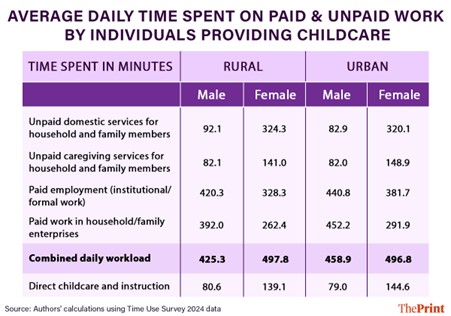
Using the unit-level data from the TUS 2024, we identified individuals who devote time to childcare activities—both men and women. A detailed analysis of this cohort offers important insights into how domestic services, caregiving responsibilities, and paid employment are distributed within Indian households. The findings are striking, revealing not only the unequal burden of work but also women’s often-invisible labour that sustains families and society every single day.
Measuring the minutes
Across India, women who devote time to childcare activities consistently spend far more time on unpaid work within households than men who devote time to the same activities. In rural areas, women spend an average of 324 minutes per day—over 5 hours—on unpaid domestic services such as cooking, cleaning, fetching water, and managing the household. Their male counterparts spend approximately 92 minutes on the same activities. The pattern holds in urban areas too: women average 320 minutes daily compared to men’s 83 minutes.
The story is similar, though somewhat less stark, when it comes to unpaid caregiving: looking after children, the elderly, and household members with disabilities. Rural women spend around 141 minutes a day on caregiving, while rural men spend about 82 minutes. Urban women spend nearly 149 minutes, compared to urban men’s 82 minutes.
What makes these figures even more concerning is what happens when one combines paid employment with unpaid domestic and caregiving work. Women in both rural and urban India put in more time overall than men when all four categories of work are considered together. On average, a rural woman works nearly 498 minutes in combined paid and unpaid activities; a rural man spends around 425 minutes. The urban figures are along similar lines—497 minutes for women and 459 minutes for men.
Childcare and nurturing
When it comes to childcare and instruction—a category that captures time spent directly nurturing and educating children—rural women spend an average of 139 minutes a day, compared to 81 minutes spent by rural men. Urban women spend 145 minutes on childcare and instruction, while their male counterparts spend 79 minutes. Mothers, it seems, are not only primary caregivers but also the principal educators of the next generation, often without formal recognition or remuneration.
It is worth noting that women who are employed also bear the full weight of domestic responsibility. The TUS 2024 data shows that even working women—those engaged in paid institutional/formal or household-enterprise employment—continue to shoulder a substantially larger portion of the unpaid workload. This convergence of paid and unpaid labour is what researchers and economists have long described as the “double burden” of women’s work.
Visibilising women’s labour
This is not a critique of any individual or household arrangement. Families across India function in diverse economic, social, and cultural contexts, and men also work long hours in fields, factories, and offices. What the data simply invites us to do—on a day dedicated to celebrating mothers—is to make the invisible labour visible.
For generations, the work that women do within the home has gone largely uncounted in national productivity measures, uncompensated in formal economic terms, and under-recognised even in everyday conversation. The TUS is an important step toward correcting that oversight. It puts numbers to sacrifices that were previously only spoken of in grateful, affectionate, but ultimately superficial terms.
The woman who rises before dawn to cook a meal, the grandmother who minds the children so her daughter-in-law can go to work, the aunt who steps in during a family crisis—their contributions have always mattered. Now, India has a way to measure how much.
Poonam Munjal is a professor at the National Council of Applied Economic Research (NCAER), New Delhi. Palash Baruah is a fellow at NCAER. Views are personal.