Five years on, five lessons from Covid lockdowns

Above all, trust in government is the key to successfully implementing difficult decisions during emergencies.

This March marks five years since the world stopped. On March 11, 2020, the World Health Organisation (WHO) declared Covid a pandemic. On March 24, the Government of India declared a nationwide lockdown, one of the most stringent globally. With five years and much water under the bridge, it is easy to forget the gasping breaths, millions of deaths, and shuttered businesses. That is, until the next disaster strikes. Can we learn from that painful experience to prepare for the next disaster, whether it is a black swan event like the pandemic, a tsunami, or a drought?

There are five lessons from the pandemic that are relevant. First, many problems are global. Closing our borders to keep diseases like HIV/AIDS or Covid at bay is not an option. An earthquake in Indonesia creates a tsunami that reaches Sri Lanka. We need global systems that continually monitor these threats and explore strategies to deal with them. However, the pandemic induced a paranoia that was exacerbated by political winds that have weakened rather than strengthened these global institutions.

America’s withdrawal from the WHO and shuttering of the USAID-funded Famine Early Warning System Network are simply some examples of these weakening bonds. All is not bleak, however. There are incipient signs of increasing global biomedical collaboration as seen in the launch of the Indian genomic dataset to encourage global collaborations. This is a unique opportunity to create international  collaborations in which India could and should take a lead.

Second, the solutions often need to be local and locally relevant. When the whole world is in the throes of a pandemic, the ability of nations to support each other is increasingly limited. Each country seeks to protect its citizens when vaccines are in short supply. India was fortunate to have local vaccine manufacturing capabilities but countries that did not were unable to get timely access to vaccines. Social distancing is workable in sparsely populated areas; in slums like Dharavi, it was difficult to contain disease transmission, and seroprevalence studies by Anup Malani and colleagues found that five months into the pandemic, about 50 per cent of the slum residents had antibodies, compared to 15 per cent of the non-slum residents. Under the circumstances, it would make sense to prioritise areas with higher prevalence for surgical mask distribution and supply of ventilators.

Third, disaster preparedness begins with planning and building systems that can be activated as needed. One of the reasons the pandemic and lockdown did not lead to mass starvation in India was the existence of a public distribution system that could be harnessed to provide extra rations, particularly when transportation difficulties could have led to price gouging. However, when it came to sending emergency cash, we had to rely on people who were part of various registries, such as PM-KISAN or those who had Jan Dhan accounts. Lockdown offered an opportunity to bend the disease progression curve, but we did not use this time to prepare health systems. Access to oxygen cylinders could have been coordinated if there were a centralized database. Disaster planning at local, state, and central levels is essential if we are to respond effectively to emergencies — both medical and natural.

Fourth, data and information must be part of the DNA of modern governance. When the migrant crisis struck, we could see lines of individuals crossing the Yamuna on foot, but we had no idea how many migrant workers were living in Delhi and how many had left behind families where they could seek shelter. Without a recent census, the situation has not improved. In many countries, the pandemic brought about a desire to kill the messenger, and data systems were either discredited or crippled. This distrust of data has spread globally, with the US government shutting down projects that study vaccine hesitancy. We need a mindset that sees information and data as tools of governance rather than enemies.

Fifth, trust in government is the key to successfully implementing difficult decisions during emergencies. Every emergency will be different, and policymakers will often have to make decisions under uncertainty. For policy pronouncements to turn into national action, there needs to be a partnership between the state and its citizens. In multi-party democracies, few governments are elected with more than 50 per cent vote share. Nonetheless, emergency actions require trust that during emergencies, the government is acting in the interest of the whole population and not just its supporters. During the pandemic, telephone surveys by the National Council of Applied Economic Research in Delhi-NCR found that 85 per cent of those surveyed supported the lockdown simply because the government deemed it necessary. Even in retrospect, the India Human Development Survey of 2022-24 finds that nearly 80 per cent of respondents nationwide believe it was a good decision. However, global experiences show that this trust is fragile and must be nurtured to ensure the nation is united in future emergencies.

The writer is professor, University of Maryland and National Council of Applied Economic Research. Views are personal.

MARGIN: Volume 18, Issue 3-4

Margin: The Journal of Applied Economic Research is a peer-reviewed bi-annual journal published jointly by NCAER & SAGE International.

Volume 18, Issue 3-4, August–November 2024 includes the following papers-

To purchase any article or to subscribe to this journal, please click here

Leakages in India’s water security

If India does not act now, the next decade could see a severe water crisis affecting not just agriculture and industry but also basic human survival.

India is standing at the edge of a water crisis. While the government has allocated Rs 99,503 crore to the Ministry of Jal Shakti for 2025-26, the real concern is whether this money will translate into tangible improvements in water security. The Jal Jeevan Mission (JJM), launched in 2019 to provide tap water to all rural households by 2024, has failed to meet its target. As of January 2025, only 80% of rural households have been covered, forcing an extension of the scheme until 2028.

In 2 decades, North India lost 450 cubic km of groundwater, thanks to climate change
Water scarcity is not just a rural issue — it affects urban India as well. Several cities, including Bengaluru, Chennai and Delhi, face periodic water shortages, exacerbated by poor planning, over-extraction of groundwater and increasing climate variability. The question remains: Will more money alone solve India’s water crisis, or do we need a fundamental shift in water governance and management?

A Tale of Inequality

While States like Goa, Gujarat, Haryana and Telangana have achieved full functional tap water coverage under JJM, others lag behind. In Jharkhand, Rajasthan, West Bengal and Kerala, less than 60% of rural households have received tap water connections. The disparities do not end with coverage — water quality and consistency remain major challenges.

According to the 2022 Functionality Assessment Report, only 62% of households with tap connections receive adequate, regular and potable water. In States like Kerala, Tripura and Sikkim, 40% of households receive water that fails to meet safety standards. This means that even where infrastructure exists, the water itself may be unsafe to drink. The issue is compounded by weak water quality monitoring.

The Mihir Shah Committee (2016) proposed the creation of a National Water Commission, merging Central Water Commission and Central Ground Water Board to improve coordination and governance. Eight years later, this reform remains unimplemented

In 2024-25, only 66 lakh water samples were tested across India, of which 3.3 lakh (5%) were found contaminated. Yet, remedial action was taken for only 59% of these cases. This lack of enforcement means that millions continue to consume unsafe water.

The Struggle for Funds

A major roadblock to achieving full coverage is JJM’s funding mechanism. The scheme operates on a 50:50 cost-sharing model between the Centre and States (90:10 for Himalayan and Northeastern States). However, many States have struggled to contribute their share.

In 2024-25, only 31% of the central allocation was released due to delays in State contributions. This is a recurring issue — funds are released only after States contribute their share and utilise at least 75% of previously released funds. Many States fail to meet these requirements, leading to significant delays in project implementation.

The Swachh Bharat Mission-Grameen (SBM-G), which focuses on rural sanitation, faces similar challenges. Less than 50% of the funds allocated by the Centre between 2020 and 2023 was released to the States. If financing issues persist, both water and sanitation goals will continue to suffer, leaving millions without access to clean water and hygienic conditions.

Groundwater: The Silent Crisis

While policy discussions often focus on surface water sources like rivers and dams, India’s groundwater depletion is reaching catastrophic levels. Nearly 90% of extracted groundwater is used for irrigation, with much of it wasted due to inefficient farming practices.

The Atal Bhujal Yojana (ABY), launched in 2020 to promote sustainable groundwater management, has met only 60% of its targets. While Gujarat, Haryana and Karnataka have made some progress, Punjab and Rajasthan — two of India’s most water-stressed States —have utilised less than 50% of their allocated funds.

Despite these warning signs, water-intensive crops like paddy and sugarcane continue to dominate India’s agricultural landscape. These crops, largely grown in Punjab, Haryana and Maharashtra, consume excessive amounts of groundwater. The Meri Pani Meri Virasat scheme in Haryana offers Rs 7,000 per acre to farmers who shift away from paddy, but such initiatives remain limited. Without a nationwide push for crop diversification and efficient irrigation methods, groundwater depletion will accelerate, threatening India’s long-term water security.

Namami Gange Paradox

The Namami Gange programme, launched in 2014 with a vision to clean and rejuvenate the Ganga, has fallen short of its goals. Despite a Rs 2,400 crore allocation for 2025-26, the programme suffers from low fund utilisation — only 52% of the targeted sewage treatment capacity has been built.

The biggest contributors to Ganga pollution are industrial waste and untreated sewage. The Public Accounts Committee (PAC) 2024 noted that 450 industries along the Ganga are violating discharge norms, yet regulatory action has been weak.

Similarly, river interlinking projects hailed as a long-term solution to India’s uneven water distribution, have barely progressed. Out of 30 planned river-linking projects, only one — the Ken-Betwa Link Project — is under implementation. The lack of inter-State cooperation and environmental concerns have stalled progress, leaving many drought-prone regions without relief.

Need for Structural Reform

The Mihir Shah Committee (2016) proposed the creation of a National Water Commission, merging the Central Water Commission (CWC) and the Central Ground Water Board (CGWB) to improve coordination and governance. Eight years later, this reform remains unimplemented.

Currently, water governance is fragmented across multiple agencies, leading to poor coordination, data inconsistencies and policy paralysis. The Standing Committee on Water Resources (2023) emphasised that State governments often fail to share critical water data with the Centre, making policy planning difficult. Without an integrated approach, India’s water crisis will only worsen.

Call for Urgent Action

Water security is not just about budget allocations — it requires systemic reform, political will and community participation. India must

  • Prioritise conservation over consumption: groundwater recharge, rainwater harvesting, and wastewater recycling should be mandatory across States.
  • Enforce stricter pollution control measures: Industries violating discharge norms should face hefty penalties and licence revocations.
  • Promote water-efficient farming: The government must scale up incentives for farmers to adopt micro-irrigation and shift away from water-guzzling crops.
  • Strengthen water governance: The Centre must push States to implement the National Water Commission, ensuring a unified and accountable management system.
  • Ensure financial accountability: Delays in State fund contributions must be penalised, and unspent allocations should be reallocated to performing States.

If India does not act now, the next decade could see a severe water crisis affecting not just agriculture and industry but also basic human survival. The Budget may look promising, but without deeper reforms, we are simply pouring water into a leaking bucket.

The authors are associated with NCAER, New Delhi. Views are personal.

Expansion in renewable energy implies an employment growth in the sector too — are we undercounting green jobs?

With targets to achieve 50 per cent of energy needs through renewable sources and 500 GW of renewable energy installed capacity by 2030, India is progressing to expand its renewable energy sector with a particular focus on solar and wind.

According to the Union Ministry of New and Renewable Energy (MNRE) data, within this financial year, between April 2024 and January 2025, India’s installed capacity in solar power increased from 81.8 GW to 100.3 GW, and that for wind from 45.9 GW to 48.4 GW. Expansion in renewable energy implies an expansion of jobs in the sector too.

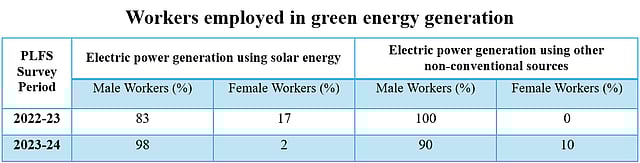
The Periodic Labour Force Survey (PLFS) data published by the Ministry of Statistics and Programme (MoSPI) confirms this too. For the sector ‘electric power generation using solar energy’, the number of workers went up from 16,844 in 2017–18 to 150,000  approximately in 2023–24.

However, for ‘electric power generation using other renewable (non-conventional) sources’, the number of workers fluctuated yearly: from 56,466 workers in 2017–18 to 90,000 in 2020–21 to 5,695 in 2021–22 to 50,680 in 2023–24.

These numbers are puzzling given that dedicated skilling initiatives have been undertaken by MNRE to train workers for installation, operation and maintenance of renewable energy projects.

Two key initiatives are the ‘Suryamitra Skill Development Programme’ and ‘Vayumitra Skill Development Programme’ – with an aim to create a skilled workforce for India’s solar and wind energy sectors respectively, and thereby help achieve India’s aforementioned green energy targets.

According to the programme portals, till date 57,371 Suryamitras and  2,010 Vayumitras have been trained.

These trained personnel would be expected to take up relevant jobs in the solar and wind energy sectors and should therefore be reflected in India’s employment statistics.

But are these workers being adequately captured in the statistics? If not, how can there be better accounting for such workers in the growing green energy sector?

Deep dive into statistics

To answer this question, we need to look at occupational data. Let us first consider solar energy. The ‘Suryamitra Skill Development Programme’ trains workers to fulfill the occupation requirements of a solar panel installation technician. The occupation code for a solar panel installation technician, according to the National Classification of Occupations (NCO 2015) is 7421.1401.

Considering that PLFS provides data on workers at a relatively aggregated NCO-3-digit level, all solar panel installation technicians should be reflected under the broad heading of NCO 742 within the sector ‘electric power generation using solar energy’.

As it turns out, according to PLFS 2022-23 data, there were no workers reported under NCO code 742 and therefore in effect solar panel installation technicians were not covered in the data. In the latest PLFS 2023-24, of the 150,000 workers engaged in generation of solar energy, about 5,600 workers (four per cent) were reported under NCO code 742.

Despite the fact that the Suryamitra programme has been running since 2015, has trained more than 57,000 technicians, and that solar related schemes have been promoted with much fanfare over the last few years, it is confusing to find an absence of installation technicians during 2022-23. And while there are some workers reported sporadically under NCO code 742, for instance in PLFS 2021-22 and 2023-24, there is no way to ascertain if any of these are solar panel installation technicians.

Let us now consider wind energy. The three segments of the ‘Vayumitra Skill Development Programme’ train workers to fulfill the occupation requirements of wind resource assessors and site surveyorsmechanical technician for operation and maintenance (O&M), and electrical and instrumentation technician for O&M.

Their respective occupation codes in NCO 2015 are: 2165.9900 (Cartographers and Surveyors, Other), 3115.0102 (Maintenance Technician- Mechanical), and 3113.0102 (Maintenance Technician- Electrical). The data on these workers should be available in PLFS under the 3-digit NCO codes of 216 and 311.

However, unlike solar electricity generation, there is no dedicated sector accorded to wind electricity generation in India’s National Industrial Classification (NIC 2008).

Rather, wind energy is subsumed with other renewable sources, such as biogas and small hydro power, under ‘electric power generation using other non-conventional sources’. Within this sector, there are no workers reported under the NCO code 216 since 2021-22, and sporadically under NCO code 311– though they are missing in the two latest rounds of PLFS 2022-23 and 2023-24.

Coding woes

Training programmes for the solar and wind sectors have been undertaken by MNRE based on the needs evinced by the stakeholders in the renewable energy industry.

Hence, solar panel installers, wind plant O&M technicians, and wind resource assessors and site surveyors can be regarded to be in demand, and therefore to be employed in such occupations. Their absence in India’s labour statistics is a matter of concern. It also questions any quantitative projections concerning the future number of workers needed in the sector using existing data. What measures can help overcome such data gaps?

Firstly, workers’ occupations are being assigned NCO codes in PLFS at the 3-digit level, while the sector skill councils are assigning NCO codes to occupational qualification packs (as for Suryamitra and Vayumitra) at the 8-digit level. Is it possible that the workers in question are being captured in PLFS under a different NCO, other than the ones expected? The slightest potential for any mismatch calls for an alignment in the attribution of NCO codes to different occupations, between the data producing and skilling agencies, which could help capture the worker data with better accuracy.

Secondly, occupations differ between wind, biogas and small hydro sectors – but there is no way to distinguish since all workers are reflected under a single industrial classification of ‘electric power generation using other non-conventional sources’ in PLFS.

This limits our understanding concerning job creation, and policy measures concerning skill development, in each of these renewable sectors. With MNRE releasing monthly data concerning the progress on installed capacity for wind, small hydro and biogas (along with solar), and the focus on green energy sources in recent years (including green hydrogen), there is a need for dedicated industrial classifications for each of these.

There cannot be concerns about mis-alignment with the international standards set within the International Standard Industrial Classification of All Economic Activities (ISIC 2008), since the disaggregated classification (by sources of electricity) under the broad industrial grouping of ‘Electric power generation, transmission and distribution’  has been performed at the national level.

Lastly, PLFS is a household survey and it is possible that with differences in respondents surveyed in each round, there are corresponding changes in the occupations being reported. Overcoming such issues requires supplementing the existing PLFS with dedicated and appropriate data collation at the sectoral and occupational level.

Isha Dayal is Fellow and Bornali Bhandari is Professor at National Council of Applied Economic Research (NCAER). The authors are grateful to Dr Gurucharan Manna, Senior Advisor at NCAER, for his guidance.

Views expressed are authors’ own and do not necessarily reflect that of Down To Earth.

What happens when global donors shy away from aid

Will aid dependency now lead to debt dependency?

Imagine being the finance minister of a country that has long relied on foreign aid to fund critical public services. You hear the news that your country’s most prominent donors have economic constraints and are shifting priorities. The budget you had meticulously planned, counting on aid inflows to support essential sectors, is now in question. You must quickly address funding shortfalls and reassure citizens of your country’s economic viability.

Some will view this as an opportunity for self-sufficiency; others will point out the dire socioeconomic reality that compels governments to borrow more. The retreat of global aid and programme suspensions comes when debt levels in low-income countries are already high, with fiscal space diminishing further.

The key question is not whether the decline in aid and external assistance will push these economies towards more debt – it already does – but rather what kind of debt they will incur and what long-term implications it will bring.

The link to debt accumulation

Various estimates suggest that donor aid reductions will disproportionately impact the poorest low-income countries, particularly in essential health, education and infrastructure sectors. The Center for Global Development has calculated that potential aid cuts will reduce recipient economies’ fiscal buffers by 2-4% of gross domestic product, forcing them to find alternative funding sources.

Many of the 69 low-income economies eligible for the International Monetary Fund’s concessional financing through the Poverty Reduction and Growth Trust are already burdened by unsustainable debt. As of October 2024, the IMF assessed 11 countries as being in debt distress, 24 at high risk and 25 facing moderate risk of default – a situation that has likely deteriorated further.

Recourse to borrowings and risk-laden financing

Countries with functional domestic debt markets (only a handful) may turn to local borrowing through treasury bonds, bills and central banks. While this can provide short-term relief, it risks crowding out private investment, increasing domestic interest rates and fuelling inflation.

Larger countries with deeper financial sectors may absorb this shift better than smaller economies with limited capital market depth. However, for most of the poorer, low-income nations, domestic borrowing is constrained by underdeveloped banking systems and a narrow investor base, making it an insufficient solution.

For countries with limited access to international capital markets, sovereign bond issuance – or other offshore financing – is an attractive alternative. Countries that previously relied on international bond issuances have since defaulted, rendering the issuance of Eurobonds at sustainable rates challenging without substantial risk premiums. Moreover, issuance of this kind of funding is complex due to market volatility, global interest rates, concerns over creditworthiness surrounding some categories of lenders.

Bilateral borrowing from non-traditional creditors has emerged as another option. Once a dominant lender to African economies, China has become more selective due to concerns over debt vulnerabilities and calls for greater transparency. In contrast, Gulf states and Asian lenders have shifted their focus towards commercially driven investments rather than concessional loans. The result is a financing landscape where bilateral lending is increasingly tied to infrastructure projects or resource-backed agreements. Historically, countries that seek to use commodity-backed lending structures may continue along this path, but such strategies expose them to significant volatility in global commodity prices.

Alternative financing

A likely outcome could be seeking the South-South payment platforms in INR, CNY or Brics currency swap agreements. Several PRGT-eligible countries have engaged in local currency trade mechanisms with China and India to facilitate the import and export of essential goods and energy. As of 2025, India has authorised 156 Special Rupee Vostro Accounts with banks from 30 countries – most from the global South. China has expanded renminbi use for international trade settlements, with 31 offshore clearing banks globally.

Digital money presents an untested avenue for mitigating short-term funding and liquidity challenges. Digital credit platforms provide small, short-term loans to individuals and businesses without requiring a formal credit history, while stablecoins maintain value for transactions and cross-border remittances.

Nigeria’s e-Naira and Ghana’s e-Cedi are early examples of digital money easing liquidity pressures without using expensive external borrowing. While these mechanisms will not replace traditional aid flows, they offer innovative ways to navigate financial uncertainty.

Some have suggested that philanthropies and charities could play a role in addressing some of the financing gaps. However, this channel is very different and cannot be viewed as a substitute for the scale of required financing for fiscal and financial sustainability.

Structural shifts in fiscal, financial and debt policies are vital

While the instinct might be to borrow or leverage more, this moment should spark a broader rethinking of fiscal and financial governance at the country level and the aid architecture at the international level.

Governments must strengthen debt and asset-liability management frameworks as many low-income economies borrow reactively rather than strategically. Some possess state-owned assets that, if properly managed, could contribute to the financing flows. An ALM approach could help unlock their potential, leading to better asset management strategies, stronger institutions and debt management strategies that align borrowing with macroeconomic stability.

To add, a significant share of debt obligations remains unclear. Strengthening reporting requirements and public accountability will enhance market and stakeholder confidence and reduce financing volatility and extreme dependence on donor aid.

Many poorer low-income countries also lack the legal mechanisms, human skills and capacity to adequately manage new funding agreements. Multilateral institutions can step in to provide quick, systematic help to build capacity and processes. Establishing accountability rules and requiring a parliamentary or independent review of how a country and its socioeconomic needs are financed can help prevent the accumulation of unsustainable liabilities that burden future generations.

A seismic shift for the most financially vulnerable countries

With traditional aid flows becoming increasingly conditional, the most debt-stressed low-income countries are facing an accelerated shift towards reliance on borrowing. Domestic debt issuance, international bond markets and bilateral loans have become default financing mechanisms, yet each introduces risks that could further destabilise macro-financial conditions.

Policy-makers cannot afford to rely on short-term financing fixes or the uncertain prospect of donor policy reversals. They must implement deeper structural reforms to ensure that today’s funding crisis does not create an irreversible debt spiral. Strengthening debt management, transparency and instituting legal safeguards are critical steps that can improve fiscal resilience. While none of these measures will generate immediate funding, they are necessary to prevent future crises and ensure that today’s budgetary decisions do not become tomorrow’s burdens.

These reforms are essential to breaking the cycle of reactive crisis management. The policy choices today will determine whether the most financially vulnerable economies navigate this transition towards greater resilience or fall deeper into a self-reinforcing debt spiral with long-term consequences for growth and stability.

Udaibir Das is a visiting professor at the National Council of Applied Economic Research, senior non-resident adviser at the Bank of England, senior adviser of the International Forum for Sovereign Wealth Funds, and distinguished fellow at the Observer Research Foundation America. He was previously at the Bank for International Settlements, the International Monetary Fund, and the Reserve Bank of India.

    Get updates from NCAER