Had Joe Biden withdrawn from the US presidential race earlier, there might have been a good chance that his successor would maintain many of his economic-policy initiatives. Now we will see how many of those policies – if any at all – survive another four years of Donald Trump.
The New York Times famously prepares obituaries for notable individuals well in advance of their death. Now that President Joe Biden’s administration is about to expire, an elegy is in order for its economic achievements, failures, and missed opportunities.
The administration’s achievements are self-evident, at least to the clear-eyed analyst – if not, as it appears, to the average voter. In Biden’s four years, the US outperformed virtually every other advanced economy in terms of output, employment, and productivity growth. Despite inheriting an unemployment rate of 6.3% in January 2021 and an elevated level of pandemic-related uncertainty, the administration drove unemployment down to just 4% in its first 12 months, where it essentially remained throughout Biden’s term.
Job growth among Black workers was especially impressive. Unemployment among African-Americans fell below 6%, down sharply from an average of 10% in the first two decades of the twenty-first century.
Admittedly, Biden’s inheritance also included a pandemic-stricken economy, creating ample scope for output and employment to bounce back. But the aftermath of the global financial crisis and recession of 2007-10 showed that the mere presence of economic slack is no guarantee of a macroeconomic bounce-back and sustained recovery. Biden administration officials took this lesson to heart. By boosting demand, the massive macroeconomic stimulus applied through the American Rescue Plan, the Infrastructure Investment and Jobs Act, the Inflation Reduction Act (IRA), and the CHIPS and Science Act made all the difference.
With the benefit of hindsight, it will now be popular to argue that these measures made too much of a difference. They delivered a burst of inflation, which was a major factor in the electoral defeat of Biden’s anointed successor, Vice President Kamala Harris. Although the Fed succeeded in bringing this post-pandemic inflation under control relatively quickly, the rise in prices at the pump and the supermarket created angst among consumers and provided an effective talking point for Donald Trump.
If pandemic-era deficit spending had been curtailed more quickly, inflation would have been lower, but the recovery of output and employment would have been slower. It is not clear on balance that sentiment among consumers and workers would have improved or that the Democrats’ electoral prospects would have been any better.
Another cost of the Biden stimulus was the increase in federal government debt. But it is important not to exaggerate the severity of the problem. Debt in the hands of the public as a share of GDP rose from 94% in 2021 to 100% of GDP in 2024. Some will view this increase as modest, others will be alarmed. Either way, it does not signal an imminent debt crisis. Conventional economic models suggest that a debt increase of this magnitude will raise the real (inflation-adjusted) interest rate by at most a quarter of a percentage point – hardly Armageddon for debt-servicing costs.
It is, of course, regrettable that neither the Democrats nor the Republicans have an appetite for meeting the problem of chronic deficits head-on. And Trump’s promise of massive tax cuts implies even larger deficits and higher debt. But the United States still has some years to run before this problem becomes acute. US Treasury securities are still regarded as safe assets. There may come a point in the not-too-distant future when securities currently regarded as safe are re-rated as unsafe. But financial markets are not going to force the issue in 2025.
Then there are Biden’s industrial policies. The US Department of Commerce is on track to allocate $53 billion by the end of 2024 to proposed CHIPS private-sector investments spanning 23 projects. Taking advantage of other incentives, companies have committed to nearly $400 billion in new US semiconductor investments. The outgoing administration anticipates 115,000 new construction and manufacturing jobs as a result of these investments.
Yet whether troubled companies like Intel can compete with powerhouses like the Taiwan Semiconductor Manufacturing Company (TSMC) and Samsung, even with help of these subsidies, is unclear. Foreign semiconductor firms seeking to set up in the US complain about high construction costs and inadequately trained and poorly disciplined workers. Moreover, the federal bureaucracy has a very mixed record of picking winners. Can you say “Solyndra,” the failed solar-panel company supported by Barack Obama’s administration? (In fairness, the Obama administration also backed Elon Musk’s Tesla early on, though Tesla’s market share in the US declining.)
In fact, boosting productivity and creating good jobs were not the fundamental motives for the CHIPS Act. The central motive was geopolitical: to reduce US dependence on China – and on Taiwan, over which China looms – for high-tech inputs, and more generally to ensure that the US is self-sufficient in the development and manufacture of essential high-tech products. If the CHIPS Act’s subsidies don’t produce the desired result, then more subsidies will follow. The ultimate objective is not higher productivity and employment, but rather national security, even if achieving it comes at a significant economic cost.
On the environment, Biden’s record is mixed. He has used executive orders and regulations to protect parkland, strengthen the enforcement of environmental laws, and assist communities suffering from pollution and related harms. Unable to get Congress to agree on the Green New Deal, his administration turned to consumer tax credits for electric vehicles (EVs) and energy-efficient appliances. The IRA also provides funding for investments in clean-energy technologies. But this spending is spread over ten years, and its magnitude pales in comparison with both the clean-energy investments by European governments and the scale of the global problem. Moreover, the consumer subsidies of the IRA are discriminatory. They are not extended to imported EVs and heat pumps.
This brings us to the administration’s record on trade and protection. Biden did not retain the worst of Trump’s tariffs, but he maintained the tariffs on imports from China, and in 2024 his administration announced tariff hikes on an additional $18 billion of Chinese goods, including EVs, solar cells, batteries, steel, aluminum, and face masks. More than promoting national self-sufficiency, these measures sought to advance the specific objective of decoupling from China, reflecting the administration’s view of the People’s Republic as an economic and geopolitical rival.
Meanwhile, Biden did nothing to advance reform of the World Trade Organization. He continued to obstruct the appointment of judges to the WTO’s Appellate Body, no doubt because those judges would have had the IRA’s discriminatory subsidies squarely in their sights. For those who believe that globalization needs all the help it can get, this record was disappointing. It was not the worst record on trade of any recent administration, but neither was it the best.
A final economic policy issue is immigration, where Biden swung from liberal to restrictive, in line with the prevailing political mood. His policies ended up pleasing neither advocates nor opponents of immigration. Biden clamped down on illegal border crossings while opening legal pathways for immigrants from distressed countries like Haiti and Ukraine. But the legal status of many immigrants remains uncertain, limiting their incentive to invest in education and take other steps to contribute to the economy.
One can dispute who is responsible for this failure to reform the immigration system: an administration that swung from one position to the other, or a Republican Congress that saw chaos at the border as working to its political advantage. (Personally, I opt for the latter.) But there is no disputing that the result was a signal failure.
Such is Biden’s economic legacy. His political legacy can be summarized more briefly: he leaves behind a hot mess. Had he withdrawn from the presidential race earlier, there might have been a good chance that his successor would maintain many of his economic-policy initiatives. Now we will see how many of those policies – if any at all – survive four years of Trump and J.D. Vance.
Barry Eichengreen, Professor of Economics and Political Science at the University of California, Berkeley, is a former senior policy adviser at the International Monetary Fund. He is the author of many books, including In Defense of Public Debt (Oxford University Press, 2021).


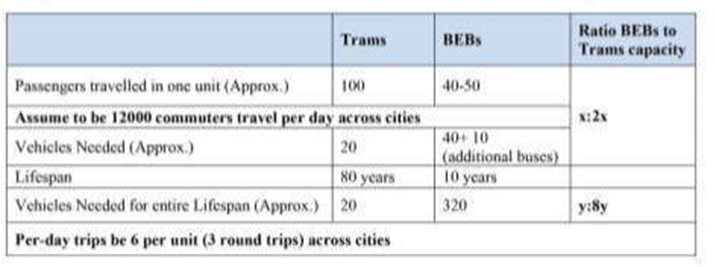
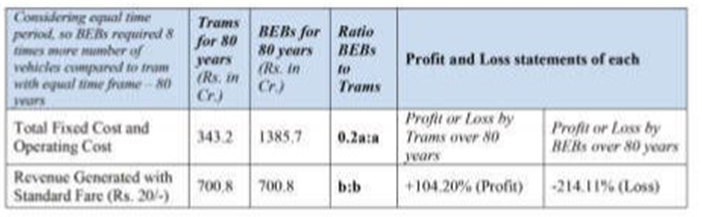 Now, think about revenue. At aRs20 fare, BEBs generate nearly a loss of 214.11 per cent which is almost double the percentage relative to the tram’s profit margin over 80 years. Also, no matter over 80 years, even in its single life span it runs at a loss of Rs. 51crore, which is a reason to rethink our decisions.