Among the many achievements of G20 under India’s leadership in 2023 was their specific commitment to promote women-led development. This commitment went beyond the general catchall of advancing “women’s economic empowerment”.
It signalled an increasing recognition by world’s top leaders that promoting full, equal, effective, and meaningful participation of women in the economy as decision-makers benefits society multidimensionally.
What are these benefits? Where’s the evidence? What is India’s record in promoting more women to the top? What are the hindrances, and what more can be done?
Women in leadership posts | Countries that have embraced gender diversity in decision making have witnessed better economic and financial performance of their economies and companies.
Women leaders in politics also enhance social development. Those in the corporate sector contribute to inclusive workplace policies, fostering a culture of fairness and equity.
In our research paper, co-authors Benedict Clements, Huy Nguyen, and I find that in a sample of about 120 countries, higher share of women in parliaments and cabinet positions raises govt health spend, both as share of GDP and as a share of total spend.
Greater representation of women in policymaking has positive effects on social outcomes, such as infant mortality rates, access to basic water services, and upper secondary school enrolment rates.
Studies conducted by Esther Duflo (Nobel laureate in 2019) and her co-authors during 2004-09 find that female political leadership in Indian villages has several societal benefits. It positively influences adolescent girls’ career aspirations and educational attainment. Female leaders invest more in infra. Exposure to women leaders improves perceptions about their effectiveness and weakens stereotypes about gender roles, while women are also more likely to stand for, and win, elected positions.
The corporate sector, too, benefits. An IMF global study reported that a higher share of women on commercial bank boards and supervisory positions goes hand-in-hand with lower non-performing loans and greater financial stability. A cross-country study of fintech firms also finds that gender diversity on executive boards improves firm’s performance in terms of funding obtained and revenues earned.
In a recent paper on India, my co-authors and I find that having at least one woman on the board in NSE-listed firms is associated with higher profitability and lower debt-equity ratio. When such firms hire women in top management positions as well, employee ratings and sentiment scores are also higher.
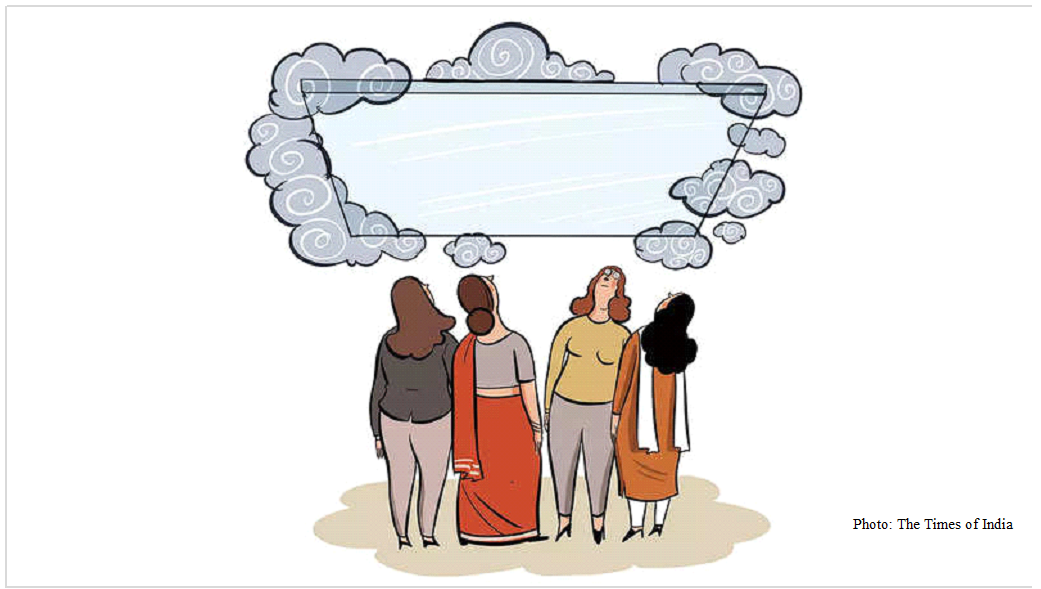
Why are women in India not breaking the glass ceiling? | India still has a long way to go in achieving gender parity in policymaking. As of 2024, women held 14% of Lok Sabha seats and 15% in Rajya Sabha, and occupied less than 7% of ministerial positions. This places India far behind the emerging market and developing economies’ average of 23% for parliamentary positions and 20% for ministerial positions.
However, India’s grassroots political representation presents a more encouraging picture. Reservation for women in panchayati raj institutions (PRIs) ranging from 33% to 50% has led to 1.4mn elected women representatives, enhancing gender balance in policymaking at the local level.
Companies Act (2013) played a pivotal role in increasing representation of women on boards in the corporate sector. Between April 2014 and April 2015, the share of women rose from about 5% to nearly 10%. As of April 2023, women held nearly 16% of board positions and 22% of top management positions, according to PRIME Database. This progress, while commendable, still falls short of global averages.
Challenges women face in rising to the top | Several factors contribute to the underrepresentation of women in Indian politics. They face higher levels of harassment, threats, and violence, and patriarchal norms and societal stereotypes remain deeply entrenched. Even when women are elected to political office, decisions are often influenced or controlled by male family members, undermining their autonomy. Financial barriers exacerbate the problem. Women candidates often struggle to secure the funding needed for political campaigns.
What constrains women from rising to the top in corporate sector? While women’s education levels are pretty much at par with men in India, female labour force participation, according to the latest PLFS survey, at nearly 42% is substantially lower than those of men at about 79%. A major factor preventing women from joining the labour force is the disproportionate burden they carry at home of unpaid household duties besides child and elderly care responsibilities. If women don’t join the workforce or many drop out after children are born, the pipeline of senior women shrinks substantially.
A path forward | Govt policies, corporate initiatives, and societal change must work in tandem to dismantle barriers for women.
To increase female labour force participation and prevent women from exiting the labour force, govt regulation and corporate policy should formalise part-time employment, as is common in advanced economies. This means that part-time employment is at par with full-time employment in terms of job security, medical coverage, and other benefits. School and college curricula should incorporate leadership training programmes.
The corporate sector could also set targets for women in C-suite positions, introduce mentorship programmes, and gender bias training. Finally, more equitable burden sharing of unpaid care between men and women and ensuring the safety of women through effective implementation of legal protections against violence and anti-harassment policies should take centre stage.
Creating professional linkages between successful elected women leaders and sharing of peer experiences at the village level can be a step towards addressing the control by male family members. Parliament passed the women’s bill for 33% reservation of seats in Lok Sabha and state assemblies. Its implementation is put off till after delimitation, which will happen only after Census is held. It is never too soon for gender parity in legislatures.
The writer is Professor, NCAER. Views are personal.