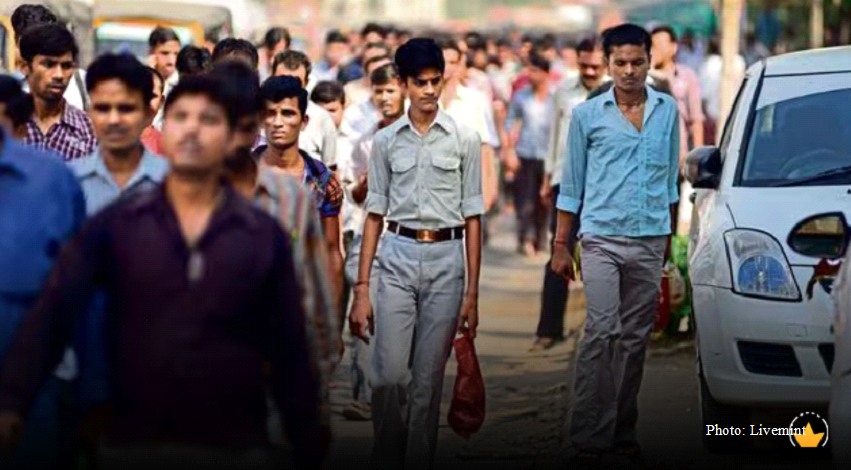
Data shows that young Indians spend an extraordinarily long time waiting for the right job opportunity to show up. The rise of AI will probably elongate the wait. This is a worry. Who’ll support them till they find suitable employment?
India’s unemployment debate is missing a crucial dimension: time. Time spent waiting is a loss at any age, but especially so in one’s youth. For both the individual and the country, it is a loss of prime productive years.
Last year, 11.6 million Indians in their 20s were unemployed and about 6.8 million of them had been job hunting for over a year. The long wait may not necessarily reflect a shortage of jobs, but a mismatch between the jobs on offer and what young Indians aspire to.
These numbers understate the full picture: another 78 million in the same age group were not looking for work at all as per our estimates based on the Periodic Labour Survey data for 2025.
In Rajasthan, Assam, Jharkhand, Odisha and West Bengal, two-thirds or more of unemployed young adults in their 20s were looking for work for over a year. In Bihar, Punjab, Uttar Pradesh, Andhra Pradesh and Telangana, more than half of unemployed young adults were in the same category.
In Maharashtra, Tamil Nadu and Gujarat—states with diversified manufacturing and services economies—unemployment durations under and over a year split roughly evenly. Kerala shows a similar pattern, though possibly for different reasons: many young people may have already migrated to other states and abroad.
In terms of the overall unemployment rate, about 10% of young Indian adults in their 20s were unemployed last year. This does not include around 40% who were not even looking for a job.
Unexpectedly, states like Uttar Pradesh, Bihar and West Bengal have lower-than average unemployment rates among people in their 20s. However, this does not necessarily reflect labour market success. Poverty forces people to take up whatever work is available.
The states with the highest young adult unemployment are not the poorer northern states, as one might expect. They include Tamil Nadu, Telangana, Andhra Pradesh, Punjab and, unsurprisingly, Kerala, all with 13-18% of young adults unemployed. Also, some prosperous states such as Gujarat, Maharashtra and Karnataka have lower young adult unemployment rates, with Gujarat recording the lowest at 2%.
In states where a higher proportion of young women are looking for work, the labour market fails them most visibly. For example, in Kerala, 41.5% of young women are in the labour force, and about 30% of them were unemployed last year, compared with just over 12% for men, among whom labour force participation is higher.
Other southern states such as Tamil Nadu, Andhra Pradesh and Telangana show double-digit gender gaps in unemployment rates. In Bihar, Haryana and Uttar Pradesh, where female economic participation is lower (less than 25%), the gender gap in unemployment is narrow, only because so few women are seeking work.
The most concerning fact, set to get worse with the advent of AI, is that as education levels rise, so does the unemployment rate. The wait is set to get longer as well. This is also the main reason for higher rates of joblessness seen among young adults in some of India’s relatively prosperous states.
Among the young adults who are not currently in education, graduates account for one fourth. However, they account for two-thirds of the unemployed. The graduate unemployment rate is 23.6%, more than twice the overall rate of about 10% in this age bracket and five times the secondary-educated joblessness rate of 4.3%. Among those with engineering degrees, the largest group among highly educated young adults, 25% were unemployed in 2025.
In an AI world, what kinds of jobs will be created and what skills should young people acquire?
In an article in 2023 in Mint, one of the authors of this article wrote, “The ability to code is a top-rated skill today. It will soon be replaced by skills that are more challenging to acquire… Resourcefulness, integrative thinking and articulation are likely to become far more valuable and necessary than basic coding and programming.” This remains true. The same will hold for skills such as marketing, sales and negotiation, areas where judgement and persuasion matter more than the process.
Young people will need to acquire more than a degree. Building genuine expertise in a core discipline—pure sciences, mathematics or psychology—demands skills of understanding that a degree does not provide. Employers today have little patience for the gap between the two. They may well hire experienced people in these fields.
The structure of most Indian schools and colleges lets students choose only narrow streams, leaving combinations such as mathematics with psychology or marketing largely out of reach. What the evolving labour market will ask for, however, is precisely the kind of integrative thinking that rigid disciplinary boundaries work against.
The employment outlook is sobering. The availability of decent-paying jobs, entry-level coding and similar work is shrinking, which will push down wages. Young women will likely be hit hardest. In households where someone must give up the job search, it is rarely the man. If the financial return does not justify the effort and time, women will be the first to stop looking for a job.
Returning to where we began: the length of the job search, already long, is set to grow longer and not only for women. As the wait extends, perseverance and patience will become essential virtues. The big question is whether families, society and policy can support young people through it.
The authors are, respectively, Union Bank Chair professor of economics, Great Lakes Institute of Management, and associate fellow, National Council for Applied Economic Research. Views are personal