26 September, 2025
Published in: The Hindu Business Line


Published in: The Hindu Business Line
A structured care-giving industry can not only meet a vital social need but also generate large-scale employment, spur health-tech innovation, and create new public-private models of welfare.
India is often described as a young country, but the truth is that it is also ageing faster. As per a report by NITI Aayog, the elderly in India currently comprises a little over 10 per cent of the population, translating to about 104 million, and is projected to reach 19.5 per cent of the total population by 2050. This demographic shift brings with it profound challenges for healthcare, social support, and above all, care-giving.
For generations, India’s joint family system ensured that elders were cared for at home and surrounded by family members. But as urbanisation and migration break down this traditional structure, millions of elderly Indians now face the prospect of living their final years without adequate support. Unlike developed countries that have built robust systems of long-term care, India remains woefully unprepared for the sheer scale of its ageing population.
The silent emergency
The need for professional care-giving is not just a social observation; it’s a statistical reality. The National Sample Survey Office (NSSO) data from the health rounds for 2004 and 2017-18 reveals a compelling link between age and physical immobility, a key indicator of the need for assistance. While only 4.93 per cent of those aged 60-70 were immobile in2017-18, the figure soared to more than 56.57 per cent for those above 90years. Even among the 81-90 age group, more than a quarter faced mobility challenges
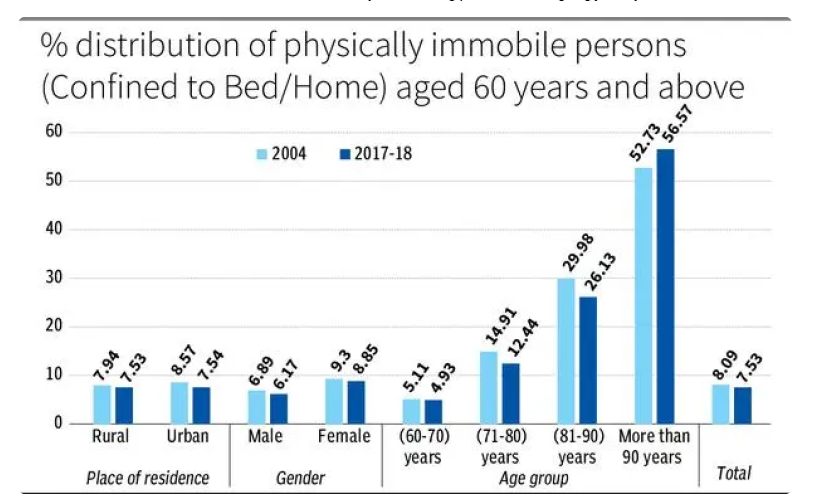
Women are disproportionately affected. Around 8.85 per cent of elderly women are physically immobile, compared to just over 6.17 per cent of men. With women living longer on average, they form the largest demo-graphic in need of long-term support. These statistics signal a silent but urgent crisis. While the overall percentage of immobility has marginally declined over the two time periods between 2004 and 2017-18, the absolute number of elderly Indians is growing rapidly. In other words, mil-lions more people will need assistance with daily living, medical sup-port, and companionship in the years ahead.
Breaking away from tradition
Traditionally, care-giving was an unquestioned ‘sacred duty’ of the family — it is a family-centric care model. Parents cared for their children, who in turn were expected to look after their parents in old age. But this cultural equation no longer holds true and is under immense pressure in modern India. Migration has scattered families across cities and even continents leading to a unique evolution of the ‘nuclear family structure’. Dual-income households with time-pressed and work-stressed of-ten failed to provide the kind of constant support to immobile elders. The result is a gaping “care gap,” where elders find themselves without reliable assistance for their basic needs.
In this vacuum, the care-giving market is slowly emerging. Currently, itis a patchwork of domestic workers, a few home healthcare agencies, and some assisted living facilities concentrated mostly in metropolitan and urban areas. But demand far outstrips supply, and affordability re-mains a major hurdle.
Nascent industry
India’s elder care industry remains in its infancy, but its potential is enormous. It can expand into diverse services from basic home assistance to specialised care for chronic conditions like dementia and Parkinson’s. The integration of technology, such as tele-health and wearable health monitors, can further enhance the quality and reach of these services. The need for professionalised services could give rise to an entire scalable “silver economy.”
Most elderly Indians prefer to age in their own homes. This makes home-based services like nursing, physiotherapy, personal attendants, and remote health monitoring a critical growth area. Technology such as tele-health consultations, fall-detection sensors, and medication re-minders can extend the reach and quality of such care.
Although culturally resisted, senior living communities are gaining traction in urban India. Independent apartments with emergency sup-port, assisted living facilities with 24/7 caregivers, and memory care units for dementia patients are slowly emerging as viable options for wealthier families. Tiered-pricing could make these more accessible in semi-urban and smaller cities.
Training and employment
India faces a shortage of trained caregivers. Formal certification pro-grammes could both raise quality standards and create millions of jobs, especially for women in rural and semi-urban areas. Care-giving for the elderly could become a respected, professional career path rather than informal labour.
End-of-life care and dementia care are woefully neglected in India. Culturally, conversations around death and cognitive decline still re-mains a taboo. Yet the need is undeniable. Establishing hospices, memory care centres, and home-based palliative services will be essential for dignified ageing.
Many families still view professional care-giving as abandonment, preferring to somehow “manage” at home even when overwhelmed. Overcoming this stigma will require public awareness campaigns that frame professional care as an extension, not a replacement, of family love. Cost is another major barrier. Without insurance or government subsidies, professional care remains unaffordable for most. Expanding schemes like Ayushman Bharat to include elder care, or creating a long-term care insurance model, could transform affordability. Finally, there is the lack of a regulatory framework. Without standards for training, wages, and service delivery, quality varies dramatically. Regulation could ensure dignity and safety for both caregivers and care receivers.
India’s ageing is not a looming crisis — it is already here. As data sug-gest, more than half of our nonagenarians are immobile, and millions of seniors in their 70s and 80s struggle daily with limited mobility and in-adequate support. But if approached with vision, this challenge can be turned into an opportunity. A structured care-giving industry can not only meet a vital social need but also generate large-scale employment, spur health-tech innovation, and create new public-private models of welfare. Perhaps one day we may see tech-firms entering this space to offer a range of care services for the elderly.
A call for urgency
The measure of a society is how it treats its most vulnerable. India today stands at a crossroads. One path is denial and delay, which will turn our demographic shift into a humanitarian crisis. The other is urgency and foresight, which can transform elder care into a new frontier of social progress. Caring for our elderly is not charity. It is an obligation —moral, social, and economic.
Baruah is Fellow at National Council of Applied Economic Research(NCAER), New Delhi, and Wankhar is a retired Government of India officer. Views are personal.