12 November, 2025
Published in: The Hindu Business Line



Published in: The Hindu Business Line
The current care-giving model is overwhelmingly informal and family-based, with little to no state or institutional support.
In the quiet routines of everyday Indian households, an invisible yet indispensable workforce is at play, one that fuels the nation’s social fabric through everyday acts of care. Whether it is a grandmother helping with child-care, a father tending to an ageing parent, a mother attending to a toddler or the elderly, the care economy in India is thriving, albeit unrecognised and unremunerated. Data from the NSSO’s Time Use Survey-2024 reveals an economy hidden in plain sight, an immense engine of social welfare.
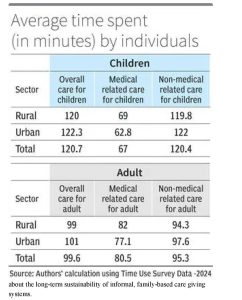
On average, an individual dedicates an average of over two hours (120.7 minutes) daily of caring activities for children and the bulk of this is directed towards routine activities such as bathing, minding the children, feeding them, and helping with school-work. An average of 1 hour 40 minutes is dedicated for caring adults which includes assisting the elderly with daily life, providing emotional support, passive care or assisting adults with medical care which can include feeding, cleaning and other physical care.
Urban vs rural divide
Urban dwellers spent marginally more total time on care-giving work for both children and adults compared to their rural counterparts. On average, urban residents spent 122.3 minutes on child care and 101.0 minutes on adult care, while rural residents spent 120.0 minutes and 99.0 minutes, respectively. A more significant difference emerges when looking at the type of care. Rural residents spent significantly more time on medical related care for both children and adults.
This is likely driven by limited and inadequate access to sufficient healthcare facilities and other critical professional services, forcing families to personally manage such medical care needs. Conversely, rural households, which are more likely to be extended families, can better share non-medical related care duties. In contrast, urban families are typically nuclear, meaning fewer members are available to divide responsibilities, which often increases the overall care burden per person despite having greater access to professional care services.
The aged as care providers
Contrary to common perceptions that the elderly are primarily care recipients, data reveals that senior citizens in India are active contributors to care activities. Those aged over 65 spent an average of 108.3 minutes per day on caring for children, and 117.6 minutes on adult care which is more than that by many younger age groups, say those in the age group of 36-45 or the 56-65 age groups. Even those in the age groups of 56-65 years spent more time on care work than those in the lower age groups.
 This suggests that a substantial portion of family care is an intergenerational and intra-generational duty, with older persons often caring for their elderly spouses, siblings, or even great-grandchildren. This is a quiet crisis as those who need care often end up as care-givers, putting immense physical and emotional strain on a vulnerable demographic. The increasing dependence on older family members has also risen due to shifting family structures and the rise of nuclear households. Their contribution highlights the dual vulnerability of the elderly. As both caregivers and potential care-receivers, the elderly pose critical questions.
A shifting balance
In a revealing comparison of care-giving patterns across genders, data shows marked differences in the time men and women spend on caregiving activities. While both men and women participate actively in care work, the divide in certain areas reflects traditional gender roles that continue to shape responsibilities within households.
On average, women spend 141 minutes daily on child care, nearly double the 80.4 minutes reported by men. This gap is most evident among younger women (15-35 years), who handle much of the non-medical child care like feeding and playing. However, men spend more time on medical care for children (88.8 minutes against 62 for women), suggesting a more focused involvement in occasional health-related tasks.
In contrast, men spend more time caring for adults at an average of 105.3 minutes daily compared to women at 96.9 minutes. This is especially true for non-medical adult care, where men report higher involvement across most age groups, particularly those who are in the higher age groups.
Thus, data suggest the evolution of a unique care-giving roles by each of the genders. While the core responsibility for daily, non-medical childcare remains largely with women, data suggest that care-giving roles are becoming increasingly complex. Men are taking on equal or greater responsibility in critical areas like adult care and medical child care, challenging the monolithic view of gender roles in the home.
A sector hiding in plain sight
With India’s demographic transition of a rising life expectancy and growing nuclear families, the demand for structured care-giving services is set to surge. This presents both a challenge and an opportunity. The current care-giving model is overwhelmingly informal and family-based, with little to no state or institutional support. Hence, there is immense scope to formalise care-giving through professional services, trained home helpers and community support programmes. Transitioning even a fraction of these care activities into paid services could unlock umpteen opportunities for the care economy. It would create employment, especially for women while ensuring that care is delivered with dignity, professionalism, and consistency.
The future prospects
Care-giving activities is the invisible engine of Indian households, overwhelmingly provided by women and largely absent from economic calculations. Recognising, redistributing, and reducing this massive burden through better policy, investment, and public awareness is not just a matter of fairness, it is essential for India’s socio-economic progress. As we stand on the cusp of demographic, social, and economic shifts, it is time that we begin to value the time spent on care and the people who provide it. The sheer volume of care-giving hours, a slow but rising ageing population, and the decline of the joint family model create a powerful economic imperative for a formal care-giving sector. India’s elderly population is projected to soar, meaning the current family-based care system is simply unsustainable.
As more educated women enter the paid workforce and the “sandwich generation” (caring for both children and elderly parents) faces severe time-poverty, the willingness to pay for professional services right from nannies and daycares to specialised elder and palliative care will gradually rise.
By taking decisive actions like investing in training, guaranteeing fair wages, and establishing strong regulatory oversight, India can successfully formalise its care economy. This move will achieve a dual purpose, it will honour and value the historic contribution by such caregivers, and it will ensure a rapidly ageing India can meet its care needs with dignity, professionalism, and an enormous new wave of economic opportunity.
Baruah is Fellow at National Council of Applied Economic Research (NCAER), New Delhi, and Wankhar is a retired Government of India officer. Views are personal.