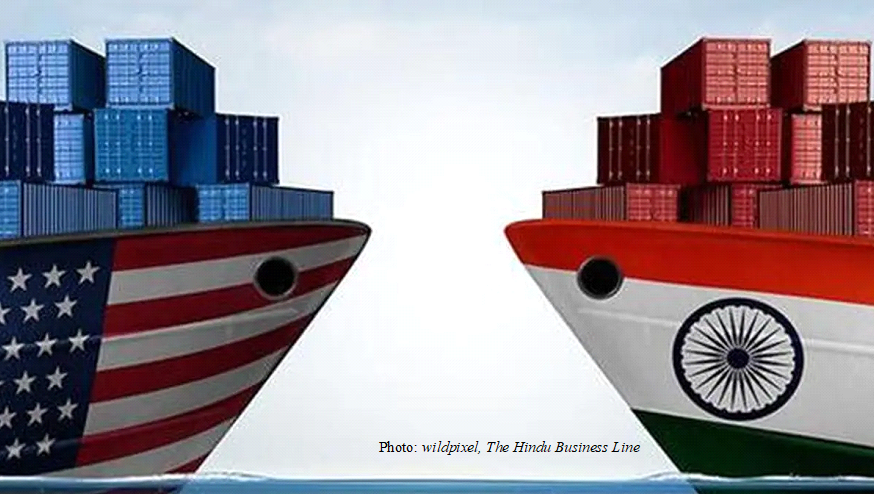
An NCAER survey shows that Indian firms seemed to have weathered the US tariff storm, for now
Amidst the international uncertainty caused by rapid announcements of US trade policies balanced by rationalisation of GST rates, business sentiments as measured by the NCAER Business Confidence Index (BCI) had eased in the second quarter of 2025-26. The most punitive of the policies was the additional tariffs imposed by the Trump Administration. Although their scarring effect may mitigate over time if India-US are able to come to a trade agreement.
Meanwhile, India’s exports to the US came down by 20.4 per cent between August and September 2025 on a month-on-month (m-o-m) basis (Ministry of Commerce). They came down by 11.9 per cent compared to September 2024 on a year-on-year basis. However, overall India’s exports went up by 6.8 per cent on a y-o-y basis and by 4.2 per cent on a m-0-m basis. The fall in India’s exports to the US did not dent overall Indian exports. So, what did India do right? Indian exporters diverted their exports to other countries.
NCAER survey
Does that mean that sentiments were shaken? Well, appears they were just ‘stirred’. The NCAER’s Business Expectations Survey (BES) for the quarter ending September threw up some interesting data. It was carried out days after the imposition of the additional tariffs by the US and almost coinciding with the GST reform and covered 484 firms across all four regions of the country. Business sentiments are assessed by firms’ perceptions on four key components in the NCAER BES: ‘overall economic conditions to improve in next six months’; ‘financial position of the firms will improve in next six months’; ‘present investment climate is positive’; and ‘present capacity utilisation was close to or above optimal level’.
Among the 484 firms surveyed, 43 per cent of firms were exporting to foreign markets, and only 17 per cent directly exported to the US. The sample was divided into three groups – firms that exported to the US along with other countries; firms that exported to non-US countries; and firms that did not export. The data threw up interesting insights about business sentiments.
Majority of firms see no impact
A large majority of firms, 80 per cent, reported no impact of US tariffs on their business, as did 55 per cent of exporting firms, and 99 per cent of non-exporting firms. However, among the 17 per cent of firms directly exporting to the US, 82 per cent reported a negative impact of tariffs on their business.
In alignment, business sentiments were the most elevated, on all four aforementioned components of BCI, among the firms that exported to non-US countries. On the contrary, sentiments were the most subdued among the firms that exported to the US.
Only 39.8 per cent of firms exporting to the US perceived that the ‘present investment climate’ is positive compared to 65.8 per cent of firms exporting to non-US countries and 55 per cent for all firms. Sixty-one per cent of firms exporting to the US perceived ‘overall economic conditions to improve in the next six months’ compared to overall 67 per cent firms. Fifty-eight per cent of firms exporting to the US perceived that ‘financial position of the firms will improve in next six months’ compared to the overall 63 per cent. Sentiments about ‘present capacity utilisation was close to or above optimal level’ for 97.6 per cent of firms that exported to the US compared to 98.1 per cent for all firms. Further, sentiments did not differ across manufacturing and services firms.
Firms diversify markets
To overcome the impact of US tariffs on their business, the majority of firms exporting to the US planned to diversify their markets, either by exporting existing products to countries other than the US, or by redirecting sale of existing products domestically in India, or reduce profit margins of own goods/services to keep prices low.
The majority of firms, negatively impacted by US tariffs, asked for increase in export subsidies, trade agreements with other countries and enhanced credit availability. On the other hand, the firms called for lowering import duties on inputs/raw materials, GS T rates ( which was already implemented), logistics costs and excise duties on petroleum products.
In the survey outcome, it was not a surprise to find that the impact of Trump’s tariffs was limited to firms exporting to the US. Majority of them also exported to other non-US countries and revealed that their dominant strategy was to divert exports to other countries, besides the domestic market.
More FTAs urged
The resilience of Indian firms and timely action by the Indian government appears to have helped mitigate the fallout from the US tariffs in the short run. However, a long-run approach is also needed, which should address the bleak investment sentiments.
India’s exports increased to the UAE and the UK in September, with whom we have trade agreements. And this is also the request of firms from the government. Concluding more trade agreements, combined with additional domestic reforms, could make Indian firms more competitive in the long run.
Bhandari is a Professor, Dayal and Sahu are Fellows and Urs is an Associate Fellow at NCAER. Views are personal.