The deal creates economic and strategic opportunities, yet its sustainability will depend on how adjustment costs are managed and how quickly firms are enabled to become competitive.
After nearly two decades of intermittent negotiations, India and the European Union have finally moved towards a comprehensive trade agreement that is being billed as both economically significant and strategically consequential. Given the scale of the two markets and the breadth of the proposed commitments, the deal has the potential to reshape India’s engagement with advanced economies. Whether it becomes a genuine win-win, however, depends less on tariff cuts alone and more on how adjustment costs and regulatory frictions are managed.
At its core, the agreement seeks to lower tariffs and reduce non-tariff barriers across a large share of bilateral trade, with liberalisation to be phased in over time. Market access for European automobiles, wines, and industrial machinery is expected to improve, while Indian exports such as textiles, gems and jewellery, chemicals, marine products, and selected services gain preferential entry into the EU. Sensitive sectors, particularly agriculture and dairy, remain largely protected — reflecting political realism on both sides.
The economic asymmetry that the deal seeks to address is clear. The European Union is currently India’s second-largest trading partner, with bilateral trade in goods and services exceeding €120 billion annually. Yet India accounts for less than 3 per cent of the EU’s total external trade, while the EU represents a far larger share of India’s high-value exports and inward foreign direct investment. Average applied tariffs in India on many industrial goods remain several times higher than those faced by Indian exporters in Europe, especially in automobiles, wines, and capital goods. The agreement narrows this imbalance while retaining safeguards for India’s most sensitive domestic sectors.
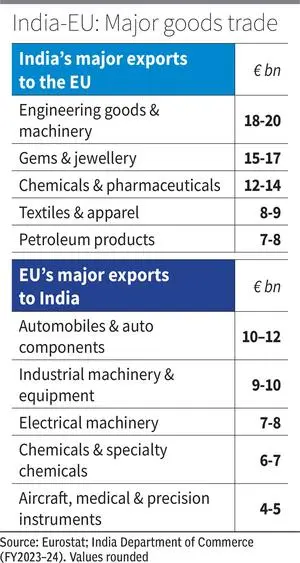
From the EU’s perspective, improved access to a large and fast-growing consumer market is a commercial prize at a time when global trade is becoming more fragmented. Lower tariffs and clearer investment rules reduce costs for European firms and help diversify supply chains away from excessive geographic concentration. For India, the gains are not limited to exports. Deeper integration with the EU can attract higher-quality investment, embed domestic firms into global value chains, and support the shift towards more technology- and skill-intensive manufacturing and services.
Adjustment pressure
However, trade liberalisation is never distribution-neutral. While consumers and competitive exporters stand to gain, adjustment pressures will be felt by firms that have grown under high tariff protection, particularly smaller and less productive enterprises. In sectors such as automobiles and select manufacturing segments, the pace and sequencing of tariff reductions will matter as much as the headline numbers. Without complementary domestic policies — access to finance, skilling, and easier regulatory compliance — trade openness can quickly become politically contentious.
Regulatory standards form the second major fault line. The EU has consistently pushed for strong commitments on sustainability, labour norms, and regulatory alignment. Measures such as the Carbon Border Adjustment Mechanism, though motivated by climate objectives, risk functioning as de facto trade barriers unless India accelerates its transition to cleaner production. The agreement’s emphasis on technical cooperation and climate finance is therefore not peripheral; it will be central to ensuring that compliance costs do not undermine export competitiveness.
Beyond economics, the deal carries strategic weight. As global supply chains are reconfigured amid geopolitical uncertainty, both India and the EU are seeking reliable partners. For Europe, India offers scale, growth, and political alignment in the Indo-Pacific. For India, closer economic ties with the EU strengthen its negotiating position globally and reduce dependence on any single market. In this sense, the agreement is as much about strategic insurance as it is about trade flows.
So, is the India-EU trade deal a win-win? In aggregate terms, yes — but conditionally so. The agreement creates clear economic and strategic opportunities for both sides. Yet its political sustainability will depend on how adjustment costs are managed, how quickly firms are enabled to become competitive, and whether regulatory ambitions are matched with practical support.
Trade agreements open doors; they do not automatically ensure that all firms can walk through them. If India pairs this deal with targeted support for small enterprises, investments in skills and green competitiveness, and continued improvements in logistics and ease of doing business, the gains can be broad-based. If not, the benefits may remain concentrated, even as the politics become more fragile.
The real test of the India-EU trade agreement, therefore, will not lie in the signing ceremony, but in the domestic follow-through that determines whether openness translates into sustained and inclusive growth.
The writer is Senior Fellow at NCAER, New Delhi. Views expressed are personal.

