22 May, 2026
Published in: Ideas for India


Published in: Ideas for India
In the fourth part of our series on India’s new labour reforms, Afridi and Talukder focus on the Occupational Safety, Health and Working Conditions Code, 2020 – in terms of its rationale, the key legislative changes that it entails, state-level implementation, and what the existing theoretical and empirical literature says about potential impacts. They contend that the Code is a structurally coherent reform that lowers the cost of formal hiring, extends protections to categories of workers who had none, and creates administrative data infrastructure for evidence-based enforcement.
Of the four Labour Codes that came into effect on 1 April 2026, the Occupational Safety, Health and Working Conditions (OSHWC) Code, 2020 is perhaps the most structurally ambitious. India’s pre-existing occupational safety framework imposed meaningful safety, health, and welfare obligations on covered establishments, but the more persistent problem was one of fragmented architecture and uneven reach. Thirteen separate Acts governed different worker categories and thresholds, leaving many either outside formal coverage or subject to safety standards that existing inspector regimes rarely enforced in practice. The OSHWC Code thus is less a response to absent standards than to their uneven applications as it subsumes sector-specific legislation covering factories, mines, plantations, docks, construction, beedi and cigar workers, journalists, contract, and migrant workers under a single mandate.
The rationale is compelling in principle: simpler compliance lowers entry costs and increased licensing thresholds draw more firms into the formal economy, broadening the base of regulated employment. The implications, however, are more equivocal.
Key legislative changes under the OSHWC Code
The changes to the employment thresholds are the most consequential features of the OSHWC Code. It does not apply a single uniform threshold but uses different tiers by worker-counts. The factory definition threshold doubles from 10 to 20 workers for premises using power. The contractor licensing threshold rises from 20 to 50 workers, with license validity extended from one to five years.
Several other provisions represent stated advances over the previous regime. The standardisation and digitisation of employment documentation regardless of sector, annual health examinations for all workers above the age of 40, migrant portability, extension of night shifts for women, gender-inclusive facilities, and mandatory safety committees, all connotate procedurally meaningful progressions. The Shram Suvidha Portal now handles registration, returns, and accident reporting. Certificates are auto-generated within seven days if unprocessed. The Inspector-cum-Facilitator replaces the old inspectorate cadre, with cross-designation across all four Labour Codes and a mandate for risk-based rather than complaint-based inspection.
State-level implementation
The figure below shows when states have adopted the new Code, with 16 states notifying their OSHWC rules in 2021 alone, and all states except West Bengal having done so, as of April 2026.
Figure 1. State-wise timing of adoption of rules under the OSHWC Code
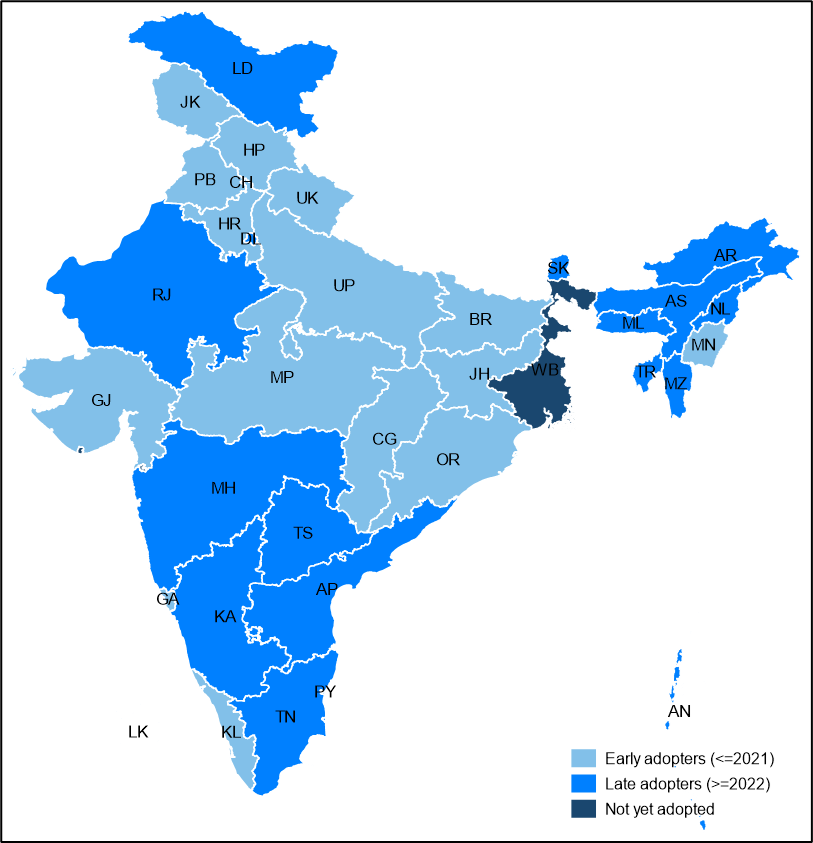
Source: Authors’ compilation based on state government gazette notifications on the OSHWC Rules issued by state labour departments (2020-2025).
Note: The map shows the variation in which states and union territories issued their draft or final rules. Where both draft and final rules were notified, the year of the first notification is reported.
Literature review
Given this premise, we take a cue from the legacy empirical and theoretical literature on labour regulation reforms in India and other economies, and postulate an expected pathway of employment and labour productivity implications. Our hypothesised channels are tabulated below.
Potential impact on employment
Table 1. Theoretical impact of the OSHWC Code on employment
Source: Authors’ compilation.
Theory thereby predicts that changes such as raising thresholds will not eliminate all distortions but rather shift the equilibrium outward. The corresponding empirical literature, drawn from quasi-experimental evaluations of previous legislations and state-level amendments, broadly validates these predictions (Aghion et al. 2008, Hasan and Jandoc 2012, Sapkal 2016). While a net positive effect on total employment is expected, recurring informalisation or increased contractualisation can undo gains in smaller sectors.
Potential impact on labour productivity
Parallelly, Table 2 below merges theory with their purported effect on worker productivity under the new OSHWC regulations.
Source: Authors’ compilation.
These implications are theoretically more unambiguous than the employment effects, but equally contingent on implementation capacity of enforcement, hazard governance, health surveillance and state-specific safety metrics to cover what the Central Code does not. The empirical evidence particularly on the safety-productivity trade-off also promises one of the strongest impacts of the Code on worker productivity, as long as we take into account safety improvement costs by the principle employer, inspection targeting and frequency, and penalty credibility for deterrents (Bossavie, Cho and Heath 2023).
Summary of potential impacts
Firm size thresholds and compliance costs: The OSHWC Code’s new obligations make formalisation easier and more expensive for the employer at the same time. For micro and small establishments, these may outweigh the productivity and profitability gains from formalisation, at least in the short run. The net employment effect, therefore, may depend critically on firm size, sector, and enforcement, none of which are uniform across India’s states.
Safety, health and labour productivity: Our deductions from the literature show how safer workplaces coupled with managerial effort can reduce injury-induced losses, lower absenteeism, and raise worker confidence. However, in India, weak judicial machinery can mean that gains are not automatic but depend on whether rules are actually followed. Mandatory health examinations can enable earlier detection of occupational disease that currently suppresses productivity invisibly. Hazard disclosure requirements can correct information asymmetry between employers and workers. The period of implementation will be the key.
Implementation and the State: Take for example, the extension of night work permissions for women, after 7 pm and before 6 am with consent, allowing women access to sectors previously unavailable to them. The Code imposes no corresponding obligation on employers to provide safe transport, shifting risk onto the worker while characterising that shift as expanded opportunity. Whether this translates into a labour supply gain or remains unrealised will depend on how state governments notify safety protocols that make the provision meaningful rather than notional.
Such implementation-dependent reforms create risk as well as opportunity. States with historically weak inspection capacity may find it harder to break out of the rent-extraction patterns of the old regime. States with higher concentrations in mining, chemicals, or plantations, such as Jharkhand, Rajasthan and Kerala, have the strongest incentive to notify granular, sector-specific hazard rules that go beyond the central worker protection baseline. They could serve as role models for other states.
Thus, the OSHWC Code is a structurally coherent reform that lowers the cost of formal hiring, extends protections to categories of workers who had none, and creates administrative data infrastructure for evidence-based enforcement that India’s labour market has long lacked. Initial compliance cost absorption may be difficult in sectors where OSHWC compliance was minimal. In the medium term, lower barriers to registration can generate positive employment effects in firms that expand above the formal threshold. Over a longer horizon, fewer workplace injuries and reduced turnover could enhance labour productivity.
The views expressed in this post are solely those of the authors and do not necessarily reflect those of the I4I Editorial Board.