India’s female labour force participation rate remains among the lowest in the world. Based on a structural economic model calibrated to Indian data, this article finds that the reason lies at the intersection of two forces that have largely been studied in isolation – macroeconomic environment, and distribution of unpaid work within the household. Understanding this interaction is the first step towards designing policy that actually works.
India has a labour force participation problem that is hard to look away from. Nearly half of all working-age adults – around 49% – are outside the labour force entirely. Among women, the figure rises to approximately 75%. In a country where more than 60% of the population is of working age, this represents an enormous economic loss, and a human one too. Despite decades of sustained growth, India’s female labour force participation rate remains among the lowest in the world, lower than most of sub-Saharan Africa and dramatically lower than East Asia.
The standard explanations point to cultural constraints, social norms, safety concerns, and a lack of suitable jobs for women (Goldin, 2006; Jayachandran, 2021; Afridi et al. 2022). These are real and important. But they leave a puzzle unsolved: why is participation so low even among households that face relatively normal labour market conditions? And why does it remain low even after accounting for demand-side barriers? In research we have conducted using a structural economic model calibrated to Indian data (Chatterjee and Dev 2026), we find that the answer lies at the intersection of two forces that have largely been studied in isolation – the macroeconomic environment, and the distribution of unpaid work within the household. Neither alone can account for what we observe. Together, they generate a trap.
The role of the household
Most economic models of labour supply treat the worker as an individual. You receive a wage offer, compare it to your outside option, and accept or reject. But in India – as in most of the world – labour market decisions are rarely made by individuals alone. They are made by households. The employment status of one spouse changes the options available to the other. And the division of unpaid domestic work within the household directly determines how much time each person can realistically devote to market employment.
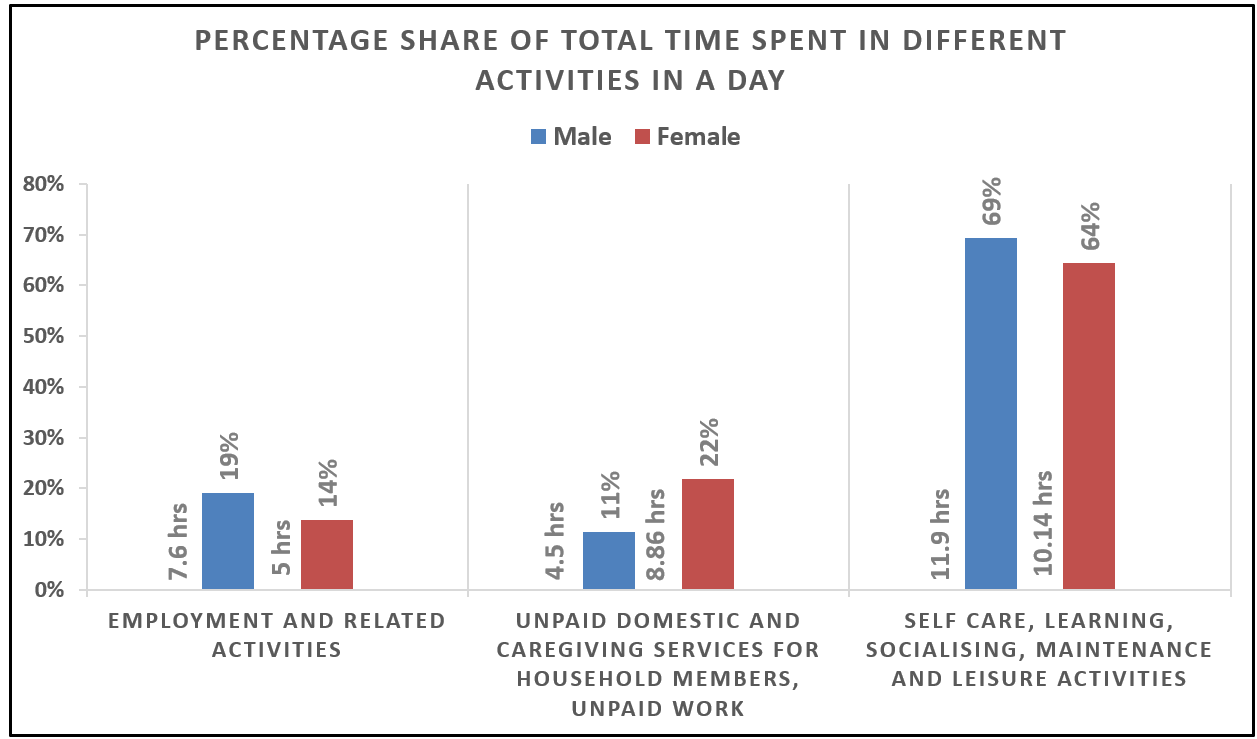
India’s official Time Use Survey, 2019 documents this division starkly (Figure 1). Working-age women spend, on average, nearly nine hours a day on unpaid household work – cooking, cleaning, childcare, eldercare. Men spend roughly four and a half hours. This is not a small difference. It means that before a woman even considers entering the labour market, more than half her non-sleeping hours are already committed.
Figure 1. Percentage share of total time spent in different activities in a day, by gender
Source: Time Use Survey, Government of India, 2019; Authors’ calculations.
We model this using a joint household search model. A household consists of two members – a husband and a wife – who pool their resources and make employment decisions together. Each faces an uncertain labour market: job offers arrive at some rate, and jobs can be lost at some rate. The question the model asks is: at what wage offer does it become worthwhile to enter the labour market? This is the “reservation wage” – the minimum acceptable wage.
What the data tells us
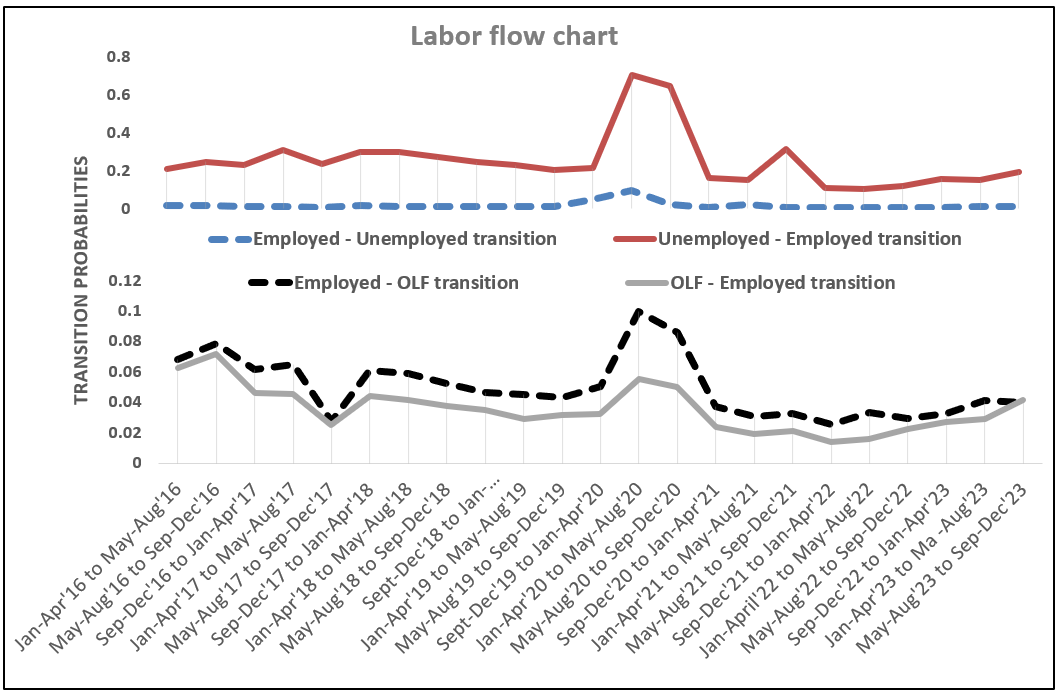
To calibrate the model to reality, we use the Consumer Pyramids Household Survey (CPHS) from the Centre for Monitoring Indian Economy (CMIE) – a rich panel covering more than 170,000 households surveyed multiple times per year. Using eight years of data from 2016 to 2023, we compute the probability that an employed person loses their job in a given period, and the probability that an unemployed person finds one (Figure 2).
The numbers are sobering. For men, the probability of finding a job in any four-month period is about 24%. For women, it is less than 7% – barely a quarter of the male rate. Women also face a higher probability of losing a job once they have one. This gender asymmetry in labour market conditions is severe.
Figure 2. Labour flow chart for India
Source: CMIE data; Authors’ calculations.
The reservation wage gap
When we solve the model using these parameters together with the time-use data, we find that women’s reservation wages are nearly double those of men. In households where both spouses are looking for work, men require a monthly wage of around Rs. 2,781 to accept an offer. Women require Rs. 4,976. Given the actual distribution of wages on offer in the Indian economy, this difference is decisive. A large fraction of job offers that men would accept are simply declined by women – not because of preference or cultural constraint as such, but because their time is genuinely more costly to withdraw from the home.
How much is due to what?
A formal decomposition reveals what fraction of this gap can be attributed to each source.
Household factors – the unequal burden of home production – account for approximately 45% of the gender gap in reservation wages. This is the single largest driver. Women’s greater commitment to unpaid domestic work raises their opportunity cost of labour market entry to such an extent that a very large share of available jobs fails to meet their reservation wage.
Labour market frictions – women’s dramatically lower job-finding rate and higher job-loss rate – account for around 35% of the gap. Worse employment prospects weaken women’s outside options but paradoxically raise their reservation wages: if a job is hard to find and easy to lose, it needs to pay more to be worth taking.
The remaining 20% reflects the interaction between the two. This matters: the two channels are not independent. A woman facing both a heavy home production burden and poor labour market prospects experiences a gap larger than the sum of either effect in isolation. The combination creates a trap that neither set of policies, pursued alone, can fully undo.
A more dynamic labour market helps everyone
The Indian labour market is currently characterised by low dynamism – both job-finding rates and job-loss rates are low. This sounds safe, but it is not good. A low-dynamism market is one where few new jobs form, and workers who exit – for any reason – find it very hard to return.
Our simulations show that a transition to a high-dynamism market – one where jobs form and dissolve more rapidly, but the overall probability of being employed is higher – substantially reduces reservation wages and raises participation for both women and men. The gains for women are larger.
What policy should do
The decomposition implies that no single policy can close India’s female participation gap. Two broad directions are necessary, and they reinforce each other.
Reduce the household burden on women. This means investing seriously in childcare and eldercare infrastructure, expanding access to labour-saving household technology (washing machines, clean cooking fuel, reliable water access), and enabling flexible employment arrangements.
Reduce labour market frictions. Women’s job-finding rate is less than a third of men’s. Hiring subsidies targeted at female employment, anti-discrimination enforcement, and expansion of formal sector jobs where women are employable can improve women’s labour market prospects.
Crucially, our model shows that these two policy dimensions are super-additive: combining them produces effects larger than the sum of their parts. A woman whose home production burden has been reduced benefits more from an improvement in the labour market, and vice versa. Integrated, multi-dimensional policy will therefore be more effective – and more efficient – than parallel single-issue interventions.
India’s labour force participation problem is not simply a cultural hangover, nor simply an economic failure. It is both, interacting in ways that each make the other worse. Understanding this interaction is the first step toward designing policy that actually works.