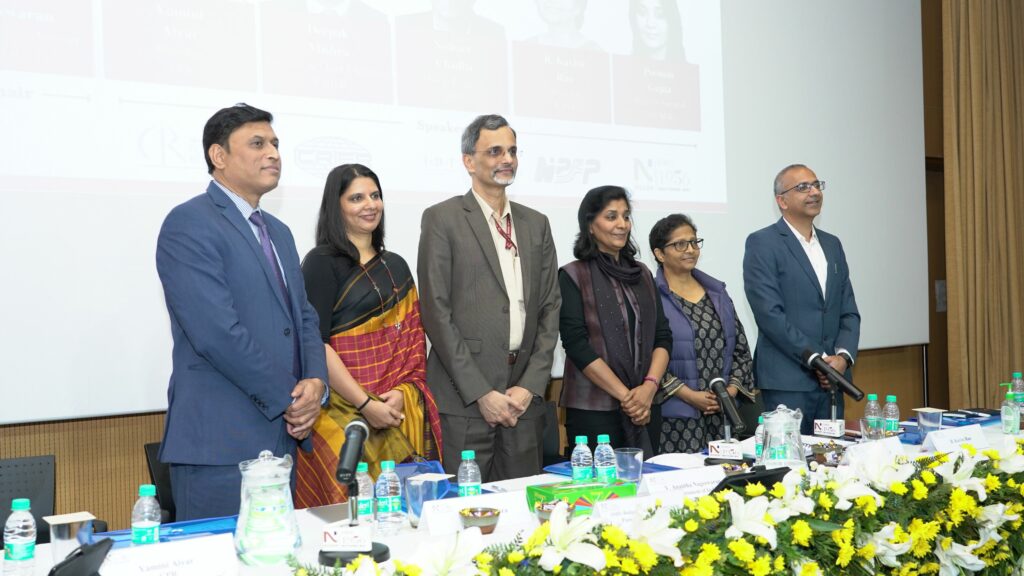
The India Policy Forum 2022

NCAER hosted its annual flagship event, the India Policy Forum (IPF) from July 12-13, 2022. The event was held in person at the India International Centre and NCAER in New Delhi.

Every summer, the NCAER IPF brings to New Delhi a unique combination of intense scholarship and policymaker engagement through this forum that aims to promote rigorous empirical economic policy research on India through commissioned papers, which are then published in the form of an annual volume. In addition, the IPF also features public lectures by eminent experts and roundtable discussions on critical issues.

The 19th edition of the IPF was attended by a galaxy of eminent policymakers, economists, academics, and researchers. The proceedings at the conference deliberated on five research papers, covering a range of diverse sectors and subjects, including entrepreneurship, banking, disease surveillance, trade, services, and ways to accelerate formal jobs and wages through larger firms.

Commenting on the 19th IPF, the NCAER Director General, Dr Poonam Gupta stated, “The IPF stands out for the vigorous review and state-of-the-art analysis of key economic issues of concern to India. It is heartening to the distinguished gathering collected here to engage with each other at the Conference in person after three years when the COVID health crisis had compelled us to switch to the digital mode.”

A paper by Professor Tarun Khanna on “Science-based Entrepreneurship in India: A Policy Glass (as yet) Quarter-Full” reveals that the entrepreneurship in India is heavily circumscribed in a handful of sectors and a gaping lacuna is the lack of science-based entrepreneurship. Science is the fuel for innovative entrepreneurial economic output, which requires universities and institutions of higher learning to promote science and vibrant local ecosystems that allow the translation of science into entrepreneurship.

In a paper titled, ‘Privatization of Public Sector Banks in India: Why, How and How Far’, presented on 12 July 2022, the authors Dr Poonam Gupta and Dr Arvind Panagariya made a case for privatisation of all public sector banks (PSBs) except the State Bank of India. This is because private banks have emerged as a credible alternative to PSBs with substantial market share and the status quo will result in further erosion of the market share of PSBs toward oblivion, while impeding India’s economic growth and inflicting substantial costs onto the depositors, firms, taxpayers and the government as their majority owner.

A paper on “Lessons from Disease and Economic Surveillance during COVID in India” by Professor Anup Malani uses the lessons learned during the current pandemic to suggest ways to gather intelligence for the next pandemic in India and stresses the value of population-level surveillance; understanding the incentives and disincentives for surveillance and reporting; and, tailoring policy to the results of surveillance.

While chairing the session on ‘The US-China Trade War and India’s Exports’, on 13th of July 2022, Mr B.V.R. Subrahmanyam, Secretary, Ministry of Commerce and Industry, highlighted the gaps and pain points in the country’s trade promotion policy. He stated, “Exports do not merely represent a one-way process but this is a two-way street, as it also includes imports….Although the Government has initiated large-scale restructuring in the exports arena, it still needs to do much more to exploit the available windows of opportunity because India is currently in a sweet spot with all external stakeholders wanting India to succeed in this area.”

The authors of a paper “India’s Services Sector Growth: The Impact of Services Trade on Non-tradable Services” find strong evidence to suggest that an increase in tradable services employment leads to an increase in non-tradable services employment and increases the number of firms in non-tradable services.

A Policy Roundtable at the event on  ‘Accelerating Formal Jobs, Higher Wages, and Larger Firms’, focused on a critical issue facing the country, the need for accelerating the creation of formal jobs and higher wages through larger firms for boosting economic growth. Mr Rajesh Aggarwal, Secretary, Ministry of Skill Development and Entrepreneurship, pointed out, “Data suggests that though we are skilling people in the rural areas, we find that these people migrate to the urban areas for employment….In this context, we must remember that clusters will grow, urbanisation will increase, and globalisation will continue unchecked, and any policy on skilling and job generation needs to keep these dynamics in mind.”

According to Mr Sanjeev Sanyal, Member of the Economic Advisory Council to the Prime Minister, the issue of generation of more intuitive and better-paying jobs lies in the evolution of “Agglomeration economies versus economies of scale, [as the former] are a reality.” He concluded, “This is also a political economy challenge, in view of the fact that the high-paying jobs are presently concentrated among the highly educated people in the urban areas.”

Day 1 of the Conference ended with the IPF Annual Lecture on ‘Trade Policy for the Twenty-first Century’, delivered by Professor Anne Krueger, Senior Fellow at the Johns Hopkins University, Emeritus Professor at Stanford University, and former First Deputy Managing Director of the International Monetary Fund. This session was chaired by Professor Arvind Panagariya, Columbia University and former Vice Chairman of NITI Aayog.

What does the Evidence Show? Consumption, Poverty and the Labour Market in India – 2011/12-Present

This webinar hosted Dr Surjit S. Bhalla, Executive Director for India, Sri Lanka, Bangladesh and Bhutan at the IMF, and Dr Tirthatanmoy Das, Associate Professor in the Economics and Social Sciences Area at the Indian Institute of Management Bangalore. Dr Amit Basole, Associate Professor of Economics and Head, Centre for Sustainable Employment, Azim Premji University, was the discussant. The discussion was moderated by Dr Sonalde Desai, Distinguished University Professor, University of Maryland and Professor, NCAER.

The presentation is available on this webpage

The authors discussed their paper which examines household and individual level data from a number of major data sources, including CPHS, NSSO, and PLFS. The paper evaluates the data, and data sources, for the information contained therein on some major policy issues – for example, the state of extreme poverty, the functioning of the labour market, etc. The findings are fivefold. First, the authors’ analysis of the PLFS indicates that newly introduced education-based sampling schemes do not necessarily influence results. Second, a detailed analysis suggests that the sampling weights in the CPHS should be treated with extreme caution. The decline in extreme poverty using CPHS data appears to be larger than popularly believed, and consumption growth is larger than that reported by CPHS. Fourth, CPHS shows significantly lower female participation rates compared with other surveys, while the male labour force participation rates are more comparable rates. Fifth, the non-parametric bounds of CPHS labour force participation rates for men are similar to those of PLFS; however, for women, the non-parametric estimates are radically dissimilar.

Surjit S. Bhalla is Executive Director for India, Sri Lanka, Bangladesh and Bhutan at the IMF (Nov. 2019). He has served as part-time member of Prime Minister Narendra Modi’s Economic Advisory Council, Chairperson for the Ministry of Commerce High Level Advisory Group on Trade and Economic Adviser to the Fifteenth Finance Commission, Government of India. In addition, he is a regular Invitee to the Aspen Institute Program on World Economy, USA, 2002-present. Dr Bhalla has taught at the Delhi School of Economics and served as executive director of the Policy Group in New Delhi. Since 1999, he has been on the governing board of NCAER. He has worked as a research economist at the RAND Corporation, the Brookings Institution, and at both the research and treasury departments of the World Bank, and as a consultant to Warburg Pincus. He has also worked on Wall Street in Deutsche Bank and Goldman Sachs. He holds a PhD in Economics from Princeton University, a Masters in Public and International Affairs from Woodrow Wilson School, Princeton University, and a BSEE degree from Purdue University.

Tirthatanmoy Das is an Associate Professor in the Economics & Social Sciences Area at the Indian Institute of Management Bangalore. He is also a Research Fellow at IZA Institute of Labor Economics and a Fellow at the Global Labor Organization. Before joining IIMB, he was an Assistant Professor of Economics at Temple University (2012-2014) and the University of Central Florida (2014-2017). His research spans topics in labour economics, econometrics, health economics, and behavioural economics. He has also contributed to policy research on the Indian labour market, including the background reports submitted to the Economic Advisory Council to the Prime Minister of India (EAC-PM). He received an MA and a PhD in Economics from the State University of New York at Binghamton, an MA from Jawaharlal Nehru University, and a BSc from the University of Calcutta.

Amit Basole is Associate Professor of Economics and Head, Centre for Sustainable Employment, Azim Premji University. Prior to joining Azim Premji University, he taught at Bucknell University and the University of Massachusetts, Boston. His research interests include labour and structural change, poverty and inequality, and the economics of artisanal knowledge. He is the lead author of the State of Working India report. He has a PhD in Economics from the University of Massachusetts, Amherst.

Sonalde Desai is a Distinguished University Professor at the University of Maryland and Professor at NCAER, and Director of NCAER’s National Data Innovation Centre. She is a demographer whose work deals primarily with social inequalities in developing countries with a particular focus on gender and class inequalities in human development. While much of her research focuses on South Asia, she has also engaged in comparative studies across Asia, Latin America, and Sub-Saharan Africa. She has published articles in a wide range of sociological and demographic journals including American Sociological Review, Demography, Population and Development Review, and Feminist Studies. Dr Desai leads the India Human Development Survey and is serving as President for the Population Association of America for 2022.

Dr Mridul Saggar, the new IEPF Chair Professor

NCAER is delighted to announce the appointment of Dr Mridul Saggar as the Investor Education and Protection Fund Authority (IEPF) Chair Professor at NCAER. He joins the Chair today. The Chair has been established with the support of the Investor Education and Protection Fund Authority under the Ministry of Corporate Affairs in the Government of India. Dr Saggar will lead a group focused on research and policy outreach in the broad area of regulatory and public policies, including concerns about investor education and protection and financial sector reforms. He is expected to contribute widely to the IEPF Chair activities through his research and engagement with economists, financial market participants, policy makers, and regulators, while dealing with investors and investor education at the Centre and in the States, interacting with various stakeholders including donors and the media.

The NCAER Director General, Dr Poonam Gupta stated, “We feel privileged to have Dr Mridul Saggar as the NCAER IEPF Chair Professor. He brings to the position tremendous expertise in the macroeconomics, financial markets and banking space. He is also a distinguished academic and researcher in these areas. We look forward to him expanding NCAER’s research agenda with special focus on investor education and protection, making a significant contribution to its intellectual legacy.”

A central banker for three decades, Dr Saggar has extensive experience in various central banking functions. Prior to joining NCAER, he was the Executive Director, Reserve Bank of India (RBI), overseeing the central bank’s monetary policy and economics research functions. He was also one of the six members of the RBI’s Monetary Policy Committee (MPC) in charge of taking collegiate decisions on policy interest rate and the monetary policy stance as also of its Financial Markets Committee (FMC) that takes decisions on its financial market operations. Earlier, he has served as the Head of the International Department of RBI, representing India at various international bodies/G20 Working Groups/Task Forces.

His research interests cover macroeconomics, international finance, monetary policy and monetary operations, international financial architecture and international economic relations, global financial regulatory reforms, financial inclusion, national accounts, and agriculture policy.

Mridul Saggar holds a doctorate degree from Indira Gandhi Institute of Development Research, Mumbai, and has been a fellow at the Princeton University, NJ, USA. He has published widely in leading refereed national and international journals and has taught and delivered guest lectures at various eminent academic and professional institutions in India and abroad.

Role of National Financial Reporting Authority, NFRA in Investor Education and Protection

The webinar organised by NCAER is part of the Investor Education and Protection Fund (IEPF) Chair Unit’s webinar series. NCAER established the IEPF Chair Unit in 2020, with funding from the Investor Education and Protection Fund Authority, Ministry of Corporate Affairs. NCAER’s IEPF Chair Unit conducts research on contemporary issues related to investor education and protection, and an analysis of related economic and regulatory issues.

Recently a government-appointed committee to review the quality of audits has recommended that the powers of the National Financial Reporting Authority (NFRA) be enlarged.  It should cover much more than investigating misconduct by auditors and company managements. If the committee has its way, the NFRA will be able to seek information from promoters, directors, and executives in the course of investigation into the conduct of auditors. Financial statements certified by chartered accountant are the very bedrock on which everything else is based, whether it is investment decisions by retail investors and mutual funds or lending decisions by banks. Consequently, anything that improves the quality and integrity of these statements is a shot for retail investors.

What does all this mean for investor protection? How can the NFRA deliver on its promise? To discuss this and more, NCAER along with the Ministry of Corporate Affairs, under the aegis of the ministry-funded Investor Protection and Education Chair at the NCAER, organised a webinar on this subject. The panel of experts invited for the discussion were; Amarjit Chopra, former head of the Institute of Chartered Accountants and member of the Expert Committee; Pradeep Ramakrishnan, General Manager, Securities and Exchange Board of India and Hemindra Hazari, Independent Analyst.  The discussion was moderated by Mythili Bhusnurmath, Senior Adviser, NCAER.

About the NFRA

Amarjit Chopra is a Chartered Accountant with more than 46 years of professional experience. He is a senior partner in GSA & Associates LLP, New Delhi. He was elected to Central Council of ICAI for five terms of three years each consecutively from 1998 to 2013 and also served as its Vice President and President. He served the Northern India Regional Council (NIRC) of ICAI for two terms and was its Chairman for the year 1988-89. He completed his Ph. D. from Apex University.

Hemindra Hazari is a Securities and Exchange Board of India (SEBI) registered independent research analyst with over 25 years’ experience in the Indian capital markets. He has specialized in banking and the macro-economy. He holds a Master’s Degree in International Studies from the University of South Carolina, USA and a Bachelors in Economics from St. Xavier’s College, Mumbai.

Pradeep Ramakrishnan is General Manager, Securities and Exchange Board of India (SEBI). He joined SEBI in the year 2002 and worked in the Compliance and monitoring division. He is presently at the Department of Debt and Hybrid Securities at SEBI. Previously, he has worked with Madras Fertilizers Limited and Kothari Petrochemicals Limited. He is a commerce graduate and a qualified Company Secretary.

Mythili Bhusnurmath is Senior Adviser, NCAER, and Consulting Editor, ET Now TV. She holds a Master’s in Economics from the Delhi School of Economics and is a Certified Associate of the Indian Institute of Bankers. She also holds a law degree from Delhi University.

Improving Investor Education and Protection in the Bond Market in India

The webinar organised by NCAER is part of its Investor Education and Protection Fund (IEPF) Chair Unit’s webinar series. NCAER established the IEPF Chair Unit in 2020, with funding from the Investor Education and Protection Fund Authority, Ministry of Corporate Affairs. NCAER’s IEPF Chair Unit conducts research on contemporary issues related to investor education and protection, and an analysis of related economic and regulatory issues.

Stock market instruments come in various forms. But regardless of the nomenclature and the finer differences between them, all instruments can be classified into two broad categories: Equity and Debt. However, the difference doesn’t end there. In the Indian context, equity markets are well-developed and have a huge retail presence, especially post-Covid-19, when thanks to a combination of factors retail investors turned to equity in a big way. In contrast, our bond markets are notable for the absence of retail investors. Whether it is government bonds (G-Secs) or corporate bonds, the market is dominated by institutional players. While the G-Sec market is dominated by banks, insurance companies and pension funds that are mandated to invest some proportion of their funds in G-Secs, private placements are the norm in the corporate bond market.

Why are retail investors reluctant to invest in either G-Secs (despite their risk-free nature) or corporate bonds? Is it lack of awareness/financial literacy/high (?) incidence of fraud and default/poor recourse? Can we energise the bond market and make it as vibrant as the equity market? The webinar hosted  discussions on these issues and the way forward with panel of experts: Usha Thorat, former Deputy Governor, Reserve Bank of India; Ananth Narayan, Associate Professor, SPJIMR, Mumbai and Senior India Analyst, Observatory Group, LLC and Madan Sabnavis, formerly Chief Economist, Care Ratings, presently Chief Economist, Bank of Baroda. The discussion was moderated by Mythili Bhusnurmath, Senior Adviser, NCAER.

Panellists:

Usha Thorat is a former Deputy Governor of the Reserve Bank of India Her experience covers foreign exchange and reserves management, debt management of Central and State governments, development and regulation of money, forex and government securities markets, rural planning and credit, cooperative banking, customer service and grievance redressal, and payment and settlement systems. She has an MA in Economics from the Delhi School of Economics.

Ananth Narayan is an Associate Professor at the SP Jain Institute of Management and Research. He is an international banking and financial markets expert. He holds over 24 years of experience in banking and financial markets with Standard Chartered, Deutsche Bank and Citibank. He holds a B.Tech. from IIT Bombay, and a post graduate diploma in Management from IIM Lucknow.

Madan Sabnavis is the Chief Economist at the Bank of Baroda. Prior to this, he was the Chief Economist at Care Ratings Ltd. He has over 30 years of experience across development banking, commercial banking, engineering, commodity exchange and credit ratings. He has an MA in Economics from the Delhi School of Economics.

Mythili Bhusnurmath is Senior Adviser, NCAER, and Consulting Editor, ET Now TV. She holds a Master’s in Economics from the Delhi School of Economics and is a Certified Associate of the Indian Institute of Bankers. She also holds a law degree from Delhi University.

    Get updates from NCAER