The National Council of Applied Economic Research (NCAER) and the Asian Infrastructure Investment Bank (AIIB) organised the regional launch of the AIIB Flagship Report titled, “Moonshots for the Emerging World: Building State Capacity and Mobilising the Private Sector toward Net Zero”, on 8 December 2022, at the Tamarind Hall, India Habitat Centre, New Delhi.
Dr Erik Berglöf, Chief Economist, AIIB, presented the key findings of the report. The main context of the report was that net zero transmission across the world is not happening fast enough, especially because of the persistently large fossil fuel footprints of the emerging markets and developing economies (EMDEs), and the slow adoption of green technology. He flagged the following net zero moonshots during his presentation:
- There is a need to build the capacity of the State-owned institutions to transform them into leaders.
- The private sector must be encouraged to participate in the transition to net zero but under the right atmosphere.
- The adoption of green technology is the need of the hour to fight the challenge of climate change in the backdrop of the Paris Agreement.
- The implementation of a meaningful carbon price should be accompanied by mission-driven coordination to ensure a smooth transition to net zero.
Dr Berglöf’s presentation was followed by a panel discussion, moderated by Mr Subhamoy Bhattacharjee, Senior Adjunct Fellow, RIS, and Consulting Editor at Business Standard. The panellists included Professor Purnamita Dasgupta, Chair in Environmental Economics and Head, Environmental and Resource Economics Unit, Institute of Economic Growth (IEG); Dr Laveesh Bhandari, Senior Fellow, Centre for Social and Economic Progress (CSEP); and Mr Rahul Bharti, Executive Director (Corporate Affairs), Maruti Suzuki.
The panel discussion was followed by the Keynote Address delivered by Mr Suman Bery, Vice-Chairman, NITI Aayog. This session was chaired by Dr Bornali Bhandari, Senior Fellow, NCAER.
In his keynote speech, Mr Bery highlighted the importance of complementing domestic efforts noted in the AIIB Report with the enhanced flow of external finance on reasonable terms, which is a central theme of India’s G20 Presidency.
Profiles of Panellists
Suman Bery is currently Vice Chairperson, NITI Aayog, in the rank and status of a Cabinet Minister. An experienced policy economist and research administrator, he has been a Senior Visiting Fellow at the Centre for Policy Research, New Delhi; a Global Fellow in the Asia Programme of the Woodrow Wilson International Centre for Scholars in Washington D.C.; and a non-resident fellow at Bruegel, an economic policy research institution in Brussels. From early 2012 till mid-2016, Mr Bery was Royal Dutch Shell’s global Chief Economist based in The Hague. Before his appointment at Shell, he served as Director-General of the National Council of Applied Economic Research (NCAER). He has earlier served as member of the Prime Minister’s Economic Advisory Council; of India’s Statistical Commission; and of the Reserve Bank of India’s Technical Advisory Committee on Monetary Policy.
Erik Berglöf is the inaugural Chief Economist at the Asian Infrastructure Investment Bank (AIIB). He sets the vision and strategy for the Economics Department and leads the planning, implementation, and supervision of its work plan in support of the Bank’s mandate. Prior to joining AIIB in September 2020, he was Director of the Institute of Global Affairs, London School of Economics, and Chief Economist of the European Bank for Reconstruction and Development from 2006 to 2015, where he helped create and co-led the Vienna Initiative, a European crisis response team credited with mitigating the impact of the 2008 Global Financial Crisis. He is an expert in transition economics and institutional transformation through private sector development. He holds a PhD in Financial Economics and an MA in Business and Economics, both from the Stockholm School of Economics.
Subhomoy Bhattacharjee is Consulting Editor at the Business Standard newspaper. He is also Senior Adjunct Fellow (energy sector) at RIS, a think tank which works closely with the Ministries of External Affairs, Finance, and Commerce. He is also Faculty at OP Jindal Global University, where he teaches Economics. He has worked in the Indian Information Service of the Government of India (through the civil services examination), and leading newspapers, including The Economic Times, The Indian Express, and The Financial Express.
Bornali Bhandari is a Senior Fellow at NCAER with a background in international economics and macroeconomics, specifically focusing on the impact of globalisation on development. Currently, she is engaged in a number of industry studies, covering automobiles, farm mechanisation, and digitisation. Her wider research interests include analysis of skilling from a 3-E perspective (education, employability and employment); e-Governance, infrastructure, particularly the roads and ICT sectors; G-20 issues like climate change financing and reserve currency; FDI and trade-related issues. She also oversees the production of the NCAER Quarterly Business Expectations Surveys. She has received her doctorate degree from University of Oregon, Eugene, USA.
Laveesh Bhandari is a Senior Fellow at Centre for Social and Economic Progress (CSEP) and Chief Economist at Indicus Foundation. He leads the climate change capability at CSEP and also plays an advisory role on the broad macro agenda, sub-national reform, and human capital. Laveesh has published widely on subjects related to sustainable livelihoods, industrial, economic and social reforms in India, economic geography, and financial inclusion. He has taught economics in Boston University and Indian Institute of Technology (IIT), Delhi. He has been the Managing Editor of Journal of Emerging Market Finance, and earlier worked at National Council of Applied Economic Research (NCAER), New Delhi. Currently, he is conducting research on issues of inclusion, India’s energy transition, and how it will impact the government as well as the economy. He received his PhD in Economics from Boston University, for which he was awarded the Best thesis in International Economics.
Rahul Bharti is Executive Director (Corporate Affairs), and Chief Investor Relations Officer at Maruti Suzuki. He also holds the offices of Chairman, International Relations and Trade Policy, Society of Indian Automobile Manufacturers (SIAM); Chief Engagement Officer, SIAM; Member, International Organization of Motor Vehicle Manufacturers (OICA or Organisation Internationale des Constructeurs d’Automobiles), the Global Auto Industry Association; and Member, Confederation of Indian Industry (CII) Haryana State Council.He is a Gold Medallist from (now) Indian Institute of Technology (IIT), Roorkee, with more than 28 years of experience at Maruti Suzuki across vendor development, new product development, and corporate affairs.
Purnamita Dasgupta is Chair Professor and Head of the Environmental Economics Unit, Institute of Economic Growth, Delhi. Her research and teaching focus on the relationship between environment and economic development, in the context of climate change, health, and environmental sustainability. She has been Visiting Professor at the University of Cambridge, UK, and Johns Hopkins University, USA. She is an author with the Intergovernmental Panel on Climate Change, International Panel on Social Progress and the Himalayan Mountain Assessment. She has been associated with several Government committees related to setting standards, compensations, economic valuation, and accounting for the environment in India. Purnamita is currently a member of the Task Group for preparation of India’s Long-Term Low Greenhouse Gas Emissions Development Strategy. She has published widely in books and international journals, and serves on several international Editorial Boards and review committees.
Somya Mathur is an Associate Fellow at NCAER. She is working on CGE models. Previously, she has worked with Infinite Sum Modelling Inc., USA; Pune International Center on Climate Change Impacts; and the Ministry of Panchayati Raj. Her domain areas include trade and climate change. She has a Masters in Economics from the Gokhale Institute of Politics and Economics, Pune.
Anil K. Sharma is Secretary to the Governing Body and Operations Director at NCAER. He has held several positions at NCAER after joining in 1992, including as the Officiating Director General in May-June 2021. He has also been the NABARD Chair Professor at NCAER; Visiting Researcher at the International Trade Division, The World Bank, Washington D.C., USA; Consultant to the Organisation for Economic Co-operation and Development (OECD), Paris; Food and Agriculture Organisation (FAO), Rome; and, Asian Development Bank (ADB), Manila; and a Post-Doctoral Fellow at Research Institute for Agricultural Economics, Budapest, Hungary. His main areas of research include: The WTO Agreement on Agriculture, Economic and Policy Reforms in Agriculture, Price Policy and Price Stabilization Mechanisms, Rural Credit, Rural Infrastructure, and Rural Poverty. He advised the Ministry of Commerce and Industry on trade negotiations in agriculture under the WTO Agreement on Agriculture, and has been a member of several government and industry committees and task forces. He received his MSc and PhD in Agricultural Economics from the Himachal Pradesh Agricultural University.


 Dr Allendorf’s paper suggests that a neglected consequence of declining fertility is the likely rise of families with children of one sex—only sons or only daughters. Increases in sonless families, in particular, may present a gendered demographic dividend that weakens patrilineal family systems. Drawing on 88 demographic surveys and two censuses, Dr Allendorf describes trends in shares of families with only daughters and only sons from the early 1990s to around 2015, in India and several other Asian countries. Increases in ‘sons-only families’ were universal where numbers of children fell. The growth of ‘daughters-only families’ was suppressed in India and other patrilineal contexts, but these sonless families still rose in 13 of the 18 countries where the numbers of children declined.
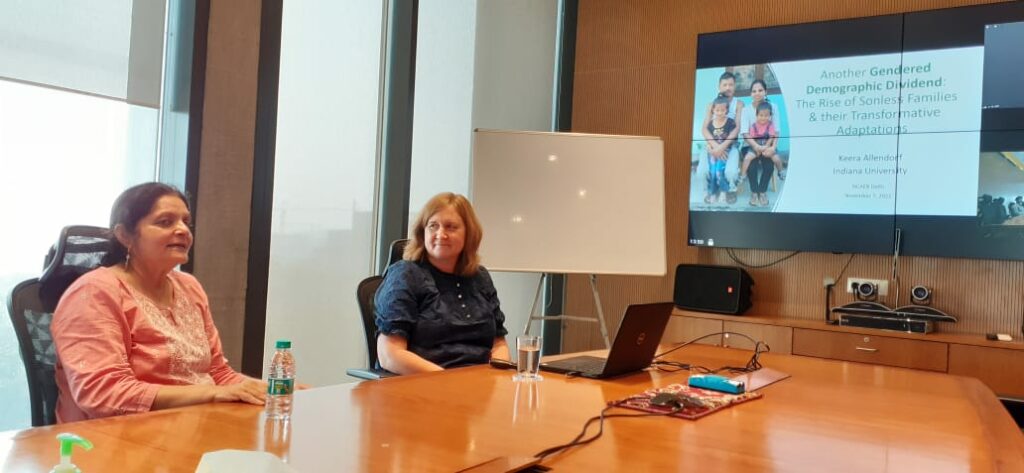 Dr Allendorf also examines one potentially transformative adaptation in India—mothers expecting to rely on a daughter, rather than a son, for old age support. Using panel data from the India Human Development Survey (IHDS), she compares how expectations of old age support changed from when women were newly married and did not yet have children to a period seven years later when they did have children. Women with sons kept or further embraced patrilineal expectations that a son would provide support. On the other hand, sonless mothers largely gave up patrlineal expectations, turning to daughters or away from children altogether.
 Keera Allendorf is an Associate Professor of Sociology at Indiana University. Her research focuses on family, gender, and health, primarily in India and Nepal. She investigates how and why family behaviours vary and change over time and how family behaviours shape well-being. In her current projects, she examines adaptations of sonless families and explores Indian Americans’ views and experiences of family life. She is also a co-investigator in the ongoing third round of the India Human Development Survey. Her articles have appeared in the American Journal of Sociology, Demography, and Population and Development Review.
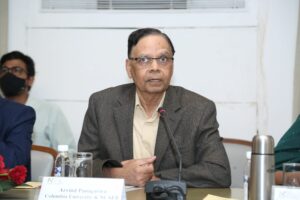 During the discussion, the Chair, Professor Arvind Panagariya noted, “My forecast for growth of the Indian economy for the year 2022-23 would be about 8 per cent. This is because during the first quarter of the year, we have already achieved a growth figure of 13.5 per cent of GDP. In order to achieve a growth of 8 per cent, we need to touch a total of 32 per cent for the four quarters of the year, and having achieved 13.5 per cent in the first quarter, we need to achieve a total of 18.5 per cent in the remaining three quarters, which is absolutely doable. ”
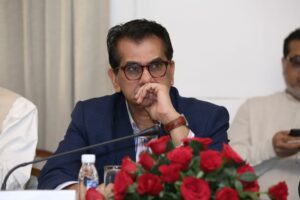 Reflecting on the economic indicators during the year and the concomitant analysis in NCAER’s MYR, Mr Amitabh Kant suggested, “All our high-frequency indicators, as also reflected in the NCAER MYR, are robust and underscore the resilience of the Indian economy. The two important indicators that need attention and a response are rising commodity prices and depreciating currency in the face of the strengthening of the US dollar.” He also said, “We have achieved success in many areas, especially in manufacturing, and now we need to focus on the sunrise sectors and the green transition sectors.” According to him, one of the key measures will be asset monetisation, while the others would be increasing the plugging of private resources into infrastructure, boosting public-private partnerships, and focusing on increasing disinvestment. He also surmised that India could be the first country worldwide that would develop at an unprecedented rate without any carbonisation.
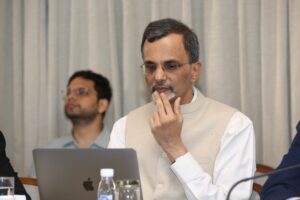 Providing a very comprehensive overview of the economic outlook, the Chief Economic Adviser, Dr Anantha Nageswaran stated, “India’s bond yields are doing much better than those of others, which is indicative of the prevailing macroeconomic stability in India despite the opposite global trends.” He argued that the projections, including both the optimistic and pessimistic ones, should, however, be taken with some degree of scepticism because of the ‘unknown unknowns’”. “Among these ‘unknown unknowns’ are the central banking measures, which could lead to negative interest rates in Europe during the coming decade, stemming both from the Global Financial Crisis of 2007-08, and the impact of the pandemic and the response to it by the advanced economies,” he said.
 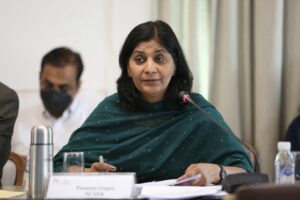 The NCAER Director General, Dr Poonam Gupta pointed out, “The global outlook is both challenging and uncertain, but the available high-frequency indicators that the NCAER Mid-Year Review has taken into account highlight the resilience of the Indian economy.” She also said that the worrying indicators globally were the rise in inflation in all advanced economies, policy tightening by the US Fed and other central banks, and softening of both global growth and global trade, which could impact the Indian economy too.
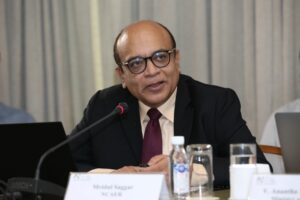 The IEPF Chair Professor, NCAER, Dr Mridul Saggar highlighted the need for maintaining macro-financial stability amid the sharp slowdown in global growth and tighter financial conditions expected next year on the back of further monetary tightening.
 Dr Krishna Srinivasan, Director of the IMF’s Asia Pacific Department, made a presentation on the latest assessment for the region focusing on large medium-term output losses, which could be 9 per cent of GDP for the region, and the need to build greater resilience in the region. He highlighted the need for fiscal consolidation in view of elevated public debt levels and cautioned that elevated corporate debt has increased scarring risks. He noted, “While there is no panacea for productivity losses due to pandemic scarring, digital technologies can increase efficiency, deepen financial inclusion, and open new markets.” He also added that fragmentation can affect trade and slowdown growth.
 The Chief Economic Adviser, Dr Anantha Nageswaran said that “India is expected to clock better growth than IMF’s projections next year aided by enhanced capital formation.” He added that fiscal consolidation is needed to bring inflation down, and said, “Asset monetisation receipts could be used to lower government debt, which would be the best stimulus for the economy”. He also maintained that the debt-to-GDP ratio did not pose any sustainability concern and could come down due to asset monetisation.
 Dr Rakesh Mohan, President and Distinguished Fellow, Centre for Social and Economic Progress (CSEP), cautioned that while we were on the right track in reducing debt levels, we should not be complacent about financial repression. He emphasised the need for keeping inflation expectations anchored, pointing out that though in the U.S., inflation was high, inflation expectations remained hinged.
 Highlighting the need for fiscal adjustment, the NCAER Director General, Dr Poonam Gupta pointed out that fiscal outcomes have been sticky and mentioned, “Debt may decline very slowly over the next five years and macro shocks can change the trajectory.” She also advocated the central bank swap lines amongst the G20 countries to be extended to all economies during the pandemic.
 Ms Sonal Varma, Chief Economist (India and Asia ex-Japan), Nomura, raised risks of stagflation and pointed out that “central banks will bring down inflation even if it leads to recession but Asia is relatively better placed than other economies. As far as India is concerned, an export slowdown will lead to moderation in demand.”
 Summing up the discussion at the seminar, Dr Mridul Saggar noted, “It is common economic sophism that fiscal policy can be assigned to prop up growth while monetary policy is assigned to bringing inflation under control. Instead, gradual fiscal consolidation is needed to moderate demand.” He also highlighted the need to address climate risks faced by small island economies.