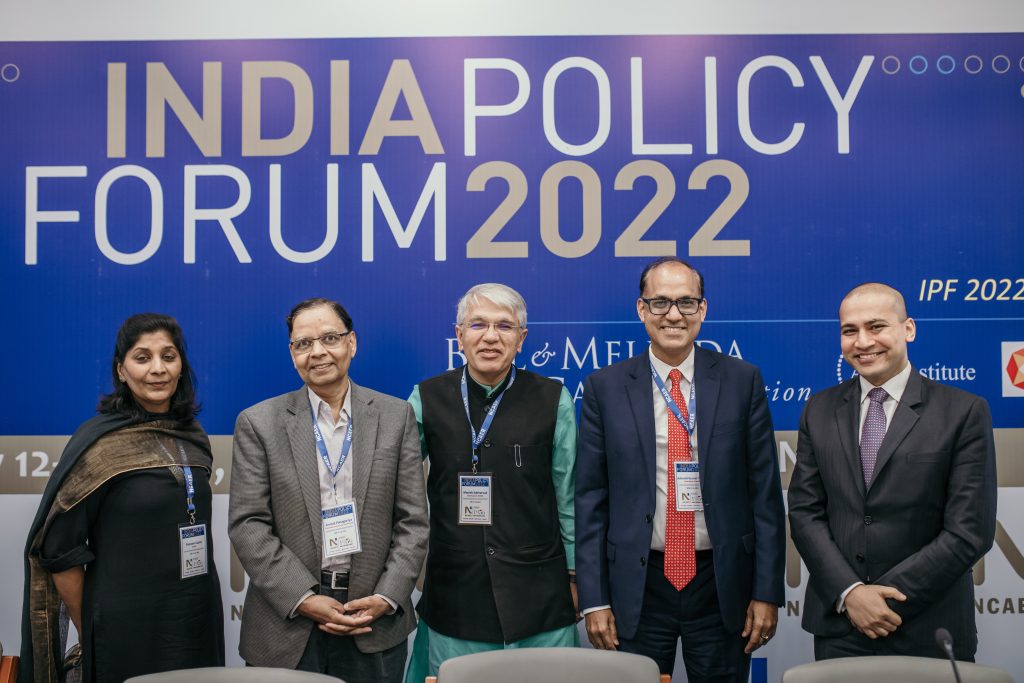
NCAER hosted its annual flagship event, the India Policy Forum (IPF) from July 12-13, 2022. The event was held in person at the India International Centre and NCAER in New Delhi.
Every summer, the NCAER IPF brings to New Delhi a unique combination of intense scholarship and policymaker engagement through this forum that aims to promote rigorous empirical economic policy research on India through commissioned papers, which are then published in the form of an annual volume. In addition, the IPF also features public lectures by eminent experts and roundtable discussions on critical issues.
The 19th edition of the IPF was attended by a galaxy of eminent policymakers, economists, academics, and researchers. The proceedings at the conference deliberated on five research papers, covering a range of diverse sectors and subjects, including entrepreneurship, banking, disease surveillance, trade, services, and ways to accelerate formal jobs and wages through larger firms.
Commenting on the 19th IPF, the NCAER Director General, Dr Poonam Gupta stated, “The IPF stands out for the vigorous review and state-of-the-art analysis of key economic issues of concern to India. It is heartening to the distinguished gathering collected here to engage with each other at the Conference in person after three years when the COVID health crisis had compelled us to switch to the digital mode.”
A paper by Professor Tarun Khanna on “Science-based Entrepreneurship in India: A Policy Glass (as yet) Quarter-Full” reveals that the entrepreneurship in India is heavily circumscribed in a handful of sectors and a gaping lacuna is the lack of science-based entrepreneurship. Science is the fuel for innovative entrepreneurial economic output, which requires universities and institutions of higher learning to promote science and vibrant local ecosystems that allow the translation of science into entrepreneurship.
In a paper titled, ‘Privatization of Public Sector Banks in India: Why, How and How Far’, presented on 12 July 2022, the authors Dr Poonam Gupta and Dr Arvind Panagariya made a case for privatisation of all public sector banks (PSBs) except the State Bank of India. This is because private banks have emerged as a credible alternative to PSBs with substantial market share and the status quo will result in further erosion of the market share of PSBs toward oblivion, while impeding India’s economic growth and inflicting substantial costs onto the depositors, firms, taxpayers and the government as their majority owner.
A paper on “Lessons from Disease and Economic Surveillance during COVID in India” by Professor Anup Malani uses the lessons learned during the current pandemic to suggest ways to gather intelligence for the next pandemic in India and stresses the value of population-level surveillance; understanding the incentives and disincentives for surveillance and reporting; and, tailoring policy to the results of surveillance.
While chairing the session on ‘The US-China Trade War and India’s Exports’, on 13th of July 2022, Mr B.V.R. Subrahmanyam, Secretary, Ministry of Commerce and Industry, highlighted the gaps and pain points in the country’s trade promotion policy. He stated, “Exports do not merely represent a one-way process but this is a two-way street, as it also includes imports….Although the Government has initiated large-scale restructuring in the exports arena, it still needs to do much more to exploit the available windows of opportunity because India is currently in a sweet spot with all external stakeholders wanting India to succeed in this area.”
The authors of a paper “India’s Services Sector Growth: The Impact of Services Trade on Non-tradable Services” find strong evidence to suggest that an increase in tradable services employment leads to an increase in non-tradable services employment and increases the number of firms in non-tradable services.
A Policy Roundtable at the event on ‘Accelerating Formal Jobs, Higher Wages, and Larger Firms’, focused on a critical issue facing the country, the need for accelerating the creation of formal jobs and higher wages through larger firms for boosting economic growth. Mr Rajesh Aggarwal, Secretary, Ministry of Skill Development and Entrepreneurship, pointed out, “Data suggests that though we are skilling people in the rural areas, we find that these people migrate to the urban areas for employment….In this context, we must remember that clusters will grow, urbanisation will increase, and globalisation will continue unchecked, and any policy on skilling and job generation needs to keep these dynamics in mind.”
According to Mr Sanjeev Sanyal, Member of the Economic Advisory Council to the Prime Minister, the issue of generation of more intuitive and better-paying jobs lies in the evolution of “Agglomeration economies versus economies of scale, [as the former] are a reality.” He concluded, “This is also a political economy challenge, in view of the fact that the high-paying jobs are presently concentrated among the highly educated people in the urban areas.”
Day 1 of the Conference ended with the IPF Annual Lecture on ‘Trade Policy for the Twenty-first Century’, delivered by Professor Anne Krueger, Senior Fellow at the Johns Hopkins University, Emeritus Professor at Stanford University, and former First Deputy Managing Director of the International Monetary Fund. This session was chaired by Professor Arvind Panagariya, Columbia University and former Vice Chairman of NITI Aayog.



 Surjit S. Bhalla is Executive Director for India, Sri Lanka, Bangladesh and Bhutan at the IMF (Nov. 2019). He has served as part-time member of Prime Minister Narendra Modi’s Economic Advisory Council, Chairperson for the Ministry of Commerce High Level Advisory Group on Trade and Economic Adviser to the Fifteenth Finance Commission, Government of India. In addition, he is a regular Invitee to the Aspen Institute Program on World Economy, USA, 2002-present. Dr Bhalla has taught at the Delhi School of Economics and served as executive director of the Policy Group in New Delhi. Since 1999, he has been on the governing board of NCAER. He has worked as a research economist at the RAND Corporation, the Brookings Institution, and at both the research and treasury departments of the World Bank, and as a consultant to Warburg Pincus. He has also worked on Wall Street in Deutsche Bank and Goldman Sachs. He holds a PhD in Economics from Princeton University, a Masters in Public and International Affairs from Woodrow Wilson School, Princeton University, and a BSEE degree from Purdue University.
 Tirthatanmoy Das is an Associate Professor in the Economics & Social Sciences Area at the Indian Institute of Management Bangalore. He is also a Research Fellow at IZA Institute of Labor Economics and a Fellow at the Global Labor Organization. Before joining IIMB, he was an Assistant Professor of Economics at Temple University (2012-2014) and the University of Central Florida (2014-2017). His research spans topics in labour economics, econometrics, health economics, and behavioural economics. He has also contributed to policy research on the Indian labour market, including the background reports submitted to the Economic Advisory Council to the Prime Minister of India (EAC-PM). He received an MA and a PhD in Economics from the State University of New York at Binghamton, an MA from Jawaharlal Nehru University, and a BSc from the University of Calcutta.
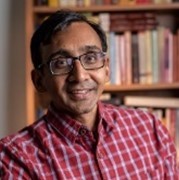 Amit Basole is Associate Professor of Economics and Head, Centre for Sustainable Employment, Azim Premji University. Prior to joining Azim Premji University, he taught at Bucknell University and the University of Massachusetts, Boston. His research interests include labour and structural change, poverty and inequality, and the economics of artisanal knowledge. He is the lead author of the State of Working India report. He has a PhD in Economics from the University of Massachusetts, Amherst.
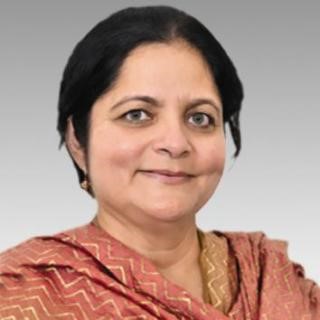 Sonalde Desai is a Distinguished University Professor at the University of Maryland and Professor at NCAER, and Director of NCAER’s National Data Innovation Centre. She is a demographer whose work deals primarily with social inequalities in developing countries with a particular focus on gender and class inequalities in human development. While much of her research focuses on South Asia, she has also engaged in comparative studies across Asia, Latin America, and Sub-Saharan Africa. She has published articles in a wide range of sociological and demographic journals including American Sociological Review, Demography, Population and Development Review, and Feminist Studies. Dr Desai leads the India Human Development Survey and is serving as President for the Population Association of America for 2022.