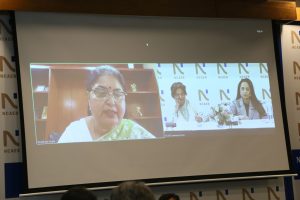
NCAER, in collaboration with the International Labour Organization (ILO), convened a high-level roundtable titled “Building Inclusive Economies: Gender, Financial Inclusion and the Platform Workforce” on 8 December 2025 at its premises in New Delhi.
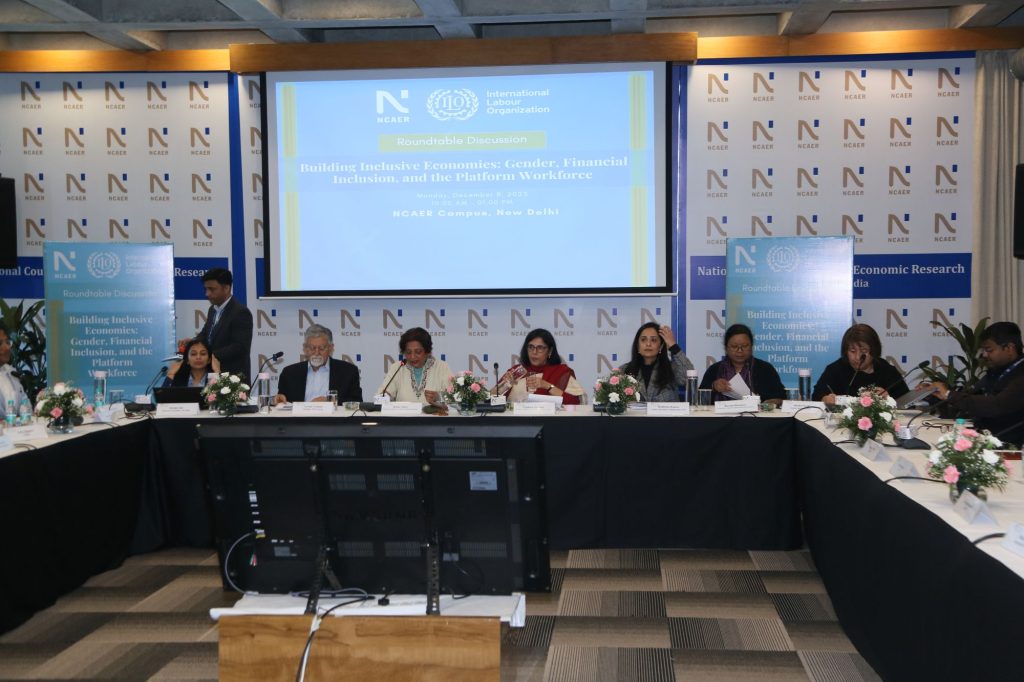
The discussion brought together senior government officials, researchers, practitioners, and representatives from the platform economy to examine gender disparities in platform work and assess how digital and financial inclusion can broaden economic opportunities for women.
 Dr Arvind Virmani, Member, NITI Aayog, delivered the keynote address, highlighting the centrality of skills development and increased female labour force participation to India’s long-term growth prospects. Ms Michiko Miyamoto, ILO Country Director for India, set the stage by reflecting on India’s fast-evolving platform-based business models and their potential to generate new forms of work and labour market outcomes.
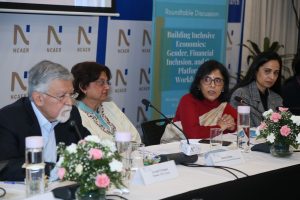 In her intervention, Ms Vandana Gurnani, Secretary, Ministry of Labour and Employment, reiterated the Government of India’s commitment to raising women’s participation in the workforce. She noted that the recently notified Labour Codes seek to ensure universal minimum wages, remove gender-based discrimination, and reinforce workplace safety and social protection, including for platform workers. Ms Sonali Sengupta, Executive Director, Reserve Bank of India, spoke about the country’s ongoing progress in financial inclusion and drew attention to emerging fintech innovations, particularly the Unified Lending Interface which may help strengthen women’s access to credit and financial services.
 Opening the thematic discussions, Dr Ratna Sahay, Professor and Director of the Centre on Gender and the Macroeconomy at NCAER, underscored the need to address gender-specific constraints that limit women’s access to financial services. She observed that improvements in women’s financial inclusion are closely associated with stronger economic growth and reduced inequality.
 On gender dynamics within the platform workforce, Prof Bornali Bhandari pointed out that although platform work offers flexibility in terms of hours and work location, women continue to encounter multiple barriers to entry, including limited access to smartphones, bank accounts, two-wheelers, and the resources required for onboarding. Dr Radhicka Kapoor (ILO) highlighted the “triple burden” faced by women in entering, remaining in, and progressing within the platform economy and stressed the importance of closing gender gaps in access to financial services. Adding to this, Ms Mariko Ouchi, Specialist in Social Protection at ILO, outlined the challenges associated with extending social protection to emerging forms of work and reiterated that social protection constitutes a core element of international labour standards.
Key Themes from the Discussions
 Participants examined a range of actionable measures to strengthen women’s participation in the platform economy. Discussions noted that persistent gaps in digital connectivity, digital skills, and access to digital financial services continue to reinforce gender disparities. Evidence shared during the roundtable showed that women remain underrepresented on location-based platforms, are concentrated in lower-paid segments, and continue to face pay gaps.
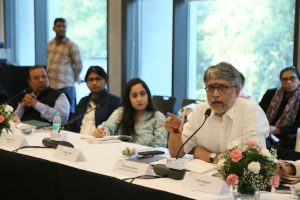 The group also explored how digital financial tools, such as e-wallets, platform-linked credit, microinsurance, and portable social protection accounts could help women manage income volatility, reduce dependence on informal credit, and invest in skills. Participants emphasised the need for coordinated policy efforts aimed at improving digital access, easing entry barriers, strengthening financial literacy, and designing gender-responsive social protection frameworks for platform workers.
The roundtable concluded with a shared recognition of the significant potential of gender-inclusive digital and financial ecosystems to expand opportunities for women in the platform economy. Participants underscored the importance of continued, multi-stakeholder engagement to ensure that India’s rapidly growing platform sector evolves into a more equitable, secure, and empowering avenue of work for women.


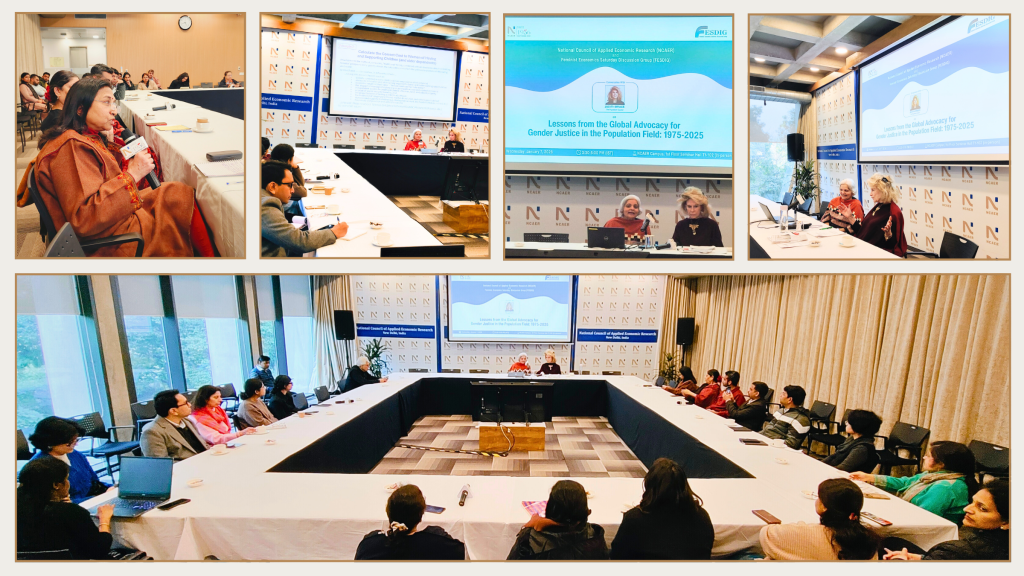

 of employment; sectoral multiplier effects; patterns of occupational mobility; and, the structural barriers hindering increased job creation in the country. The event opened with welcome remarks and introductions by Dr Anil Sharma, Secretary, National Council of Applied Economic Research (NCAER). The NCAER study, authored by Professor Farzana Afridi and her team of researchers at NCAER (Dr Arjita Chandna, Dr Jayanta Talukder, Dr Janani Rangan, Dr Jyoti Thakur, and Ms. Aliva Smruti), shows that India needs to overcome bottlenecks in increasing both the quality and quantity of workforce participation and labour productivity. Emphasising the role of skilling and small enterprises as key drivers of job creation in the country, the study indicates that the recent increases in employment are primarily due to the rise in self-employment, while transition to a skilled labour force has been slow. Strengthening employment opportunities in the labour-intensive manufacturing and services sectors could help sustain GDP growth at around 8 per cent, consistent with the vision of Viksit Bharat, says the study.
 Launching the report, NCAER Vice Chairman Manish Sabharwal said, “India is on track to become the world’s third largest economy. While its per capita GDP currently ranks 128th, this underscores valuable opportunities to prioritise employment and inclusive growth.” “India’s self-employment dominance is due to economic necessity rather than entrepreneurial dynamism. Just like small farmers, most of the small enterprises function at subsistence level. India must confront the reality that its employment future is tied to the productivity of its smallest enterprises,” said Professor Afridi. The main challenge is that the unincorporated household enterprises operate with low levels of capital, productivity, and technology adoption. “Enterprises using digital technologies hire 78 per cent more workers as compared to those not using technology. Even a 1 per cent increase in access to credit increases the expected number of hired workers by 45 per cent,” noted Professor Afridi.
 In the context of the persistent challenges faced by India in generating employment despite its distinct demographic advantage, the report suggests that on the supply side, India’s workforce could benefit greatly from upskilling, particularly with the advent of new technologies and AI. Medium-skilled jobs dominate employment growth, especially in the services sector, whereas manufacturing remains low-skill intensive. Simulations in the study show that increasing the formally skilled workforce under the moderate growth scenario could lead to significant job gains in the labour-intensive sectors. Thus, an increase of 12 percentage points in the share of the skilled workforce through investment in formal skilling could lead to more than 13 per cent increase in employment in the labour-intensive sectors by 2030. Similarly, augmenting the share of the skilled workforce by 9 percentage points could generate 9.3 million jobs by 2030.
 Discussing the report, Professor Aditya Bhattacharjea, Visiting Professor, Institute for Studies in Industrial Development, said, “The report places India in an international context and highlights areas where the country has unique opportunities for improvement and stronger alignment with global benchmarks.” Dr GC Manna, Senior Advisor, NCAER, pointed out, “The report identifies the sectors with the greatest potential to generate significant employment growth.” It estimates the multiplier effects of inter-sectoral linkages to project that a moderate growth in Gross Output (GO) of the relatively more labour-intensive sub-sectors within the manufacturing and services sectors will lead to multi-fold job creation by 2030, of about 53 per cent in the textiles, garments, and related industries in manufacturing, and 79 per cent more jobs in trade, hotel, and related services.
 The report concludes with policy suggestions for boosting aggregate demand and investment, and enhancing workforce productivity. It recommends targeted interventions to unlock employment potential in specific sectors. In manufacturing, reorienting production-linked incentives towards labour-intensive industries such as textiles, garments, footwear, and food processing can yield higher job multipliers. In services, policy support for tourism, education, and health can create large-scale, inclusive employment.
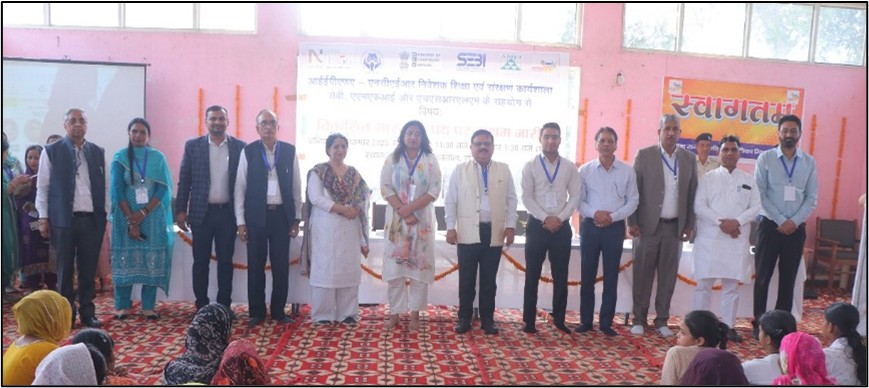
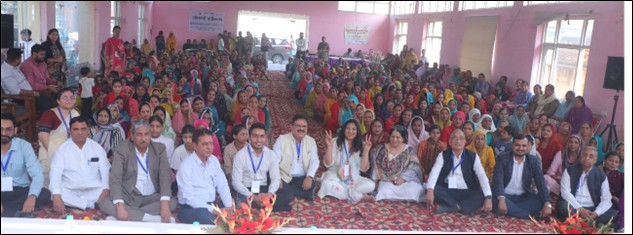 The workshop brought together distinguished experts, regulators, academic leaders, and enthusiastic members of women’s self-help groups to deepen understanding of investor protection, financial behaviour, and economic participation in the digital era. The workshop aligned with India’s vision of enabling women to become confident, informed, and active contributors to a financially resilient and prosperous Viksit Bharat.
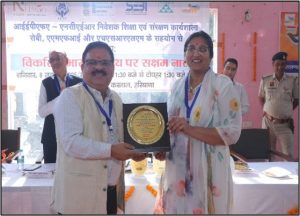 The Workshop’s tone was set by the Welcome Address by CEO, Haryana State Rural Livelihood Mission (HSRLM), Mr. Suraj Bhan, who highlighted the crucial role of women in shaping India’s economic future. Delivering the Keynote Address, Ms. Anita Shah Akella, CEO, IEPFA & Joint Secretary, Ministry of Corporate Affairs, highlighted that women are the true strength of Viksit Bharat and must be financially aware, digitally skilled, and investment-ready. She emphasised IEPFA’s initiatives like Niveshak Didi and Niveshak Shivir that empower women to save, invest safely, and protect themselves from financial fraud. A panel discussion on the theme followed, moderated by