The workshop featured a panel discussion with distinguished experts across the financial sector, including Dr. C.S. Mohapatra, IEPF Chair Professor at NCAER; Mr. Shashi Kumar V., Executive Director, SEBI, Mr. Sashi Krishnan, Director, National Institute of Securities Market & Former CEO, NPS Trust, Mr. Navneet Munot, Chairman, Association of Mutual Funds in India and MD & CEO, HDFC AMC Ltd., Ms. Kamala Kantharaj, Capital Market Expert & Chief Regulatory Officer, BSE India Ltd., and Mr. Bharat Panchal, Cyber Security Expert & Former Chief of Risk Management, NPCI.

They shared valuable insights on digital financial education’s pivotal role in empowering investors and ensuring capital market development. Their discussions highlighted how digital platforms enable accessible and effective financial education, supporting investors in making informed decisions while safeguarding against digital fraud. The panel emphasized that robust regulatory frameworks and secure digital systems are essential to enhance investor confidence and drive inclusivity in India’s capital markets. This dialogue reinforced digital financial literacy as a powerful tool to equip investors for informed participation and self-protection in a digitalized economy.
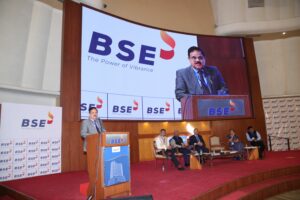 The workshop was inaugurated by Mr. Sundararaman Ramamurthy, CEO & Managing Director of BSE India Ltd., who emphasized the transformative potential of digitalization in making financial education more accessible and impactful for investors across all demographics. He underlined the BSE’s commitment to fostering financial awareness, enhancing market efficiency, and building investor confidence through innovative digital platforms. He landed the collaborative effort of conducting Investor Awareness Workshop with BSE.
 In her Keynote Address Ms. Anita Shah Akella, CEO and Joint Secretary of IEPFA highlighted the pivotal role of digital tools in transforming financial education, emphasizing the need to equip investors with the knowledge to protect their interests in an increasingly complex market. She addressed the challenges of the digital landscape and discussed how innovative approaches can strengthen investor protection while fostering the development of capital markets. Furthermore, Ms. Akella reiterated the Government’s commitment to promoting financial literacy and empowering individuals to make informed decisions, urging collaborative efforts between government bodies, financial institutions, and educational organizations to drive investor education and financial inclusion. Her address inspired participants to explore digital solutions for enhancing financial literacy and developing sustainable investment strategies.
 The main highlight of the event was the panel discussion moderated by Dr. C.S. Mohapatra, IEPF Chair Professor at NCAER, who served as the moderator for the session. Dr. Mohapatra provided valuable insights into the evolving challenges of investor protection, particularly in the digital age. He discussed the essential role that regulatory frameworks and educational initiatives play in concept and process learning also mitigating financial risks, emphasizing collaborative commitment to promoting financial security for all citizens. In his opening remarks, Dr. Mohapatra explained how digital tools have the potential to transform traditional methods of financial education, fostering more inclusive and comprehensive investor protection mechanisms. He highlighted that digital financial education democratizes access to information, enabling a broader spectrum of investors to make well-informed financial decisions and better navigate the complexities of today’s digitalized financial landscape.
Mr. Shashi Kumar V., Executive Director at SEBI, shared insights from his extensive experience in overseeing market regulation, policy, and risk frameworks. He delineated the initiatives taken by SEBI on digitalizing financial education and discussed the need for robust regulatory measures to support the rapid digitalization of financial education. He emphasized, SEBI’s role in integrating digital safety and transparency into investor education initiatives.
Shri Sashi Krishnan, Director NISM, highlighted the increased shift towards digitalization of financial and investor education, where informed decision-making is crucial. He outlined the current activities of NISM and the role digitalization is playing in capacity building for the securities market ecosystem and in certification. He urged stakeholders to leverage digital platforms to provide targeted financial guidance to investors, with the objective of supporting them in long-term financial planning.
Mr. Navneet Munot, Chairman of AMFI and Managing Director & CEO of HDFC AMC Ltd., being fully appreciative of the workshop effort, spoke on the significance of mutual fund education and the role of digital outreach in expanding investor base while enhancing investor knowledge. He emphasized that digitalization not only streamlines financial access but also supports diversified and secure investment opportunities that align with long-term wealth creation.
Mr. Bharat Panchal, a leading expert in cybersecurity and former Chief of Risk Management at the National Payments Corporation of India (NPCI), now serves as the Chief Risk Officer at Bima Sugam, underscored the essential role of cybersecurity in the digitalization process. He averted on potential risks associated with the digital shift, emphasizing the need for stringent cybersecurity frameworks to protect investors from online fraud. He explained about the digitalisation programs of the Government and highlighted how secure digital platforms are fundamental to advancing investor trust and financial empowerment.
Ms. Kamala Kantharaj, Chief Regulatory Officer at BSE, spoke on the importance of digital innovation in strengthening market infrastructure and regulatory frameworks. She highlighted BSE’s initiatives in integrating digital channels to enhance investor protection and stressed on the importance of regulatory foresight to address challenges arising from digitalization.
This workshop marks a continued effort by IEPFA, NCAER, and BSE to promote financial literacy, empower investors, and support capital market development through modern, digitalized approach’s to financial education and empowerment.
About IEPFA
The Investor Education and Protection Fund Authority (IEPFA) was set up on September 7, 2016, under the aegis of the Ministry of Corporate Affairs, Government of India, for administering the Investor Education and Protection Fund for making refunds of shares, unclaimed dividends, and matured deposits/debentures, among other things, to investors.
About NCAER
NCAER is India’s oldest and largest independent economic think tank, set up in 1956 to inform policy choices for both the public and private sectors. It is one of a few independent think tanks world-wide that combines rigorous economic analysis and policy outreach with deep data collection capabilities, particularly for large-scale household surveys. NCAER is led by its Director General, Dr Poonam Gupta, the institution’s first woman head, who assumed office on 1 July 2021, and it is governed by an independent Governing Body currently chaired by Mr. Nandan M. Nilekani.
IEPF Chair Unit at NCAER
The Investor Education and Protection Fund Authority (IEPFA), Ministry of Corporate Affairs, Government of India established an IEPF Chair on Regulation and a Programme of Economic & Regulatory Research at NCAER on Indian Investor Education, Awareness & Protection, in March 2020 with the objective of pursuing research that will help improve investor education and protection in India, and ultimately the investment climate.
The objective of IEPF Chair is to work in the broad areas of economics and regulation considering the broad objective of the IEPFA. The activities of the IEPF Chair unit include measures to assess and improve the efforts and outcomes of investor education and protection in India. In this process, we aim to develop a larger community of academicians, researchers and practitioners to create a knowledge repository both quantitative and qualitative which can form foundation for evidence-based policy actions. As the Chair Unit embarked on its fifth year of the work programme, the Unit hopes to contribute in a larger measure in 2024-25 and in future years. Dr C.S. Mohapatra is the current IEPF Chair Professor at NCAER since July 2023.
BOMBAY STOCK EXCHANGE (BSE), MUMBAI
The Bombay Stock Exchange (BSE), established in 1875, is Asia’s oldest stock exchange and a cornerstone of India’s financial markets. Known for its commitment to transparency, efficiency, and investor protection, BSE has consistently driven innovation in financial trading and market infrastructure. Today, it is one of the world’s fastest stock exchanges, with a median trade speed of 6 microseconds, supporting a diverse range of products including equities, derivatives, debt instruments, currencies, and mutual funds.
BSE has been at the forefront of digital transformation, pioneering efforts in automation, risk management, and investor education. Through platforms like BSE StAR MF, India’s largest mutual fund distribution platform, and BSE Ebix, a joint venture for insurance distribution, it has expanded access to financial products across urban and rural areas. Additionally, BSE’s initiatives in financial literacy and inclusivity, including collaborations with educational institutions, aim to empower investors by providing them with the knowledge and tools needed to make informed investment decisions.
Regulated by the Securities and Exchange Board of India (SEBI), BSE upholds stringent standards of governance and compliance, making it a trusted institution in the global financial ecosystem. Its commitment to sustainable finance and corporate social responsibility underscores its role not only as a financial marketplace but also as a catalyst for economic growth and investor protection in India.
Press Coverage:
PTI: IEPFA, NCAER and BSE jointly organised a workshop on the revolutionizing impact of digital technology on financial sector
The Statesman: IEPFA organises workshop on digitalisation of Financial Education at BSE
Taxmanagementindia.com: IEPFA, NCAER and BSE jointly organised a workshop on the revolutionizing impact of digital technology on financial sector
Financeoutlookindia.com: IEPFA Holds a Workshop on Digitizing Financial Education at BSE
Prameyanews.com: IEPFA, NCAER & BSE organise digital technology workshop on financial sector
Alayaran.com: Digital Revolution Hits Financial Sector as IEPFA, NCAER and BSE Organise Workshop


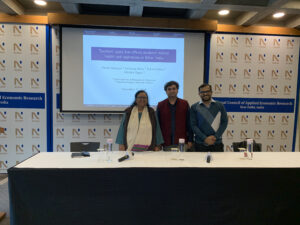 NCAER hosted a seminar titled “Does Teachers’ Caste Identity Affect Students’ Mental Health? Evidence from Bihar, India,” presented by Dr Ritwik Banerjee (Associate Professor, IIM Bangalore) and discussed by Dr Sandip Datta (Assistant Professor, DSE), as part of its Dialogue Room Seminar Series, chaired by Dr Bornali Bhandari, moderated by Dr Jyoti Thakur, and organised by Dr Souryabrata Mohapatra on Monday, 2 December 2024, at 3:00 PM on campus.
 1 Ritwik Banerjee is an Associate Professor of Economics at IIM Bangalore. His primary research area is at the intersection between behavioural and developmental economics, and he extensively uses experimental methods in his research. Some topics he has investigated or is presently investigating are corruption, inequality, education and discrimination. His research has been published in peer-reviewed journals such as Games and Economic Behavior, Journal of Public Economics and European Economic Review. Prior to his current assignment, Ritwik worked as a doctoral research fellow at Aarhus University, Denmark, with an independent grant from the Social Science Research Council of Denmark. He was an Academic Visitor at the Research Department of Federal Reserve, Chicago during the summer of 2012, a Visiting Scholar at the Economics Department, Harvard University, in Spring 2015, Visiting Scholar at UNU WIDER, Helsinki in Spring 2019, Fulbright-Nehru Academic and Professional Excellence Fellow, University of Berkeley in Fall 2019, and Humboldt Fellow, Goettingen University, 2022-25. He has also served as a Consultant at the World Bank in Washington DC and as a Research Associate at ICRIER, New Delhi. For more information on his research, please visit
  2 Sandip Datta is an Assistant Professor at the Delhi School of Economics. He earned his PhD from IIT Delhi in 2018, and his research spans education, health, labour and politics. He has published in esteemed journals like the World Bank Economic Review and Oxford Development Studies. Sandip is also an active peer reviewer for prominent journals, including the Journal of Development Studies, Economic Modelling, WBER, etc. His diverse academic achievements highlight his significant contributions to the field of social economics. For more details, please visit
  3 Bornali Bhandari is a Full Professor at NCAER with a background in international economics and macroeconomics, specifically focusing on the impact of globalisation on development. Currently, she is engaged in a number of industry studies, including automobiles, farm mechanisation and digitisation. Her wider research interests include analysis of skilling from a 3-E perspective (education, employability and employment), e-Governance, infrastructure, particularly the roads and ICT sectors, G-20 issues like climate change financing and reserve currency, FDI and trade-related issues. She also oversees the production of the NCAER Quarterly Business Expectations Surveys. Bornali has received her doctorate degree from the University of Oregon, USA. For more information, please visit