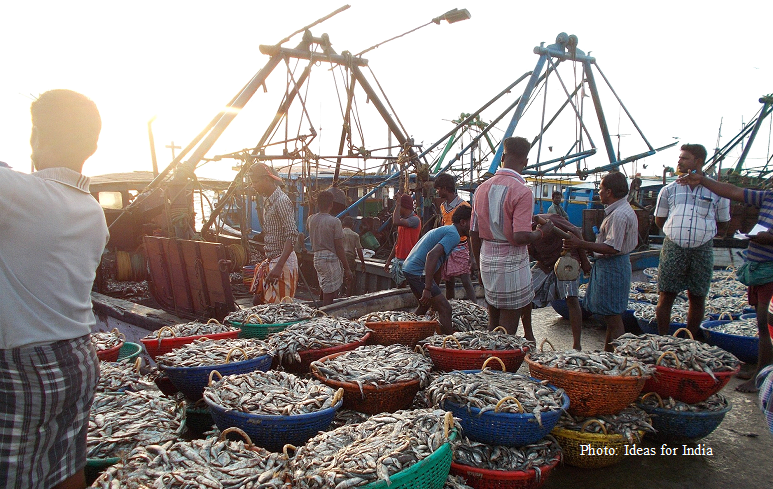
While India’s fish consumption has been dominated by freshwater species, high-value marine fish and shrimp are expanding their footprint. In this post, Bandyopadhyay and Joshi discuss how this transition is reflective of broader changes in income, urbanisation, technology-driven market access, and consumers’ nutrition awareness. They highlight the role of policy in ensuring affordability, strengthening environmental stewardship, and developing robust domestic markets.
India’s fish consumption patterns are undergoing a significant but under-recognised transformation. For decades, freshwater species such as rohu, catla, and mrigal dominated household diets, shaped by affordability, accessibility, and deeply rooted culinary traditions. Today, new evidence from the National Sample Survey (NSS) 2011-12, NCAER’s (National Council of Applied Economic Research) 2021 household survey and projections up to 2025, shows a gradual but persistent shift toward a more diversified seafood basket that includes high-value marine fish and shrimp. This transition reflects broader changes in income, urbanisation, technology-driven market access, and consumers’ rising nutrition awareness.
Freshwater species continue to account for about two-thirds of household fish consumption in India. But their share is eroding as marine varieties (26%) and shrimp (4%) expand their footprint. Though shrimp still represents a small fraction of household consumption, its growth rate is substantially higher than any other category. A combination of rising middle-class incomes, the expansion of cold-chain networks, and spillovers from export-oriented aquaculture are all helping restructure domestic demand. As more households shift from seeking “more fish” to “better fish”, consumption is becoming increasingly aspirational.
Emerging geographic clusters of demand
One of the most striking aspects of this transition is the emergence of new geographic clusters of seafood demand. Traditional coastal consumers in Kerala, Goa, Tamil Nadu, and Puducherry remain important, but demand is widening both eastwards and northwards. In Odisha and West Bengal, once dominated by freshwater and brackish-water species, urban households increasingly include shrimp as an occasional complement to traditional choices. In landlocked states such as Tripura, Meghalaya, and parts of northern India, marine fish consumption is rising due to improved cold-chain integration and the availability of frozen and ready-to-cook products.
Digital retail has accelerated this shift. Hyperlocal seafood delivery platforms in Kolkata, Bengaluru, Kochi, Chennai, and Guwahati have expanded access by offering cleaned, packaged, and hygienically handled fish delivered to the doorstep. This technology-led “democratisation of seafood retail” has made species once confined to coastal markets available across cities. In many ways, India’s seafood transition mirrors earlier changes in the poultry sector — where modern retail scaled up supply while transforming consumer expectations of hygiene and convenience.
Nutrition and equity implications
This evolving consumption pattern has broad nutritional implications. Fish remains one of the most affordable and bioavailable sources of high-quality protein, omega-3 fatty acids, and essential micronutrients. For low-income households facing persistent protein-energy deficits, even modest increases in fish consumption can translate into significant health gains.
However, the ongoing premiumisation of seafood raises equity concerns. The price differential between low-cost freshwater fish and higher-value marine or shrimp varieties may widen as demand for the latter grows faster than supply. Without policy attention, diversification in the seafood basket could reinforce nutritional inequality—where affluent households move up the value chain while poor households continue to rely exclusively on low-cost freshwater species.
A balanced approach is needed: strengthening the supply of affordable freshwater fish while supporting innovation and growth in high-value aquaculture. Policymakers can play a critical role by reducing price distortions, improving market infrastructure, and promoting species diversification in freshwater aquaculture that widens consumer choice without straining household budgets.
Environmental and sustainability considerations
Any analysis of India’s fish consumption must be situated in the broader ecological context. With aquaculture contributing more than 70% of total fish output, sustainability concerns are becoming increasingly salient. Intensive shrimp farming, while profitable, is associated with water pollution, soil salinity, disease outbreaks, and high feed dependency. These risks are amplified when production expands without adequate environmental safeguards.
Several states are responding by adopting cluster-based aquaculture models supported by water management protocols, biosecurity guidelines, and common infrastructure facilities. Andhra Pradesh and Odisha offer promising examples where production efficiency has been improved alongside environmental safeguards. Scaling such models, and promoting innovations in low-impact aquaculture systems, is essential for aligning India’s growing seafood demand with ecological sustainability.
The underdeveloped domestic market
Despite being one of the largest fish producers in the world, India’s domestic market remains an underleveraged opportunity. Historically, policy attention has tilted towards export promotion, particularly for shrimp. But domestic demand is now emerging as a major driver of sectoral growth. Harnessing this opportunity requires investment in cold-chain infrastructure, refrigerated transport, modern retail formats, and product standardisation.
Ready-to-cook, filleted, and hygienically packaged fish products have particularly high potential in urban markets, where younger consumers increasingly prioritise convenience. Strengthening domestic value chains can reduce post-harvest losses, ensure consistent quality, and support better price realisation for farmers and fishers.
Equally critical is the need for regular household consumption surveys and forecasting tools. Reliable data on household demand, species preferences, and price sensitivity can guide production planning, reduce mismatch between supply and consumption patterns, and support evidence-based policymaking.
A broader socioeconomic shift
India’s shift “from freshwater staples to premium seafood” reflects more than changing tastes. It signals deeper transformations in household income, mobility, market integration, health awareness, and aspirations. If managed well, this transition can deliver a triple dividend: improved household nutrition, higher incomes for fishers and aquaculture farmers, and a more sustainable seafood economy.
However, achieving this will require policy to move beyond production-centric strategies. A future-ready approach must integrate three priorities: ensuring affordability, strengthening environmental stewardship, and developing robust domestic markets. The transformation underway in India’s seafood consumption is ultimately a story of how a country can modernise its diet while balancing tradition, sustainability, and equity — a balance that will determine the long-term resilience of both households and the fisheries sector.
Saurabh Bandyopadhyay is Senior Fellow and Laxmi Joshi is Felllow at NCAER. Views are personal.