1 May, 2026
Published in: Ideas for India


Published in: Ideas for India
India faces a persistent challenge in generating formal, productive jobs for its growing workforce. The four new Labour Codes rolled out in November 2025, seek to address the structural imbalance in the workforce by simplifying 29 existing labour laws into a more coherent framework.
Over the next five weeks, based on their new NCAER working paper, Farzana Afridi and co-authors will review these reforms. Each of the explainers (one per week) on the four new Codes – Code on Wages, Code on Social Security, Industrial Relations Code, and Occupational Safety, Health and Working Conditions Code – will delve into the timeline of the reform and its legislative provisions, and present a critical review of the theoretical and empirical evidence on the potential effects on employment and labour productivity, including formalisation of the workforce. The final post in the series will synthesise the possible implications of all the four codes on India’s labour market.
In this introductory post, Afridi lays out the structural weaknesses in India’s workforce and provides a global perspective on the country’s employment and labour productivity landscape.
India’s economic growth over the past three and a half decades has been striking but the headline numbers carry a persistent and increasingly urgent challenge of addressing the structural weaknesses in India’s labour force.
First, India’s labour force participation rate sits below the trend line for economies at comparable economic levels (Figure 1). This reflects a structural failure to productively engage a young population that is growing rapidly (NCAER Report, 2025).
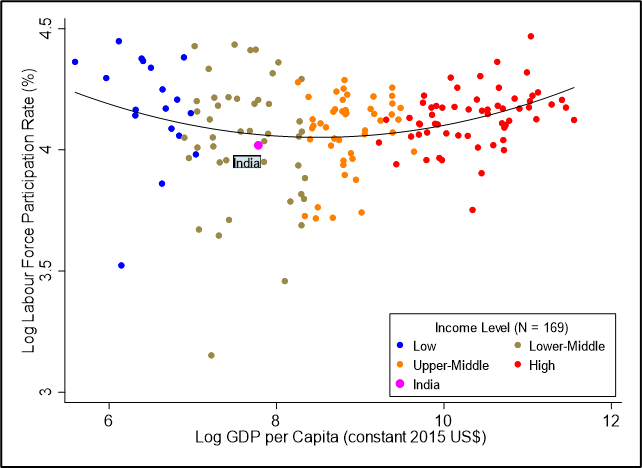
Source: Authors’ calculations. World Bank database (2025).
Notes: (i) The per capita GDP (gross domestic product) series is measured at constant 2015 US$ prices. (ii) LFPR is for ages 15+. (iii) Per capita GDP classifications follow the World Bank’s FY2025 income group thresholds. (iv) Sample consists of 169 countries.
Second, India’s workforce continues to exhibit disproportionate concentration in agriculture and self-employment, and limited expansion in salaried work (Periodic Labour Force Survey (PLFS) Annual Report, 2025). As seen in Figure 2, India’s agriculture sector continues to house the lion’s share of employment (about 45%), despite contributing less than 20% to total GVA (gross value added). The expected transition of surplus agricultural labour into formal wage employment remains incomplete. Labour market adjustment is taking place through informalisation, with workers entering the labour force in low-productivity and precarious forms of employment.
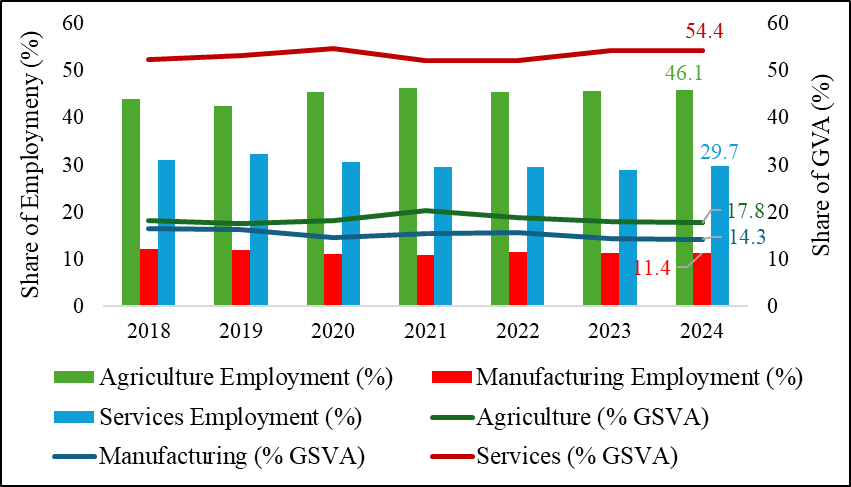
Source: Authors’ calculations based on data from PLFS 2017-18 to 2023-24, Ministry of Statistics and Programme Implementation (MoSPI)
Note: GVA is in 2011-12 constant prices.
Not surprisingly, India’s share of wage and salaried workers lies below the international average (Figure 3). This structural imbalance gets reflected in India’s anomalously higher share of self-employment relative to its per capita income (PLFS). This formalisation deficit remains the central labour market challenge as a large and increasingly educated work force is unable to access stable contract-based work at scale.
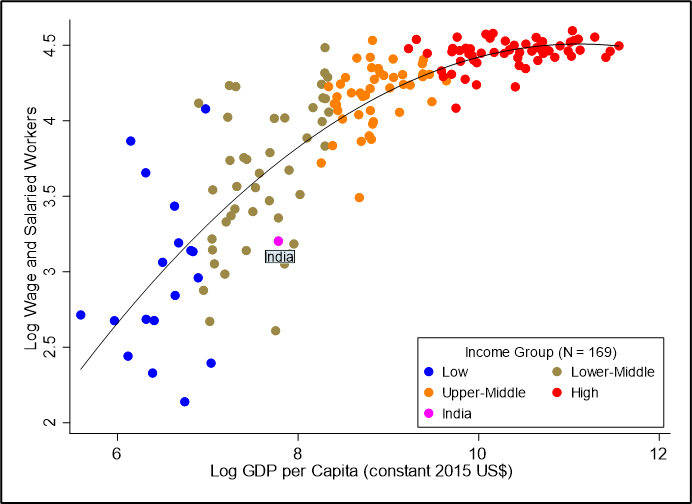
Source: Authors’ calculations based on World Bank database (2025).
Notes: (i) Proportion of wage and salaried workers is given as percentage of total employment. (ii) Income classifications follow the World Bank’s FY25 thresholds. (iii) Sample consists of 169 countries.
Third, the informal structure of the workforce is accompanied by a consistent decline in India’s labour-capital ratio as income (Figure 4). The Penn World Table data (v11.0, 2023) tells us that India’s capital stock expanded by over seven times between 1990 and 2023, while employment roughly doubled in size. Capital is substituting for labour at a dramatic pace, even in sectors where India’s comparative advantage should favour the opposite.
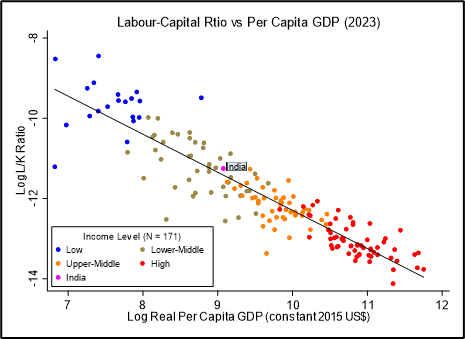
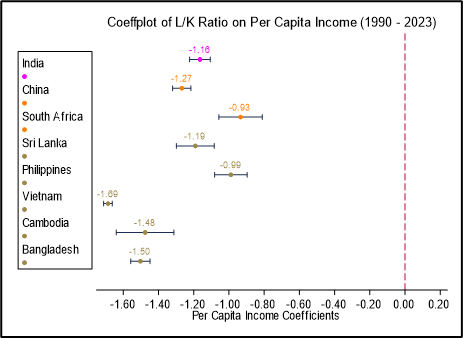
Source: Authors’ calculations based on data from Penn World Table 11.0 (2023), Groningen Growth and Development Centre and World Bank database (2025).
Notes: (i) L/K (labour/capital) ratio is the number of persons engaged (in millions) divided by capital stock measured at constant 2021 US$ prices (in millions), (ii) The per capita GDP series is measured at constant 2015 US$ prices. (iii) The colour scheme distinguishes the World Bank Income Groups (FY2025 thresholds) with the countries arranged in decreasing order of per capita GDP after India (right-hand side graph). (iv) Sample (left-hand side graph) consists of 171 countries. (v) 95% confidence interval bands are shown. A 95% confidence interval means that, if you were to repeat the experiment with new samples, 95% of the time the calculated confidence interval would contain the true effect.
The predominant informal structure accompanies low worker productivity. India’s output per worker is slightly above global labour productivity levels but still has a significant bridge to cross to reach the per capita GDP of high-income countries, even by 2047 (Figure 5). Cross-country regressions further indicate India’s weak relationship between productivity growth and income expansion, reflecting a dual nature of narrow concentration in capital- and skill-intensive sectors, and a larger share of the workforce engaged in low-productivity activities (Figure 5).
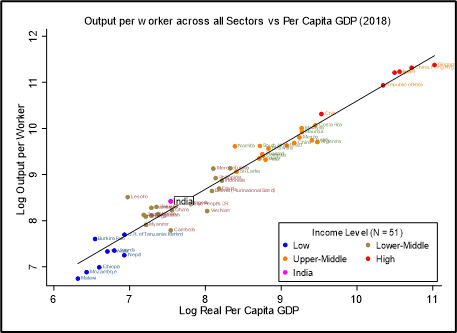
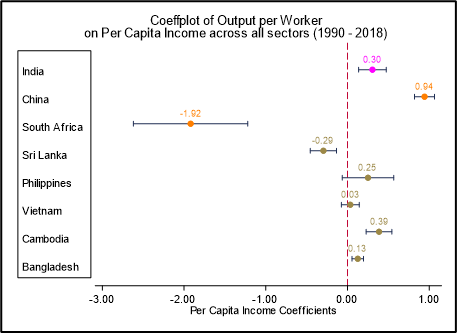
Source: Authors’ calculations based on data from Economic Transformation Database (ETD; 1990-2018), Groningen Growth and Development Centre and World Bank database (2025).
Notes: (i) Output per worker is GVA (measured in constant 2015 US$) divided by persons employed. (ii) Per capita GDP is in constant 2015 US$. (iii) Income classifications follow the World Bank’s 2017-18 thresholds. (iv) The colour scheme distinguishes the World Bank Income Groups with the countries arranged in decreasing order of per capita GDP (2018) after India. (v) Coefficients (right-hand side graph) are plotted with 95% confidence interval bands. (vi) Sample (left-hand side graph) consists of 51 non-OECD (Organisation for Economic Co-operation and Development) countries, as available in the ETD.
In summary, India faces a persistent challenge in generating formal, productive jobs for its growing workforce, with only a small share employed in the formal wage sector. The four new Labour Codes rolled out in November 2025, seek to address the structural imbalance in our workforce by simplifying 29 existing laws into a more coherent framework. This marks a shift from a fragmented legal system to a unified structure aimed at reducing regulatory complexity and improving compliance.
The writer is professor of Economics, ISI (Delhi), and visiting professor, NCAER.