Are we seeing a turnaround in infrastructure investment?

Rising public capital expenditure has supported growth, but weak private participation suggests India’s infrastructure investment cycle is yet to turn decisively.

Government data shows that India grew at a scorching pace of 7.8 per cent in the first quarter of FY 2026-27. This was the highest Q1 real GDP growth during the four years from 2023-24 to 2026-27. In July 2026, the IMF described India as one of the world’s fastest-growing economies and a key engine of global growth. India’s sovereign credit assessment was affirmed at ‘BBB/A-2’ with a Stable Outlook by S&P Global Ratings in August 2026.

The high Q1FY27 growth rate and associated accolades are indeed a major achievement, coming as they do amid persistent geopolitical tensions and uncertainty around global trade, while maintaining the 7 per cent+ Indian growth trajectory over the past three financial years.

One of the key enablers of growth is investment, as reflected in Gross Fixed Capital Formation, which grew by 11.9 per cent in Q1FY27. One of the crucial components of investment is infrastructure investment.

When infrastructure investment focuses on augmenting road, air, railway, and port connectivity, more electricity generation projects are set up, and there is better-quality water supply and sanitation, enabling more economic activity, with factories coming up and leading to more income and jobs.

For these reasons, in Budget 2026–27, the Finance Minister announced that the Central Government capital expenditure would be ₹12.2 lakh crore. She also referred to the massive increase in Central Government capex, which has increased manifold from ₹2 lakh crore in FY2014-15 to ₹11.2 lakh crore in FY 2025-26 (Budget Estimates).

But we need to distinguish between capital expenditure and infrastructure investment (as defined by the Department of Economic Affairs, Ministry of Finance through the Harmonised Master List of Infrastructure) for many reasons, including the fact that while capital expenditure constitutes about 34 per cent of GDP, infrastructure investment is only about 4.6 per cent of GDP (CRISIL 2023).

India’s infrastructure investment gap

The World Bank, in its Growth Report (2008), states that fast-growing East Asian countries during their fast-growth phases have spent about 7-8 per cent of their GDP on infrastructure, which was probably the right level for fast and sustained growth.

This was the basis for the $1.5 trillion infrastructure investment target for the six years ending FY25 in India’s first and only National Infrastructure Pipeline (2020). Since infrastructure investment is among the most important enablers of growth, this data should be officially monitored and released by the government.

However, the government has stopped collecting this data since 2015 (NITI Aayog, Appraisal Document of the 12th Five-Year Plan, 2012-17), thereby compromising evidence-based policy-making in this critical area.

One has to rely on other data sources, including private sources, which show that India’s actual infrastructure investment achievement is 4.6 per cent of GDP, well short of the target.
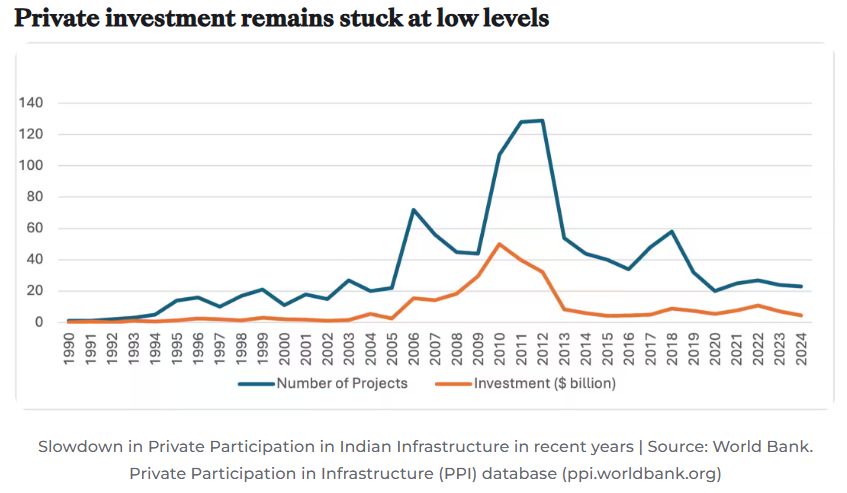
 An important source of infrastructure investment data is the World Bank’s Private Participation in Infrastructure (PPI) database, which tells us that PPI in India has not recovered from the Covid-19 dip and has stagnated at a low level.

It also tells us that the peak PPI in terms of number of projects and investments happened in the five years from 2008 to 2012 (Eleventh Five-Year Plan period) – there was financial closure of 453 projects in the 2008-12 period accounting for an investment of $170 billion.

In the latest five years (2020-24) for which data are available in the World Bank’s PPI database, these numbers have dwindled to a paltry 119 projects, accounting for only $36 billion in investment.

So, it can be stated that what India did in terms of PPI over the latest five years was roughly a quarter of what it did during the Eleventh Five-Year Plan period.
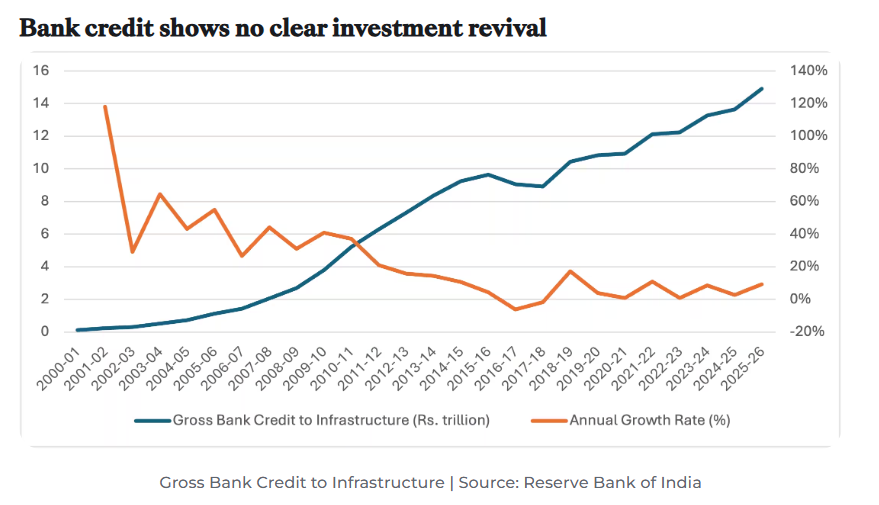
Reserve Bank of India, the country’s central bank, monitors the data on bank credit to infrastructure. As per the RBI data on Industry-wise Deployment of Gross Bank Credit, the total gross bank credit to infrastructure was ₹15.12 trillion as on 31 July 2026, and the annual growth rate (July to July) of this variable was 10.2 per cent, up from 3.4 per cent in the previous year.

The most important components of the gross bank credit to infrastructure are power (₹8.69 trillion) and road (₹3.42 trillion) sectors. The infrastructure projects, especially private ones, are highly leveraged, and it can be assumed that a major share of their debt funding came from the banking sector.

Positioning the current year’s data over a relatively long time period, Figure 2 below shows the deployment of gross bank credit to infrastructure over the last 25 years. The

figure shows that the growth rate of Gross Bank Credit to Infrastructure (the orange curve) has flattened out in recent years.

Analysis using Z-scores also shows that the recent 10.2 per cent year-to-year growth rate (July 2026 over July 2025), or the 9.2 per cent for the full FY 2025-26 (z-score -0.55), is not an outlier on the positive side.

So, what do the data from three sources (Government, World Bank and RBI) tell us about the Indian infrastructure investment story? That there is no turnaround in infrastructure investment in India in recent years. That private infrastructure investment has stagnated at a low level post-COVID.

That the massive upsurge in capital expenditure by the Central Government (not all of which is infrastructure investment) is only substituting for the low level of private infrastructure investment.

Finally, it is high time that the government started publishing official statistics on total infrastructure investment (from the Central Government, State Governments, and the private sector) in the country, as it did until 2015, to facilitate evidence-based policymaking in this critical area.

[This article is authored by Kumar V Pratap. He is a Professor of Practice at Shiv Nadar University and a visiting Professor at National Council of Applied Economic Research (NCAER). He served as Joint Secretary (Infrastructure Policy and Finance, Government of India, from 2017 to 2020. The views are personal]

India’s E20 transition needs to look beyond the engine

A motorist sees E20 simply as petrol with a higher ethanol content. But before it reaches the vehicle, the fuel passes through blending facilities, storage terminals, transportation systems, underground storage tanks, pipelines, pumps and dispensing equipment. Every stage matters in determining whether the fuel reaching the consumer retains the quality with which it was produced.

Yet India’s E20 debate has largely centred on the last link in this chain—the engine. Concerns about mileage, older vehicles, fuel system components, and maintenance costs are legitimate and should not be dismissed. But as India changes the composition of its transport fuel, another question deserves equal attention: Is the infrastructure that stores and delivers E20 ready for the change?

The question matters because ethanol behaves differently from conventional petrol. It has an affinity for water, and India’s E20 uses anhydrous ethanol, which is dried before being blended with gasoline. If water enters the blend, it can disrupt its stability and create a more challenging environment for certain metals, coatings, seals and other components.

In India, this makes moisture control important even before E20 reaches the petrol pump. At blending depots and terminals, tanks need to be dry and clean, and the ethanol received for blending must be protected from moisture. Water contamination can cause ethanol to separate from gasoline, compromising the quality of the final blend. At retail outlets, underground tanks are also checked for rust, water accumulation and the compatibility of gaskets and fittings. The concern, therefore, is not that E20 inherently contains problematic amounts of water, but that water must be kept out of a fuel system designed to handle anhydrous ethanol.

This brings the underground storage tank into the E20 conversation.

In India, underground storage tanks at retail outlets operate within the petroleum-safety framework overseen by the Petroleum and Explosives Safety Organisation (PESO), with OISD standards covering storage, inspection, handling and dispensing. The technical issue is not that steel tanks are inherently unsuitable for E20. India has a large installed base of carbon or mild-steel tanks, and their suitability depends on their condition, protective coatings, corrosion control and associated fittings.

The concern is more basic: Can a tank designed and maintained under an earlier fuel regime simply be assumed to provide decades of reliable E20 service? The answer cannot be presumed. Tank condition, piping, seals, pumps, valves and leak-detection systems need to be assessed together.

This is where the problem becomes practical. Underground tanks are not pieces of equipment that can be routinely taken out, inspected and replaced like a fuel dispenser. Replacing one can require excavation, removal or rehabilitation, installation of new equipment, testing and certification, and often disruption of the outlet’s operations. In practice, major tank replacement is more likely when a tank reaches the end of its certified life, fails an integrity test, or when a petrol pump undergoes a larger redevelopment or modernisation. It is, therefore, unrealistic to assume that thousands of legacy tanks can simply be replaced overnight as E20 becomes the norm.

But this does not mean that every outlet faces the same transition cost. The age profile of the retail network matters. An indicative distribution of outlets places around 50% in the newer category of less than 10 years, 30% in the 10–20-year range and around 20% among legacy outlets older than 20 years. This distinction is important for policy. Older outlets are more likely to enter a major redevelopment or replacement cycle in the coming years, allowing E20-compatible tanks, piping and equipment to be incorporated into investments that would have been required anyway. The more immediate challenge lies with newer and mid-age outlets, where existing infrastructure may still have substantial useful life but may nevertheless require targeted upgrades to demonstrate E20 compatibility.

The policy question, therefore, is not whether India should replace every underground tank. It is how to manage the transition between existing asset life and the new fuel requirement without imposing unnecessary costs.

Brazil offers an instructive comparison, but not a blueprint to be copied.

Brazil has used ethanol as a mainstream transport fuel since the late 1970s and today operates two distinct systems: Anhydrous ethanol blended into gasoline and hydrous ethanol sold directly as an automotive fuel. Its infrastructure and regulatory framework have consequently evolved around a longer experience with ethanol. Brazil’s underground-storage systems include carbon-steel tanks as well as fibre-reinforced alternatives, with greater emphasis on double-wall containment, leak detection and protection against soil and groundwater contamination.

The distinction in fuel chemistry also matters. Brazil’s hydrous ethanol contains water as part of the fuel itself, whereas India’s E20 is produced using anhydrous ethanol. Current Brazilian specifications permit up to 7.5% water by mass in hydrous ethanol, compared with a maximum of 0.7% for anhydrous ethanol. The two systems are, therefore, not directly comparable. But Brazil offers an important lesson: fuel specifications and the infrastructure that handles them have to evolve together.

India has already invested heavily in ethanol production, procurement and blending capacity. The next investment must extend downstream to the petrol pump. India has standards for petroleum storage, inspection and dispensing, but what remains less clear is whether the existing installed base—particularly older underground tanks—is being systematically assessed, maintained and certified for prolonged E20 service.

This requires more than checking whether a tank is leaking today. It means assessing the age and condition of tanks, protective coatings and corrosion controls; monitoring water accumulation; checking compatible piping and seals; and ensuring that leak-detection systems are functioning. Where existing infrastructure cannot meet the required standard, retrofitting or replacement should follow.

The age profile makes a targeted approach possible. For legacy outlets already approaching redevelopment, E20 readiness can be built into the replacement cycle. For newer and mid-age outlets, however, the focus may need to be on retrofitting rather than replacement—upgrading seals and fittings, strengthening corrosion protection, improving water and leak detection, and replacing only those components that cannot demonstrate compatibility.

The problem, however, is not only technical. It is financial.

A major underground-tank upgrade can require excavation, new piping and fittings, testing, certification and temporary closure of the outlet. For smaller retail operators, the cost can be substantial. If E20 is being pursued as a national strategy to reduce crude-oil dependence and strengthen energy security, the cost of making the retail network compatible with that transition should not fall entirely on individual dealers.

The government, together with oil marketing companies, should, therefore, consider an E20 Retail Infrastructure Transition Fund, targeted rather than universal. Support could prioritise older infrastructure requiring accelerated replacement, mid-age outlets requiring significant retrofits, and locations where environmental or operating risks are higher. Financial assistance should be linked to certified E20-compatible upgrades, so that public resources finance measurable improvements rather than routine maintenance.

A national audit could map the age and material of underground tanks, their maintenance condition, corrosion protection, water-monitoring systems, leak detection, piping and dispensing equipment. This could feed into an annual E20 Infrastructure Readiness Index, showing which outlets are fully ready, which require upgrading and which can be brought into compliance through their normal redevelopment cycle.

This does not mean India’s petrol pumps are currently unsafe. Recent industry testing reported that E20 samples met prescribed quality parameters, while inspections reported no widespread water ingress in underground storage tanks. But maintaining fuel quality today is not the same as demonstrating that the entire retail infrastructure is optimised for decades of E20 operation.

Nor should this infrastructure agenda dismiss concerns about vehicle compatibility. Older vehicles may experience differences in fuel economy and performance, and these concerns require transparent testing and consumer information. But the E20 transition cannot be judged only by the engine.

India has spent years preparing the ethanol. It now needs to prepare the infrastructure that carries it. The next E20 milestone should therefore not be another blending percentage alone. It should also answer a more fundamental question: how much of India’s fuel-retail infrastructure is demonstrably E20-ready? That is what will turn E20 from a blending target into a durable fuel transition.

This article is authored by Sanjib Pohit, professor and Sovini Mondal, research analyst, National Council of Applied Economic Research, New Delhi. Views are personal.

Growth gains must widen

Should lead to better jobs, more productive firms.

India’s economy has started the new financial year on a strong note. Real GDP grew 7.8 per cent in the April-June quarter, making India once again one of the fastest-growing major economies. Consumption remained reasonably strong, investment picked up and exports also performed better. These are encouraging signs at a time when the global economy remains uncertain. The number deserves to be celebrated. But it also raises a more interesting question: what is driving this growth, and what is it doing to the structure of the Indian economy?

Manufacturing GVA grew 9.2 per cent in the first quarter. Investment in capital goods has also been strong. Yet manufacturing’s share in GDP remains around 16 per cent, roughly where it was a decade ago. In other words, manufacturing is growing, but its weight in the economy has not changed very much. This is not necessarily a contradiction. A sector can grow rapidly without increasing its share if other parts of the economy are also growing. But for India, the distinction matters because manufacturing has traditionally been seen as the bridge between low-productivity work and more productive employment.

There is another interesting part of the story. Corporate profitability has risen sharply in recent years. Strong profits have helped companies repair their balance sheets and should provide resources for fresh investment. The latest GDP numbers suggest that investment is indeed beginning to respond. The real opportunity now lies in connecting these two developments. If higher corporate profits lead to more investment, and investment creates larger manufacturing ecosystems, supply chains and new businesses, the benefits can spread much beyond the large companies at the top. That is when growth starts changing the structure of the economy.

This matters particularly for India’s young population. Urban youth unemployment remains high, at around 18 per cent. The problem is not simply the absence of jobs. It is also the difficulty of creating enough productive jobs for young people entering the labour market every year. India therefore faces an unusual situation. It has relatively strong economic growth, rising investment and increasingly profitable companies, but the transition towards a more employment-intensive economy remains incomplete.

There is, however, good reason to be optimistic. The foundations are considerably stronger today than they were a decade ago. India’s physical infrastructure has improved, digital connectivity has expanded, domestic companies have become more competitive and global firms are looking at India as an alternative production base. The recent increase in investment suggests that some of these changes are beginning to translate into actual economic activity.

A large factory can create thousands of jobs. But the bigger impact comes when it also creates demand for hundreds of smaller suppliers, transport operators, technicians, designers and service providers. A successful manufacturing ecosystem can generate opportunities well beyond the factory gate.

India does not have a growth problem in the conventional sense. It has a conversion problem: converting growth into productive employment, investment into wider industrial capacity, and India’s large domestic market into globally competitive businesses. In this context, the 7.8 per cent growth rate gives us reason for confidence. The relatively modest change in manufacturing’s share and the continuing challenge of youth employment tell us that there is still considerable ground to cover. That is not a pessimistic conclusion. In fact, it is an opportunity. The next achievement would be to ensure that this growth changes the lives of a much larger number of people — not only through higher incomes, but through better jobs, more productive firms and greater economic mobility.

The writer is with NCAER, New Delhi. Views are personal.

India needs a human- and farmer-centred model of agricultural AI

The ultimate measure of success will not be the sophistication of the algorithms. It will be whether the farmer is better off

Summary

  • India’s farm sector is embracing AI amid climate stress, tiny landholdings and tighter resources.
  • The article argues that the key question is who captures the productivity gains: farmers, tech platforms or input suppliers.
  • It calls for a human- and farmer-centred AI model, built on public digital infrastructure, farmer data rights, strong cooperatives and impact measured by farm incomes, not app adoption.

Artificial intelligence (AI) is entering Indian agriculture at a time when the sector is already undergoing profound change. Weather uncertainty is increasing, farm sizes remain small, markets are becoming more integrated, and farmers are being asked to produce more with increasingly constrained land and water resources. AI promises to help address several of these challenges—from predicting weather and crop diseases to improving input use, market intelligence and supply chains. But there is a question that receives far less attention: if AI makes Indian agriculture more productive, who will capture the gains?

This is not a philosophical question. It is an economic one, and it could become one of the defining questions for Indian agriculture over the next two decades.

Much of the current discussion focuses on what AI can do for farmers. AI can process vast amounts of weather, satellite, soil, crop and market data and turn them into recommendations on sowing, irrigation, fertiliser application, pest management and harvesting. In livestock and fisheries, similar technologies could improve disease surveillance and productivity. Yet productivity is only the beginning of the economic story.

Suppose an AI-enabled advisory system increases crop yields. The farmer’s income will depend not only on the additional output but also on the cost of adopting the technology, the price at which the output can be sold and the farmer’s bargaining position. If thousands of farmers simultaneously increase production of the same crop, prices could fall. If the technology requires proprietary inputs, part of the gain could accrue to input suppliers. If a platform controls market information and access to buyers, another part could be captured further downstream. Thus, the economic chain is not simply AI leading to higher productivity and higher farmer incomes. Improvements in productivity affect production costs and output, which influence market prices, bargaining power across the value chain and ultimately the distribution of economic surplus. It is this distribution that will determine how much of the AI dividend actually reaches farmers.

This distinction needs to be at the centre of India’s AI-and-agriculture strategy.

AI divide in Indian agriculture

There is a potentially transformative opportunity because agriculture has traditionally suffered from significant information gaps. Farmers make production decisions with imperfect information about weather, pest incidence, prices, demand, input quality and market conditions. AI can reduce some of these gaps. But here lies a paradox: AI could democratise information—or concentrate it.

A farmer receiving a localised weather forecast through an affordable public platform gains better information for making decisions. But a large commercial platform possessing much richer information about crop conditions, farmer behaviour, local prices and future demand may acquire an informational advantage over the farmer. The same technology that reduces one information gap could create another.

This makes agricultural data particularly important. Indian agriculture is generating increasingly valuable data through land records, crop surveys, weather observations, satellite imagery, digital marketplaces, credit, insurance and government programmes. As AI systems become better at combining these datasets, questions of who controls, accesses and derives value from agricultural data will become increasingly important.  These are not merely questions of digital governance. They are questions about economic rents and bargaining power.

India’s experience with digital public infrastructure provides an important starting point. Open and interoperable digital systems can lower entry barriers and prevent essential infrastructure from being controlled by a handful of players. A similar principle could guide agricultural AI.

The objective should therefore be to create an agricultural AI ecosystem, rather than merely an AI market. Publicly governed datasets, digital platforms that can communicate with one another, affordable computing, common standards and open interfaces could allow startups, universities, farmer organisations and state governments to develop applications without recreating the underlying infrastructure.

Farmer Producer Organisations, cooperatives and other agricultural institutions can also play a greater role. They can help small farmers access new technologies, share information and negotiate better terms. Collective action can make AI more affordable and strengthen farmers’ bargaining power as agricultural value chains become increasingly technology-driven.

This matters because Indian agriculture is dominated by small and marginal farmers. The economics of AI developed for a large commercial farm cannot simply be transferred to a small holding. The technology must work within the realities of fragmented holdings, variable connectivity, limited liquidity and diverse farming systems.

There is therefore a danger of creating an AI divide within agriculture. Better-capitalised farmers and commercial enterprises may adopt sophisticated technologies early, while smallholders remain dependent on conventional extension systems. Over time, differences in access to information could translate into differences in productivity, market access and income. The answer is not to slow technological adoption, but to ensure that it is accompanied by complementary investments. AI cannot substitute for irrigation, storage, affordable credit or rural roads. An accurate recommendation has little value if a farmer does not have the means to act upon it. The economic returns to agricultural AI will therefore depend heavily on the infrastructure and institutions surrounding it.

Agricultural extension will also need to evolve. AI could generate highly localised information while human professionals help farmers interpret it, assess trade-offs and act upon it. The human interface will remain important because agricultural decisions depend not only on information but also on resources, risk preferences and local circumstances.

AI systems also need to be evaluated carefully. Indian agriculture is extraordinarily diverse across crops, regions, soils, irrigation regimes and farming practices. A model that performs well in one agro-climatic zone may not perform equally well elsewhere. AI-generated advice must therefore be tested against actual farm outcomes. This points towards an important principle: measure impact at the farm level, not merely adoption at the platform level.

The relevant measures should include changes in yields, input costs, water use, crop losses, price realisation, income volatility and, ultimately, farmer incomes. The number of farmers registered on an AI platform is not an impact indicator.

Key takeaways

Looking towards 2047, India should therefore consider alternative AI-enabled agricultural futures. In one, AI becomes an inclusive productivity technology: public infrastructure keeps access affordable, farmer organisations strengthen bargaining power, and productivity gains translate into higher and more stable farm incomes. In another, a few platforms control data, market access and agricultural intelligence, while farmers capture a smaller share of the value created. A third possibility is a two-speed agricultural economy in which commercially viable farmers adopt AI rapidly while millions of smallholders remain outside the technological frontier.

India’s policy challenge is therefore not simply to promote AI in agriculture, but to shape the economic architecture within which it operates.

First, agricultural AI should be treated as an element of public infrastructure. Government can create interoperable datasets, common standards, testing facilities and affordable access to computing. The objective is not for the state to develop every AI application, but to reduce the cost of innovation and prevent essential infrastructure from becoming excessively concentrated.

Second, farmers need greater agency over agricultural data. Data generated through farming activity should not become an invisible source of rents for technology platforms. Farmers and their organisations need meaningful rights over how their data are accessed and used, while appropriate safeguards should allow anonymised and aggregated data to support wider innovation.

Third, farmer organisations should become participants in the AI ecosystem. Farmer Producer Organisations, cooperatives and other agricultural institutions can help small farmers access new technologies, share information and negotiate better terms. Collective action can reduce the cost of adopting AI and strengthen farmers’ bargaining power.

Fourth, AI interventions must be evaluated against economic outcomes rather than technological adoption. The relevant question is not how many farmers use an AI application, but whether they experience higher net incomes, lower input costs, reduced crop losses, better price realisation and lower income volatility. Public policy should reward demonstrated outcomes rather than the proliferation of pilots.

This is ultimately a question of institutional design. Markets will provide powerful incentives for AI innovation, but markets alone cannot guarantee that productivity gains will be equitably distributed. Conversely, excessive state control could suppress the innovation that makes AI valuable.

India therefore needs a human-centred and farmer-centred model of agricultural AI: competitive enough to encourage innovation, open enough to prevent technological concentration, and institutionally strong enough to ensure that farmers participate in the value created from their data and adoption of new technologies.

The prize is considerable. AI could help Indian agriculture move from reactive farming to predictive farming; from generic extension to personalised advice; from fragmented markets to better-integrated value chains; and from managing risk after it occurs to anticipating it before it does. But the ultimate measure of success will not be the sophistication of the algorithms. It will be whether the farmer is better off.

India should therefore enter the AI era in agriculture with a clear economic bargain: technology may transform how agriculture is produced and marketed, but the productivity dividend must translate into better incomes, greater resilience and stronger bargaining power for those who produce our food.

That is the agricultural AI future India should seek to build by 2047.

Views expressed are the author’s own and don’t necessarily reflect those of Down To Earth.

NCAER News: August 2026

NCAER News is a monthly digest where you can learn about NCAER’s research outputs, its latest events, and offerings.

    Get updates from NCAER