Can I Interview Her? Gatekeeping in a Telephone Survey of Female Migrants in India

This paper explores ‘gatekeeping’, the phenomenon where access to a sample person in the household is controlled by another person. Gatekeeping of female persons is especially an issue in societies governed by gendered social norms. It can increase survey error by reducing response rates and potentially increasing non-response bias, and can increase measurement error when gatekeepers insist on providing proxy responses. We contribute to the sparse literature on gatekeeping by using data from a telephone survey of migrants in India and focusing on the sample of female married-out migrants. We estimate the prevalence of gatekeeping, compare outcomes of calls made to gatekept versus non-gatekept cases, and model the likelihood of a proxy interview. We estimate that gatekeeping of females in telephone surveys is in the range of 56%–65%, with gatekept calls much more likely to result in proxy interviews. We find that older and more-educated women are less subject to gatekeeping and that male and married interviewers are associated with a greater likelihood of gatekeeping. We discuss implications of these results for survey practice.

India must act now to empower women in public policy

The time for incremental progress has passed. Bold policy measures, cultural shifts, and institutional support are required to break the barriers that hinder women’s leadership.

The Women’s Reservation Bill, 2023 now enacted and set to be implemented after the census and delimitation exercise marks a significant milestone in ensuring greater representation for women in governance. As the nation prepares for this transition, continued public discourse remains crucial to holding stakeholders accountable and fostering a more inclusive political landscape.

The participation of women in public policy is not merely a matter of equality; it is a prerequisite for creating governance structures that are inclusive, equitable, and reflective of diverse societal needs. Despite constitutional guarantees of equality and the right to public office, women in India remain significantly underrepresented in decision-making roles. Historical exclusion, systemic barriers, and entrenched biases continue to hinder their full involvement in shaping policies that affect millions.

India’s journey toward gender parity in governance has been marked by both progress and persistent challenges. While the country ratified the Convention on the Political Rights of Women in 1961, the representation of women in positions of power remains dismally low. To date, India has had only one female prime minister, Indira Gandhi, and two female presidents, Pratibha Patil and Droupadi Murmu. This stark gender imbalance in leadership roles underscores the systemic obstacles women face in ascending to positions of influence.

Barriers to women’s participation

The underrepresentation of women in policymaking can be attributed to a complex interplay of societal, economic, and institutional factors. Deep-rooted and rigid gender roles often confine women to domestic spheres. Financial constraints further exacerbate this issue, as women from lower-income backgrounds struggle to access the resources needed to pursue political careers.

Institutional barriers also play a significant role. Workplace cultures in government and political institutions are often hostile to women, with harassment and sexism remaining pervasive issues. According to a 2018 study by the Inter-Parliamentary Union (IPU), 82 per cent of women parliamentarians globally reported experiencing psychological violence, and 44 per cent reported receiving threats of death, rape, or assault. In India, the lack of transparency in recruitment and promotion processes within government institutions further limits women’s advancement. The gender pay gap persists even in high-level policymaking roles, reinforcing the economic disincentives for women to pursue careers in governance.

Moreover, the unequal distribution of unpaid care work disproportionately burdens women, limiting their ability to engage in professional and political activities. According to the International Labour Organisation (ILO), women in India spend nearly 297 minutes per day on unpaid care work, compared to just 31 minutes spent by men. This disparity not only restricts women’s time but also perpetuates traditional gender roles that hinder their participation in public life.

Yet, the presence of women in policymaking has been shown to yield tangible benefits. Studies have demonstrated that women-led village councils in India prioritise investments in critical infrastructure such as drinking water, roads, and education. A 2010 study by the World Bank found that women leaders in local governments in India were more likely to invest in public goods that directly benefit their communities, particularly in areas related to health and education.

Globally, countries with higher female representation in parliament tend to pass stronger gender-sensitive legislation. For instance, Rwanda, which has the highest percentage of women in parliament (61.3 per cent), has enacted comprehensive laws addressing gender-based violence and promoting women’s economic empowerment. In India, women legislators have been instrumental in advocating for inclusive development policies, demonstrating a greater sensitivity to issues such as healthcare, education, and social welfare.

Slow progress of gender mainstreaming

While there have been notable strides in advancing women’s participation in public policy, gender mainstreaming remains slow. Many policies aimed at empowering women lack effective implementation, and economic policies often sideline their contributions. For example, despite the passage of the Women’s Reservation Bill in 2023, which mandates a 33 per cent reservation for women in Parliament and state legislatures, ensuring that their voices are equally valued in decision-making remains a challenge.

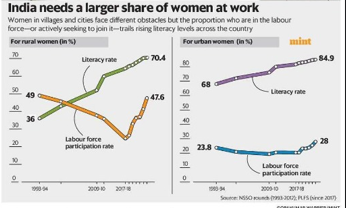
Economic policies frequently reinforce traditional gender roles, failing to recognise the significant contributions women make to the economy. According to the McKinsey Global Institute, advancing gender equality in India could add $770 billion to the country’s GDP by 2025. Yet, women’s economic participation remains low, with only 20.3 per cent of women in the labour force as of 2021, according to the World Bank.

Path forward

To accelerate gender parity in policymaking and governance, a multi-stakeholder approach is essential. Government policies, corporate initiatives, and societal change must work in tandem to dismantle barriers and create an enabling environment for women.

The implementation of a 33 per cent reservation for women in Parliament and state legislatures is a critical step toward boosting female political representation and decision-making power. This policy has the potential to transform the political landscape, ensuring that women’s voices are heard at the highest levels of governance. Providing young women with access to quality education and leadership training programmes is essential in preparing them for roles in governance and business.

The private sector must play a proactive role in promoting gender diversity. Companies should implement mentorship programs, leadership training, and equal pay policies to ensure that women have equal opportunities to advance in their careers. Ensuring the safety of women in politics through legal protections, anti-harassment policies, and support networks is crucial for encouraging greater participation. The establishment of robust mechanisms to address harassment and violence against women in political spaces is imperative.

The success of leaders like Finance Minister Nirmala Sitharaman serves as an inspiration for young women aspiring to enter politics and leadership roles. Showcasing these role models can encourage more women to step forward and pursue careers in governance.

Achieving gender parity in policymaking is not just a moral imperative; it is a necessity for a progressive and equitable society. Women’s leadership is a catalyst for economic growth, social development, and transparent governance. While India has made notable strides, the journey toward equal representation is far from over.

The time for incremental progress has passed. Bold policy measures, cultural shifts, and institutional support are required to break the barriers that hinder women’s leadership. The data is clear: When women lead, societies thrive. It is time for India to fully embrace this truth and take decisive action to empower women in public policy.

The writer is associate fellow (Macroeconomist), NCAER Centre for Gender and Macroeconomy. Views are personal.

Monthly Economic Review: February 2025

In the Review, we summarise the economic and policy developments in India; monitor global developments of relevance to India; and showcase the pulse of the economy through an analysis of high-frequency indicators and the heat map.

Click here for previous issues.

India Human Development Survey: February 2025

The IHDS Forum is a monthly update of socio-economic developments in India by the IHDS research community, based on the India Human Development Survey, jointly conducted by NCAER and the University of Maryland. While two earlier rounds of the survey were completed in 2004-05 and 2011-12, respectively. Fieldwork for the third round was undertaken in 2022-24 and the data is currently being cleaned and processed.

Click here for previous issues

India’s initiatives to strengthen green transition

India is gearing up for green transition through policy and budgetary support to reduce dependence on finite fossil fuels, to curb greenhouse gas emissions, and to mitigate climate change. The Viksit Bharat 2047 vision aims to transform India into a developed nation, which will drive a significant rise in energy demand across industries, infrastructure, and households. To meet this growing demand sustainably, India must focus on renewable energy expansion and green technologies. India is moving towards its Net Zero goal by allocating budgetary support to the green energy sector to accelerate sustainable development, while balancing it with its growth and developmental aspirations. The primary focus of the mitigation effort on the budgetary allocation in the Union Budget 2025-26 is on solar and nuclear sources

Solar energy gets top priority
There has been 39% increase in net revenue expenditure in nominal terms in budget estimates for Ministry of New and Renewable Energy in 2025-26 as compared to 2024-25. For solar energy, there is 48% increase in budget allocation in 2025-26 as compared to 2024-25, in nominal terms, mainly allocated for revenue expenditure.

Under central sector schemes, major increase in budget allocation happened in PM Surya Ghar Muft Bijli Yojana, which increased from INR 6,250 crore in 2024-25 budget estimate to INR 20,000 crore in 2024-25. There is also increase in budget allocation on Kisan Urja Suraksha evam Utthaan Mahabhiyan (KUSUM) from INR 1496 crore in 2024-25 to INR 2600 crore in 2025-26. These two programs are gaining importance in promoting solar energy, since the allocation for both these programs were increased in revised estimates on 2024-25 as compared to budget estimates. While under PM Surya Ghar Muft Bijli Yojana the government is targeting to solarizing one crore households by providing free electricity upto 300 units every month, KUSUM program aims to increase the income of farmers, provide sources for irrigation, de-dieselization the agricultural sector, promoting setting up of standalone solar pumps and solarization of existing grid-connected agricultural pumps.

Under the Other Central Sector Expenditure head, there is 42% increase in budget allocation in nominal terms on National Institute of Solar Energy, from INR 20 crore in 2024-25 to INR 28.4 crore in 2025-26. Majority of the expenditure happened in revenue section, while capital expenditure for these renewable energy sources has shown some dip

Budgetary push for nuclear energy
Significant importance is laid upon Nuclear Energy Mission for Viksit Bharat, which envisions the addition of 100 GW of nuclear energy capacity by 2047. This initiative is expected to be a major contributor to India’s low-carbon energy mix. Additionally, a dedicated Nuclear Energy R&D Mission of Small Modular Reactors (SMR) with a budget of INR 20,000 crore is announced to drive innovation. There is 12% increase in gross budgetary allocation on revenue expenditure to the Department of Atomic Energy from 2024-25 to 2025-26, and in net terms, it is 9% increase in budget allocation, after adjusting recoveries and receipts. However, budgetary allocation for capital expenditure has reduced by 14% in 2025-26 over the past year.

Low emphasis on other renewable energy sources
Under Other Central Sector Expenditure, there is 47% increase in budget allocation in nominal terms on National Institute of Bio Energy, from INR 9.5 crore in 2024-25 to INR 14 crore in 2025-26. But under Central Sector Schemes/Projects, wind energy sector faced deceased allocation from INR 800 crore in 2024-25 to INR 500 crore in 2025-26. Ideally for grid balancing with an increasingly higher share of renewable electricity, it is essential to encourage growth of alternative renewable sources like wind, pump storage electricity, etc. However, this year union budget has not been forthcoming in this direction.

Enhancing Energy Storage and Grid Infrastructure
The ‘Make in India’ initiative has been extended to include clean technology manufacturing. To improve domestic value addition and reduce reliance on imports, the government is promoting local production of solar PV cells, EV batteries, motors and controllers, electrolyzers, wind turbines, very high-voltage transmission equipment, and grid-scale batteries. These efforts will enhance India’s self-sufficiency in clean energy technology while creating employment opportunities in the sector.

A major challenge in transitioning to renewable energy is ensuring stable and reliable power supply, given the intermittent nature of solar and wind energy. There is also infrastructure needed for increasing acceptability of electric vehicles. To address this, India has prioritized investments in energy storage. There is also emphasis on enhancement of battery storage, through allocation on Production Linked Incentive (PLI) Scheme for National Programme on Advanced Chemistry Cell (ACC) Battery Storage, which is the new generation of advanced storage technology. This initiative is expected to drive significant growth in key battery-consuming sectors, including consumer electronics, electric vehicles, advanced power grids, and solar rooftops, and reduce dependence on imports. There is budget allocation of INR 155.76 crore on this scheme in 2025-26 union budget.

To encourage domestic manufacture of lithium-ion battery, which is required for both mobile phones and electric vehicles, budget 2025-26 also proposed to add 35 capital goods for EV battery manufacturing, and 28 capital goods for mobile phone battery manufacturing. The budget 2025-26 also proposed to fully exempt cobalt powder and waste, the scrap of lithium-ion battery, Lead, Zinc and 12 more critical minerals, to encourage domestic manufacturing, and thus enhancing employment.

Green Mobility Initiatives
There is significant emphasis on promoting electric mobility in the budget 2025-26. Under PM Electric Drive Revolution in Innovative Vehicle Enhancement (PM E-DRIVE) Scheme, which targets to comprehensive ecosystem for electric mobility, there is budget allocation of INR 4000 crore in 2025-26, and this allocation has more than doubled from the revised estimates of 2024-25. This scheme facilitates the adoption of e-trucks, e-buses, e-ambulances, and EV public charging stations. To reduce emissions in urban transportation, there is significant increase in allocation for PM e-Bus Sewa Scheme, for capital expenditure (INR 500 crore) in the budget 2025-26. Launched at 2023, this scheme targets at deploying over 38,000 electric buses across the country. Additionally, INR 12 crore is allocated to promote manufacturing of Electric Passenger Cars in India (SMEC), which aims to attract investments from global Electric Vehicle (EV) manufacturers and promote India as manufacturing destination for e-vehicles.

Summing Up
The government’s initiatives reflect their approach towards sustainability through emphasis on renewable energy generation, which is evident from significant increase in allocation in solar sector development, while areas like domestic manufacturing of storage, electric mobility and grid modernization are also covered. With the constraint in resources due to slowing of economic growth in recent years, allocation of budget funds is a challenge in India, where social sector is always a priority. But also, to support the goals of Viksit Bharat and Atmanirbhar Bharat, we need to mobilize resources for development of energy infrastructure, fostering domestic manufacturing, ensuring financial viability of clean energy projects, and incentivizing technological innovation in energy sector for a greener and resilient energy future.

Chetana Chaudhuri, Fellow, National Council of Applied Economic Research (NCAER)) and Prof. Sanjib Pohit, Professor & Thematic Lead—CGE Modelling and Policy Analysis, NCAER. Views are perspnal.

    Get updates from NCAER