Crime against women is one of the most significant hindrances to the achievement of equality, development, and peace. No woman in the world is secure against violence (Nussbaum 2005). According to the United Nations Declaration on the Elimination of Violence against Women (1993), “violence against women” is any act of gender-based violence that results in or is likely to result in physical, sexual, or psychological harm or suffering to women, including threats of such acts, coercion, or arbitrary deprivation of liberty, whether occurring in public or private life. This definition clearly points out that non-violent practices also form violence as these impact women’s capabilities to the same or even deeper extent as actual bodily violence. The World Health Organization (WHO) highlights violence against women as a human rights issue and a significant threat to women’s health and well-being.
In India, violence against women begins even before birth. As Nobel Laureate Amartya Sen mentioned the concept of “missing women” to highlight the gender bias in mortality, which results in a huge deficit of women in substantial parts of Asia and Africa. In India, gender-based violence is deeply institutionalised, which develops under the veil of religion, culture, and social norms (Johnson et al 2007). As Patel (2015) echoed, the fear of crime being an alarming issue among women across India, influences vulnerability due to increasing crime and having a dignified life. The patriarchal social structure and cultural roles of women and men root violence against women in multiple forms (Russo and Pirlott 2006). Deeply rooted in a male-dominated society, violence against women is often primarily associated with their social status and their communal, ethnic, and caste identities.
The article focuses on different types of crimes against women in Assam. The primary objective is to prospectively analyse the factors leading to the major crimes in different districts of the state. It also addresses the question of the reporting of crimes and the actual incidence of crimes in the districts of Assam. Assam, being one of the remotest and landlocked northeastern states of the country, needs special focus for any issues related to development. Assam has always been assumed to be the gateway to northeast India. The present government’s initiatives to improve the connectivity infrastructure in the entire northeast have opened various opportunities for development. However, the recent Crime in India Report, 2021 by the National Crime Records Bureau (NCRB) highlights that Assam has reported the highest rate of crimes against women in India for the last five consecutive years. The trend of increasing crimes against women in Assam is also pointed out in the gender-based violence information in the National Family Health Survey-5 (NFHS), 2019–20.
The article is organised as follows: Following the introduction, we first provide a summary of the data sources and methodology. We then on to explains the results by analysing how the trend of crime against women changed over time from 2011 to 2021 in Assam and comparing it to India. The further section presents the crimes at the district level in terms of both reporting and actual incidence; which explains the determinants of the incidence of violence suffered by women in Assam. Finally, the article’s primary findings are summarised in Section 6, which also looks at how important these findings are for understanding the element that results in the rising rate of crime and violence against women in Assam.
Data Source and Methodology
The primary database for the study are the NCRB and NFHS. The NCRB report is the only and most comprehensive databank available to the Government of India on the subject. The data is collected by the State Crime Records Bureau (SCRB) from the District Crime Records Bureau (DCRB) and sent to the NCRB every year. The statistical information in the report contains cognisable crimes reported in police stations during the reference year. The data on major crimes against women in Assam in the NCRB report include dowry, rape, human trafficking, kidnapping and abduction of women, insults to modesty, and domestic violence. The NFHS provides information on population, health, and nutrition for India and each state and union territory. It also provides district-level estimates for many important indicators. In the present study, violence against women is analysed based on the NFHS data. Violence against women includes sexual and physical violence.
Crime against Women in Assam
Despite the high underreporting rate of crime against women, Mukherjee et al (2001) highlighted that crime reporting is still useful for broad groupings of regions in terms of crime rate. They also mentioned that underreporting of crime varies not only across time and space but also across types of crime against women. Therefore, although the crime reporting data is not sufficient to set a narrative about the region, it definitely provides important source information at the policy level. The total crime rate for 2021, computed as the total number of crimes recorded per 1 lakh persons, ranges from 5 to 169 among the states and union territories of India. Figure 1 highlights the rate of crime against women in different states of India. It is clearly observed that the rate of crime against women is the highest in Assam (168.872), followed by Odisha (138.157) and Haryana (120.188) among all the states and Union Territories in India. According to the NCRB report, Assam is the state with the highest rate of crime against women in India for the fifth consecutive year.
Figure1: Rate of Crime against Women in India at the State Level?

Source: NCRB Report, 2021
One significant reason for the high numbers in the state could be improved reporting of such crimes. There is often a gap between reported crime rates and the actual incidence, particularly in cases involving crimes against women. Velasco et al. (2021), in their study on Mexico, highlighted that the increase in reported crimes against women can be attributed to new trends in women’s empowerment. This includes the expansion of social programs, a rise in the number of women serving as heads of households, the establishment of specialized prosecutors for crimes against women, and reduced procedural barriers due to reforms in the criminal justice system, transitioning from an inquisitorial to an accusatory model.
Figure 2(a)

Source: NCRB data between 2011-2021, compiled by authors.
Considering the six major crimes against women, which are rape, dowry, human trafficking, kidnapping and abduction, insult to modesty, and domestic violence, the table 1 shows the trend of major crimes against women in Assam over the period from 2011 to 2021. The trend shows a steady increase from a crime rate of 75 in 2011 to 147 in 2021. According to the NCRB’s Crime in India Report, 2021, the majority of cases of crime against women in Assam were registered under “Cruelty by Husband or His Relatives” followed by “Kidnapping and Abduction of Women.” The rate of total crime against women (Indian Penal Code and State Level Laws) in 2021 is 168.3, which is the highest among all states and UTs; and the charge sheet rate in 2021 will be 52.9.
Figure 2(b)

Source: NCRB data between 2011-2021, compiled by authors.
The figure 2 (b) highlights the trend of dowry-related crimes in Assam, which according to the NCRB data are incidences of dowry and dowry death. There has been a sharp drop in the rate of dowry cases in 2020 (3.4) as compared to 2019 (9), which again increased to 4.5 in 2021. According to the NCRB’s Crime in India Report, 2021, the number of dowry cases registered under the Dowry Prohibition Act, 1961 in Assam is 582, which is the fifth highest. And the number of dowry death cases filed under Section 304B of the Indian Penal Code (IPC) is 198, which is the ninth highest among all the states and UTs.
Figure 2(c)

Source: NCRB data between 2011-2021, compiled by authors.
In figure 2c, it can be observed that from 2020 to 2021, there has been an increasing growth in the crime rate of rape. The rate of rape cases, including rape (Section 376), attempt to commit rape (Section 376/511), and murder with rape or gang rape, has increased from 12.6 in 2020 to 13.4 in 2021. According to the NCRB’s Crime in India Report, 2021, the rate of rape cases reported under Section 376 IPC in Assam is 10.0 (per one lakh of the population) for 2021, which is the fourth highest after Rajasthan (16.4), Haryana (12.3), and Arunachal Pradesh (11.1%) among all states. And the rate of cases under “Attempt to Commit Rape” (Section 376/511 IPC) is 3.3, which is the highest among all states and UTs.
Figure 2 (d) 
Source: NCRB data between 2011-2021, compiled by authors.
In Figure 2 (d), it is highlighted that there has been a sharp decline in the rate of human trafficking cases in 2020, followed by an increase in 2021. In support of the abovementioned statement, using the NCRB data, it can be observed that the rate of human trafficking cases filed under Sections 370 and 370A has come down to 0.4 in 2020 from 0.9 in 2019 but increased to 0.5 in 2021. However, the rate has been steady from 2017 to 2019 (around 0.9). According to the NCRB’s Crime in India Report, 2021, the rate of human trafficking cases (per lakh population) under Section 370 in Assam is 0.4, which is the third highest after Goa (0.7), Telangana (0.3), and Maharashtra (0.2).
Figure 2 (e)

Source: NCRB data between 2011-2021, compiled by authors.
In Figure 2 (e), it is highlighted that there has been a sharp drop in the rate of kidnapping and abduction cases in 2020 compared to the previous year, but it has gradually increased. In support of the abovementioned statement, using the NCRB data, it can be observed that the rate of kidnapping and abduction has come down to 31.7 in 2020 from 41.9 in 2019 but increased to 33.6. However, the rate has been increasing from 2017 to 2019, followed by a drop in 2020, but it has again risen in 2021. According to the NCRB’s Crime in India Report 2021, the rate of abduction and kidnapping of women in total (per lakh population) in Assam is 33.3, which is the highest among all states and second highest only after Delhi.
Figure 2 (f)

Source: NCRB data between 2011-2021, compiled by authors.
In Figure 2 (f), it is highlighted that there has been a decline in the rate of “Insult to Modesty” cases in 2021 compared to 2020. In support of the abovementioned statement, using the NCRB data, it can be observed that the rate of “Insult to Modesty” cases has come down to 27.9 in 2020 from 29.7 in 2019 and declined further to 27.4 in 2021. However, the rate has been increasing from 2017 to 2019, followed by a drop from 2019 to 2020. According to the NCRB’s Crime in India Report 2021, the rate of “Insult to Modesty” (per lakh population) in Assam is 1.1, which is quite low compared to other states and UTs.
Figure 2 (g)

Source: NCRB data between 2011-2021, compiled by authors.
From Figure 2 (g), it can be observed that from 2020 to 2021, there has been a growth in the rate of domestic violence. The rate has been increasing, with a drop in 2020 (67.4). The rate of domestic violence, including cases of cruelty by a husband or his relatives (Section 498A) and the Protection of Women from Domestic Violence Act 2005, has increased from 67.4 in 2020 to 76 in 2021. According to the NCRB’s Crime in India Report 2021, for the rate of cases of cruelty by a husband or his relatives under Section 498A, Assam has the highest among all states and UTs.
Crime across Districts
The distribution of districts in Assam as per different crime rates is highlighted in Figure 3. The figure clearly shows that domestic violence dominates the total crime against women in the state. According to the NCRB data for 2021, Dhubri district has the highest number of total reported crimes against women, followed by Morigaon and Guwahati city. However, the rate of domestic violence is highest in Morigaon district, followed by Dhubri. Since the NCRB compiles only the reported crimes against women, a higher rate of domestic violence may indicate the empowerment of women. In the first 10 districts with the highest rate of total crime against women, there is a significant gap in the rate of domestic violence and other types of crime. However, towards the lower end of the total crime rates, there is not much difference in the different types of crimes in the districts. The districts with a lower crime rate for women consist of hilly, remote, and mostly tribal-dominated districts. In some exceptional districts, like South Solamar, there is a huge difference in domestic violence and other crime rates. In Karimganj, too, the rate of domestic violence is exceptionally high as compared to the other reported crimes. Since Figure 3 only shows the reported crimes, this also indicates that, due to the remoteness and lack of empowerment, women are not reporting crimes in these regions.
Apart from domestic violence, insult to modesty and kidnapping and abduction are also two of the most significant crimes in the districts of Assam. Insult to modesty is highest in Barpeta district, and kidnapping and abduction are highest in Guwahati city. Rape and related crimes are also significantly contributing to the total crime rate in different districts. Hailakandi has the highest rate of rape and related crimes, followed by Dhubri.
Figure 3: District-wise Crime against Women Reported in Assam (Crime Rate) 
Source: NCRB report 2021
Figure 4: District-wise Percentage of Violence Against Women in Assam

Source: National Family Health Survey (2019–2021)
Against the reported crime rate of the NCRB data, National Family Health Survey (2019–2021) data also provide data on some indicators of violence against women. Figue 4 highlights the percentage of sexual and physical violence against women in different districts of Assam. The difference between NCRB and NFHS is that the first is reported, and the second is the real occurrence of crime against women, which indicates that districts with a high report and a lower occurrence of crime against women indicate better law and order for women and empowerment of women in those districts. The figure shows that Hilakandi district tops the list, followed by Karimganj and Cachar. Both figures 3 and 4 mostly follow the same or close to the same ranking, except for some districts. In Kamrup metropolitan District, the occurrence of crime is very low as compared to the crime reported in Guwahati city. Darrang district also has a high report rate and a lower occurrence of crime against women.
Vulnerability due to Different Forms of Violence against Women in Assam: Factors Determining Violence
This section discusses the model determining the factors of violence against women in Assam. A simple regression model is used to highlight the factors determining violence against women in Assam. One limitation of the model is that it considers only married women in the state. Here, the dependent variable is the total violence against women, which is the sum of sexual and physical violence. The set of independent variables consists of the highest level of education of the women, the highest level of education of the husband, the work status of the women, whether the husband drinks alcohol or not, religion, caste, whether urban or rural area, autonomy over some amount of household income, bank account, and owning any property alone or jointly.
While finding the determinants of violence against women, one needs to see whether they are reported at a police station or in front of the investigator. The women need to be brave enough to disclose the facts about their own vulnerabilities, considering stereotypes and norms in our society. This is clearly reflected in the model as well. It is expected that a higher level of education must have resulted in a lower rate of violence among women, but according to the model, women with a higher education level have significantly higher chances of suffering either sexual or physical violence. This actually indicates that a higher level of education makes women more empowered to report the violence they have suffered. Further to this, a lack of education makes women unaware of their rights and tolerant of the violence they suffer. Silence remains a prevalent community response to violence against women, and not only do the victims contribute to this silence but also those who know about the violence and choose to be silent and passive (Jenkins 1996). This is an important issue because public attitudes of indifference or passivity can help to maintain a climate of social tolerance (Biden 1993).
Another significant factor leading to higher-level violence against women is work status. Ideally, working women should have lower chances of facing physical or sexual violence. However, according to the model, working women suffer a scientifically high rate of violence. This interpretation is also biased due to the level of confidence and empowerment among the working women; the reporting rate of their violence suffered is higher as compared to the women not working. Mukherjee et al (2001) also observed that working women have probably greater exposure to the risk of violence outside the home. However, in the present model, the explanation for the high rate of violence suffered by working women is highly related to their exposure to the outside world and their empowerment as compared to those not working. Gracia and Herrero (2007) are also of the view that in order to lower social tolerance and create an environment of social responsibility towards domestic violence, public awareness and education are needed, which will also address the condition of mistrust between people and diminish the social control of concentrated disadvantage and disorder.
Table 1: Model of Determinants of Total Violence against Women in Assam
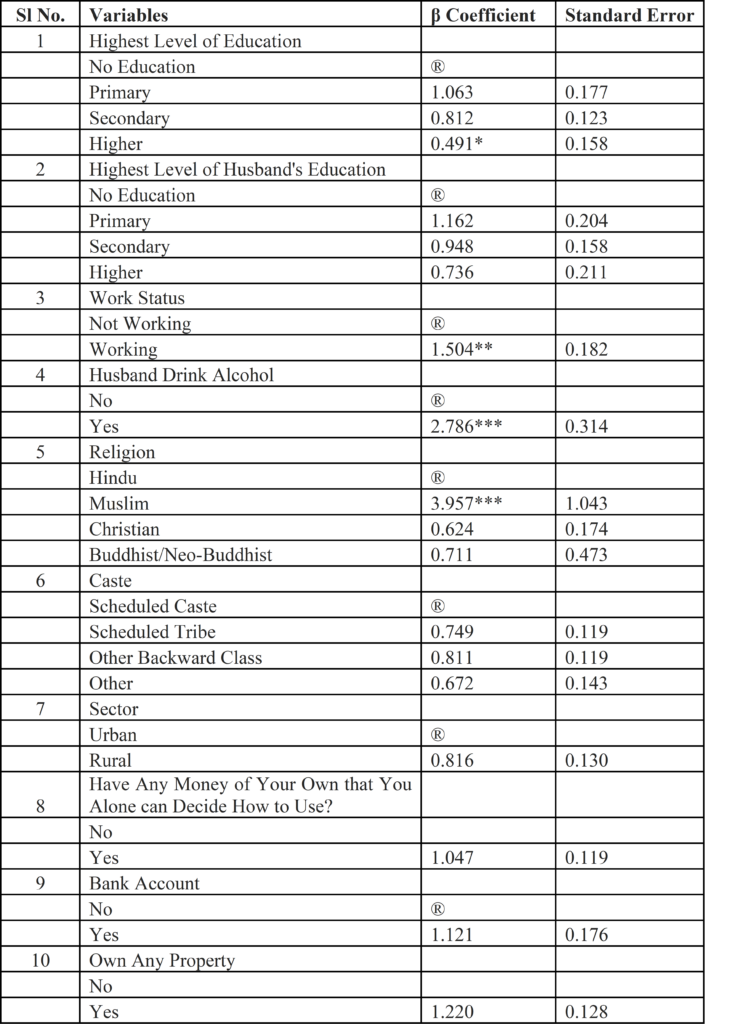
Notes: ***, **, and * are significant at 1, 5, and 10 percent. ® is the reference category.
Source: Author’s calculation based on the NFHS-5 unit-level data.
Further to this, partners’ alcohol consumption has a significantly higher impact on violence against women. This supports the previous study of Luca, Owens, and Sharma (2015), which found that prohibition on alcohol drinking behaviour is associated with a statistically significant higher reduction in the rates of cruelty by husbands and sexual harassment. Among the religion groups, Muslims have significantly higher chances of facing any kind of violence against women as compared to the Hindu religion.
Conclusions
Crime and/or violence against women, being the most important factor in assessing women’s well-being and status, should be considered in analysing the overall development of a society. In order to reduce crime against women, the first and foremost requirement is proper reporting of such crimes. Assam is the top state in India in terms of crime against women. Within the state, in Kamrup metropolitan district, which vastly is Guwahati city, violence actually identified (based on Graph 4) is lowed but reported to be very high (based on Figure 3). This may indicate comparatively higher empowerment of women as compared to other districts of the state. However, districts like Dhubri, Hailakandi, Morigaon, and Barpeta are showing a high rate of crime. The causal relationship between violence against women and other sets of variables also indicates that empowerment and confidence in one’s own rights can result in lower crime against women and an improved standard of living. As model results suggest, at the policy level, prevention of alcohol drinking and focusing on education and providing earning employment can be expected to create an environment of lower social tolerance and collective responsibility towards reducing domestic violence. The development and propagation of violent behaviour in general and specifically towards women are, in most cases, interlinked with cultural factors. In a stereotyped family, women are raised with a persistent attitude of being weak and in need of physical, social, and economic protection, which leads them to be exploited at almost every stage of their lives.
This article was published in EPW’s Vol. 59, Issue No. 51 (21 Dec, 2024)