21 January, 2026
Published in: Ideas for India


Published in: Ideas for India
Historically, India has had a much larger share of workers who are self-employed and a smaller proportion of wage and salaried workers. In this post, Farzana Afridi outlines recent trends in self-employment and the key issues associated with such work. She proposes policy solutions to address constraints around skilling, access to formal credit, and legal support in order to improve the quality of self-employment.
Two characteristics of India’s labour force are striking – the low rate of participation of the working-age population in the workforce (50%) and second, the almost stagnant structure of workforce participation. India has a much larger share of workers who are self-employed and a smaller proportion of wage and salaried workers than most other middle-income economies. This structure of the labour force participation has not shifted much in decades (Figures 1a, 1b). The continued predominance of the agricultural sector and relative shift towards the services sector, bypassing manufacturing, has a significant role to play in the continued high levels of self-employment we observe. This muted structural transformation carries adverse implications for both worker productivity and the quality of work.
Figure 1a. Structure of employment: Proportion of self-employed
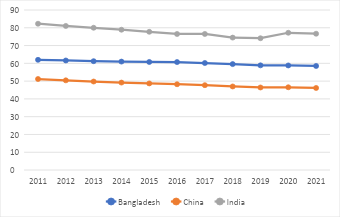
Figure 1b. Structure of employment: Proportion of wage/salaried workers
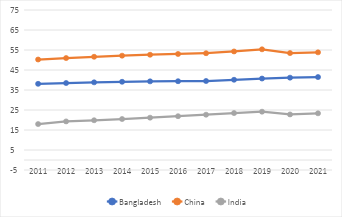
Source: Afridi (2025); Based on data from ILO (International Labour Organization) estimates, World Bank Database.
Of the working population, over half are categorised as self-employed – almost 60% in rural areas and about 40% in urban areas, with an uptick in this statistic between 2017-18 and 2023-24, particularly in rural areas and for women. At the same time, there is a stark compositional difference in self-employment of men and women. For males, the category of ‘own account worker’ dominates the composition of the self-employed, while most self-employed women are ‘helpers in household enterprises’. Although the gender gap in the proportion of own account workers has declined between 2017-18 and 2023-24, the proportion of self-employed females in the category of ‘helpers’ has also increased between 2017-18 and 2023-24.
Figure 2a. Proportion self-employed, salaried, and casual workers (male)
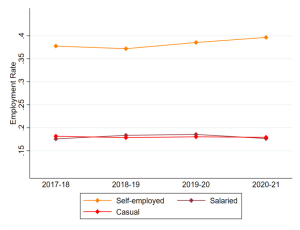
Figure 2b. Proportion self-employed, salaried and casual workers (female)
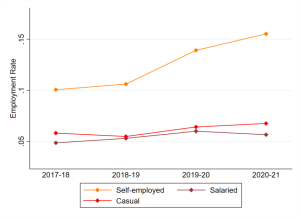
Source: Afridi (2025); Based on data from Periodic Labour Force Survey (PLFS), various years.
The increase in the proportion of self-employed workers overall, and women’s self-employment, indicates a worrying rise in the informality of work. The operational criteria used in most economies to define formal jobs – coverage by social security system; entitlement to paid annual or sick leave, and written employment contract – are missing for the self-employed. Two other features of self-employed work are notable – low earnings and significant underemployment. First, not only are the earnings of the self-employed barely above those engaged in casual labour, the gender gap in self-employed earnings has increased between 2017-18 and 2023-24, with the gap expanding more in rural relative to urban areas (Figure 3). This gap is likely worse than reported – women are more often ‘helpers in household enterprises’ and almost all helpers (irrespective of gender) report zero earnings. Second, for both rural and urban self-employed women, the hours of work is very low, at less than 40 hours per week. In most quarters, therefore, the proportion of workers who are available for additional work is highest amongst the self-employed in rural areas.
Figure 3. Gender gap in self-employed earnings
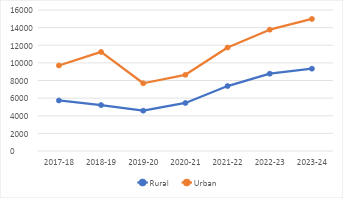
Source: Afridi (2025); Based on data from PLFS, various years.
Note: Current prices for April-June quarter.
Measurement concerns notwithstanding, the majority of self-employment work is undoubtedly of poor quality, low paying and is probably the fall back option when better work opportunities are unavailable, particularly in rural areas and for women. What are the constraints to improving the quality of self-employed work?
Low education and skills, poor access to formal credit and legal support stand out as the main limitations to improving the quality of self-employment and consequently the overall nature of work in the country. While these constraints impinge on all self-employed workers, they are often particularly binding for self-employed women.
The proportion of self-employed with grade 12 or above education was only 17% in 2017-18 and has increased only marginally to 20.6% in 2023-24. Education levels are particularly low for self-employed women – 9% of these women had completed high school or higher in 2017-18, which has inched to just 11.4% in 2023-24. In addition, the proportion of all self-employed with any formal or vocational training is abysmal at 3%. Vocational training is vital for high quality self-employment and can be a transforming force for significantly enhancing the quality of self-employment and entrepreneurship, broadening occupational choices and expanding work opportunities.
A conscious effort ought to be made to link skill training and entrepreneurship. A recent NITI report on overhauling ITIs (industrial training institutes) states that “hardly any ITI arranges for tie-ups with financing institutions to make credit accessible to ITI pass outs for starting an enterprise. Though the PM Mudra Yojana is open for a range of self-employed people such as small manufacturers or artisans, ITIs so far have not been able to channel any start-up funds for their trainees.”
Lack of access to formal credit markets limits the size and scope of self-employment, entrepreneurship and the ability to create establishments that generate employment. For instance, 41% of all unincorporated, non-agricultural establishments that employ about 10 crore workers in 2023, operate on a small scale and within household premises, as per the Annual Survey of Unincorporated Sector Enterprises (ASUSE). 5.53 crore of these establishments are Own Account Establishments (OAEs) – establishments that have not employed even one hired worker on a fairly regular basis. This implies that less than 1/5th are Hired Worker Establishments (HWE) that create employment by hiring other workers. Not surprisingly, the annual Gross Value Added per worker, or worker productivity, in OAEs is about 50% of that in HWEs on average (Rs. 100,000 versus Rs. 200,000), as detailed by the India’s Employment Prospects Report (2025).
Lack of access to formal credit not only raises the cost of borrowing and reduces the size of available loans, it also restricts the capacity and size of the entrepreneur and their enterprise.
Although the ease of doing business has been steadily improving in India, starting a formal enterprise remains challenging even when the entrepreneur has the technical know-how and access to credit. The administrative and legal landscape for setting up a formal business or enterprise is often complex. The World Development Report, 2024 notes that because their time and talent are limited, (firm) owners are compelled to manage firms through their families which inhibits their ability to grow. By some estimates, the lack of professional managerial support could account for 11% of the difference in per capita incomes between India and the United States.
Furthermore, access to legal recourse in the event of business disputes is fraught with challenges. Inadequate legal access entails frictions in contract enforcement, which lowers aggregate productivity of establishments. Studies show that efficiency of courts in India matter for future growth in the formal manufacturing sector (Amirapu 2021). According to the ASUSE, a majority of the unincorporated enterprises that are proprietary or partnerships are run by minorities. Research shows that court quality has a disproportionately larger (negative) impact on the investment decisions of SC/ST (scheduled castes/tribes) entrepreneurs (Saha et al. 2022) This further limits the ability of these informal establishments to expand, grow and create employment.
With the creation of jobs continuing to be a challenge in the near future, vocational training together with access to credit and legal support can enhance the quality of self-employment and give a boost to entrepreneurial activity in the country.
This piece is based on the author’s keynote address to the Indian Society of Labour Economics (ISLE) Conference 2025 and published in the Indian Journal of Labour Economics (2025).