3 August, 2025
Published in: The Statesman


Published in: The Statesman
As India forges ahead with its renewable energy goals to combat climate change, the transition away from coal presents a complex economic challenge.
As India forges ahead with its renewable energy goals to combat climate change, the transition away from coal presents a complex economic challenge. While the environmental urgency is clear, the macroeconomic consequences – especially those impacting employment and state finances – carry a weight that policymakers can no longer afford to overlook. Coal has long powered India’s economy, currently generating over 70 per cent of the country’s electricity. For several states, including Jharkhand, Chhattisgarh, and Odisha, coal is more than just a fuel – it supports budgets, livelihoods, and local development.
Jharkhand receives nearly 30 per cent of its own tax revenue from fossil fuelbased royalties and levies; Chhattisgarh follows closely. Together with a few other states, they account for most of India’s coal reserves and production, making the transition highly regional in both risk and impact. Moving away from coal will not be cheap. India is estimated to require about $900 billion to $1 trillion over the next three decades to fully steer its power sector away from fossil fuels. Nearly half of that cost will fund nonenergy needs – worker reskilling, land repurposing, livelihood support, and economic diversification.
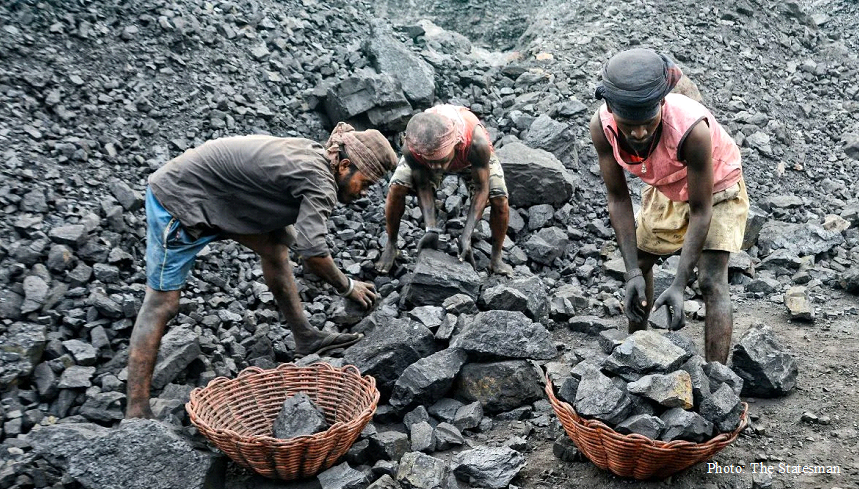
These are not peripheral concerns; they are essential to making the energy transition socially and economically viable. Employment is where the transition dilemma becomes most immediate. Coal supports the livelihoods of over 13 million people across mining, transport, thermal power, steel, brick kilns, and other linked sectors. Formal employment numbers tell only part of the story. Many workers are hired through contractors or are informally engaged – making them both invisible in official data and vulnerable to job losses. In Jharkhand alone, nearly 300,000 are employed in formal coal work, with at least a million tied indirectly to the industry.
For these workers and their families, coal is far more than an energy source – it is a livelihood, a form of stability in regions where few other opportunities exist. Abrupt coal closures without alternative employment can lead to economic stagnation, deepened inequality, and long-term social stress. The risk isn’t just of stranded assets, but of stranded communities, where entire regions are left behind in the march to net zero. Renewable energy promises jobs – indeed, over a million people were working in India’s renewables sector in 2023, with strong growth expected. By 2030, the sector could generate up to 3.4 million jobs through new solar and wind capacity alone. Yet the shift from coal to clean energy jobs is not automatic.
There’s a skills gap – technical roles in solar and wind require formal training, digital literacy, and experience that most coal workers lack. Additionally, there is a regional gap. Most renewable investments are concentrated in western and southern India – Gujarat, Rajasthan, Tamil Nadu, and Karnataka – whereas the coal belt lies in the east and central regions. Even the nature of employment differs. Coal jobs, particularly those in the formal public sector, often offer better wages, benefits, and job security compared to many clean energy roles, which are more contractual and project-based.
Without planned efforts to bridge these gaps – through training, job matching, and wage support – the transition risks leaving workers worse off. Adding to the challenge is the heavy fiscal reliance on coal revenues. Between 2018 and 2023, Jharkhand alone earned nearly Rs 24,000 crore in coal royalties and contributions to mining funds. Chhattisgarh and Odisha followed with over Rs 16,000 crore each. These funds support health, education, infrastructure, and social programmes, and their depletion could undercut development in some of the most underserved districts in the country. Current mechanisms, such as the District Mineral Foundation (DMF) funds, while useful, are insufficient for the scale of transition needed. So far, DMF has accumulated just over $3.7 billion – far short of the $420 billion estimated need for non-energy transition elements. At the same time, India’s financial system remains deeply invested in coal.
Domestic banks have poured nearly $29 billion into coal since 2016, and public sector banks account for the majority of these loans. Realigning capital flows toward clean technologies and transition support will be vital. As India aims to achieve net zero target by 2070, new jobs will emerge in solar installation, EV maintenance, climate resilient agriculture and the circular economy sector. Skilling programmes can address unemployment, improve livelihood and support climate goals simultaneously. To ensure a smooth and inclusive transition, India must invest in large-scale reskilling tailored to the local needs of coal-dependent communities.
Programmes like Suryamitra, Vayumitra, Jal Urja Mitra – focused on solar, wind and small hydro power technician training respectively – are positive initiatives but need to be dramatically scaled up and adapted for broader participation. At the same time, coal-producing states need active support to diversify their economies – whether through green manufacturing, agro-based industries, or services that can generate stable employment. Social protection systems will also need expansion to cover informal workers, offering health coverage, pensions, and income support as they navigate career shifts. Importantly, the fiscal gap left by shrinking coal revenues cannot be ignored. The central government must devise mechanisms – possibly through compensatory transfers or green revenue-sharing models – to stabilize state finances during this transition period.
Without such support, the development gains funded by coal could reverse in many of India’s poorest districts. Finally, the transition must be participatory. Local communities, trade unions, grassroots leaders, and workers must be actively involved in shaping strategies for moving beyond coal. Top-down mandates will not suffice when livelihoods are at stake. India’s coal transition is more than an environmental necessity – it is a macroeconomic test of the country’s ability to align growth, equity, and sustainability. With the right planning and financial commitment, this can be a transformation that uplifts rather than displaces. But failure to address the human and regional aspects of the transition may fracture the very social and economic fabric it seeks to rebuild.
The writers are associated with the National Council of Applied Economic Research (NCAER). Views are personal.