
On the basis of 55 non-working and 93 working married women residing in urban Delhi, this study compares the motherhood ideology of employed and stay-at-home married women. Drawing on Hays’ (1996) Intensive Mothering Ideology and Blair-Loy’s (2003) notion of ‘competing devotions’, the study categorizes women’s motherhood ideologies into three orientations—traditionalist, ambivalent and ambivalent-progressive—to examine how... Read More
This study examines women’s well-being in Assam, India, through the lens of the Capability Approach to focus on women’s substantive freedoms and lived experiences. Drawing on large-scale primary survey data, the paper constructs a multidimensional Women’s Capability Index of Assam (WCIA) using the Alkire–Foster methodology at the individual level. The index captures four interrelated capability... Read More
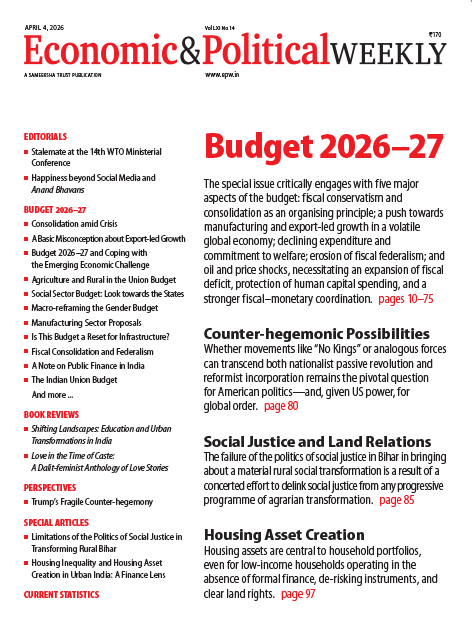
Stable fiscal ratios, high growth and low inflation portray India as a haven of stability and calm in a very turbulent world. However, this may well be a calm before the storm. The stable fiscal ratios notwithstanding, fiscal space is shrinking, which handicaps the country in coping with the economic shock, which is expected in... Read More
The renewable energy sector is witnessing rapid growth and expanding employment opportunities. However, questions remain about the development of the workforce to keep pace with this expansion, particularly in terms of skill availability and gender diversity. In a recent episode of the Renewable Watch Podcast, Mohammed Ali Siddiqi, Research Analyst, and Sakshi Bansal, Research Analyst, Renewable... Read More
Background: The COVID-19 pandemic wreaked havoc across countries, causing an unprecedented healthcare crisis and supply chain disruptions. Our paper focuses on how households coped and the role of expanded Indian government food subsidies in mitigating food insecurity. Objective: We use panel data from two rounds of household surveys (2019 and 2021) to examine changes in... Read More
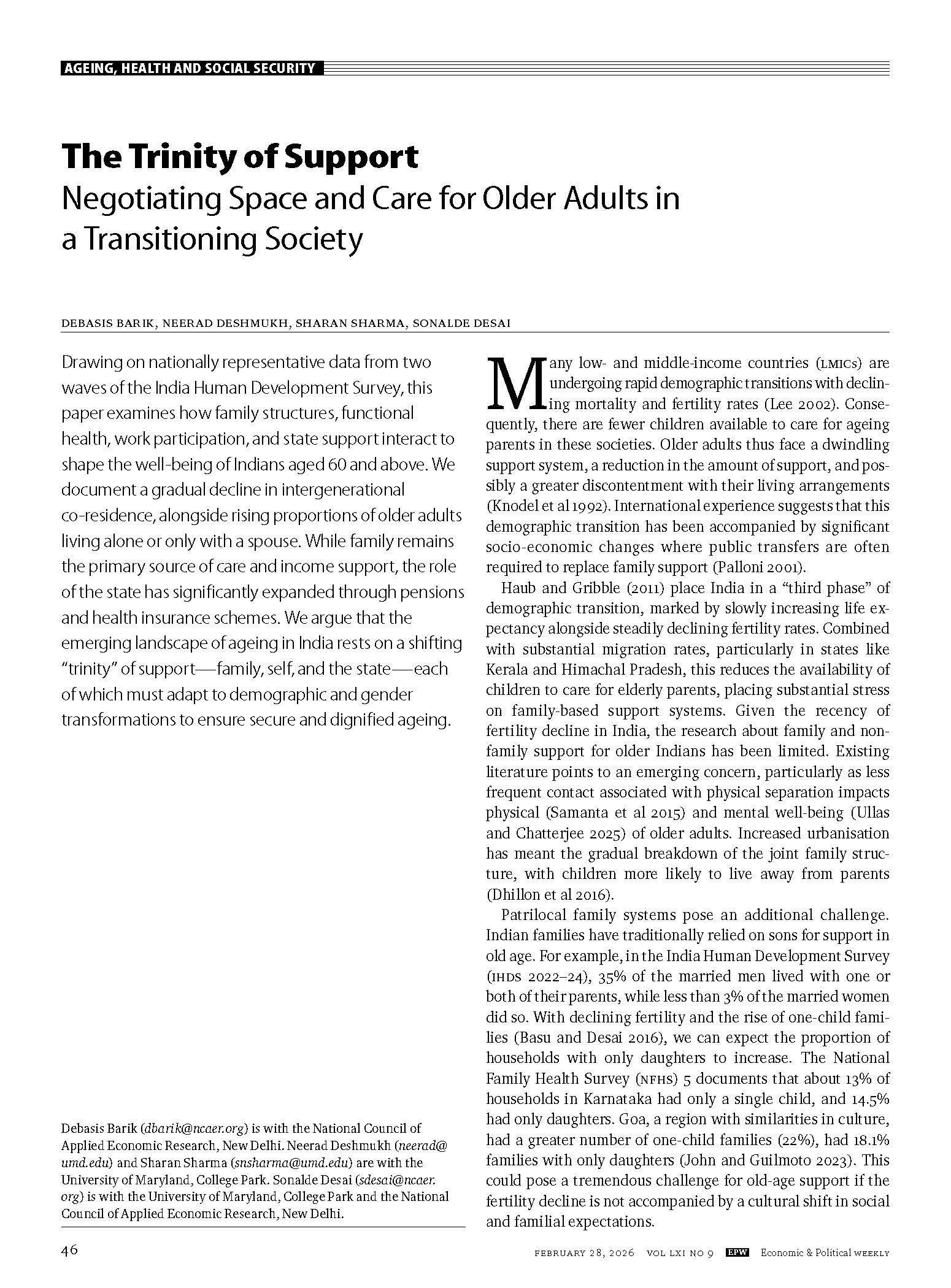
Drawing on nationally representative data from two waves of the India Human Development Survey, this paper examines how family structures, functional health, work participation, and state support interact to shape the well-being of Indians aged 60 and above. We document a gradual decline in intergenerational co-residence, alongside rising proportions of older adults living alone or... Read More
Using data from a primary survey conducted in rural India, this paper examines how two key survey design features—respondent identity and question framing—affect employment estimates. First, it estimates the causal impact of (a) replacing a single weekly employment question with a set of detailed activity-specific questions, and (b) changing the reference period from a week to individual... Read More
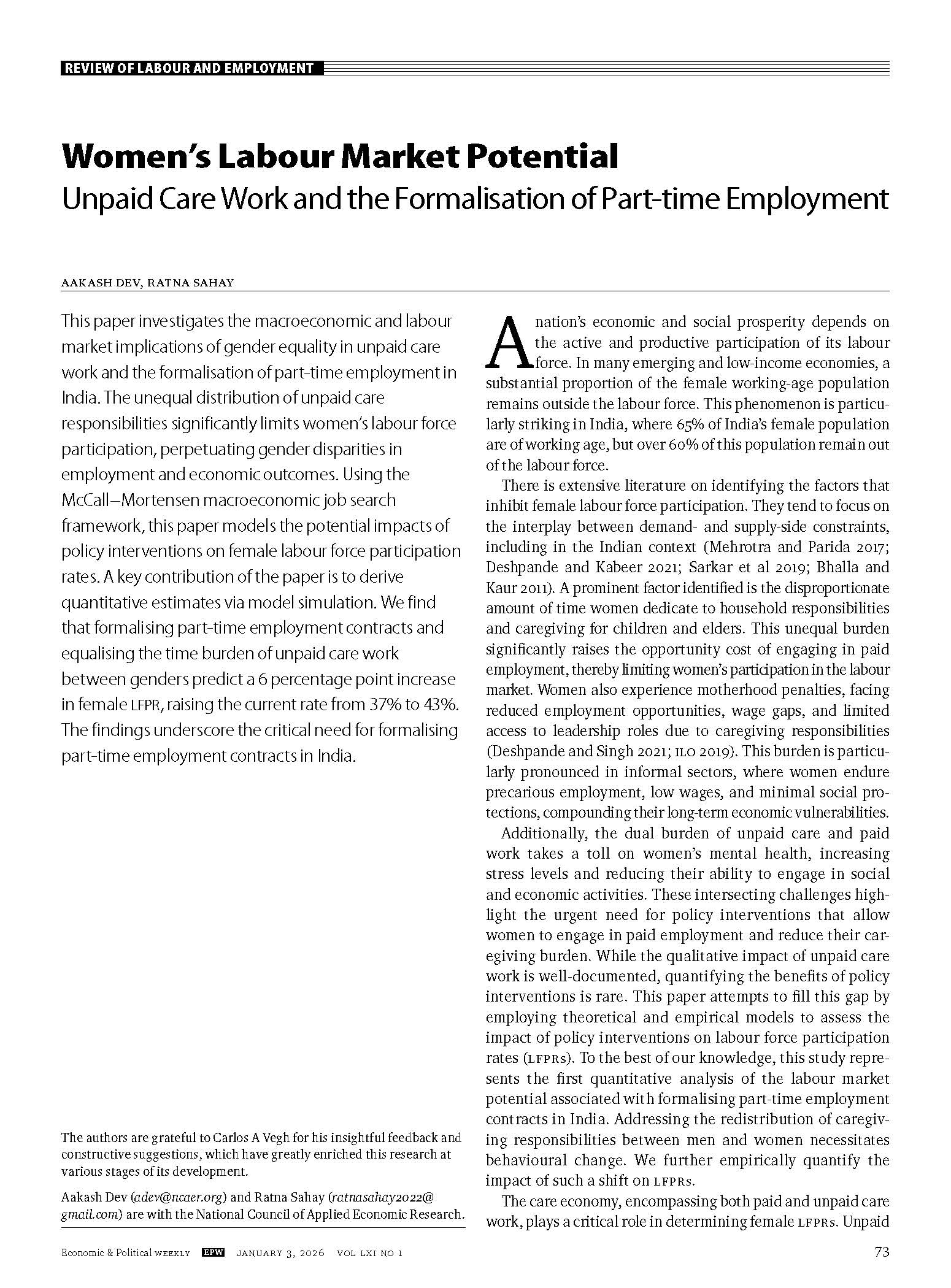
This paper investigates the macroeconomic and labour market implications of gender equality in unpaid care work and the formalisation of part-time employment in India. The unequal distribution of unpaid care responsibilities significantly limits women’s labour force participation, perpetuating gender disparities in employment and economic outcomes. Using the McCall–Mortensen macroeconomic job search framework, this paper models... Read More
Non-communicable diseases (NCDs) are now the leading cause of premature mortality in low- and middle-income countries (LMICs), accounting for more than 80% of early NCD deaths worldwide. As LMICs undergo rapid demographic, nutritional, and epidemiological transitions, obesity has emerged as a central driver of cardiometabolic risk—particularly among women. Although NCDs have long been characterised as... Read More