A nation's efficient participation in global supply chains and accelerated economic growth are driven by trade facilitation. Paperless trade has been a significant reform under the WTO's Trade Facilitation Agreement. Quantifying its potential efficiency in global trade dynamics is essential for informed policy. Therefore, this study undertakes an empirical estimation from India's perspective to understand... Read More
Regional modeling is essential for assessing the impacts of environmental policies in countries with significant regional diversity. It is particularly important for a resource-constrained state like Kerala (India), which depends heavily on electricity imports from other states. The novelty of this study lies in the development of a state-level Integrated Assessment Model (IAM) that links... Read More
India’s commitment to achieving net-zero emissions by 2070 requires state-level strategies for low-carbon economic transitions. This study develops a state-specific macroeconomic framework linked to an energy system model to assess the investment needs and employment impacts of decarbonization. Focusing on Odisha, an eastern coastal state producing 23% of India’s coal and 44% of mineral output,... Read More
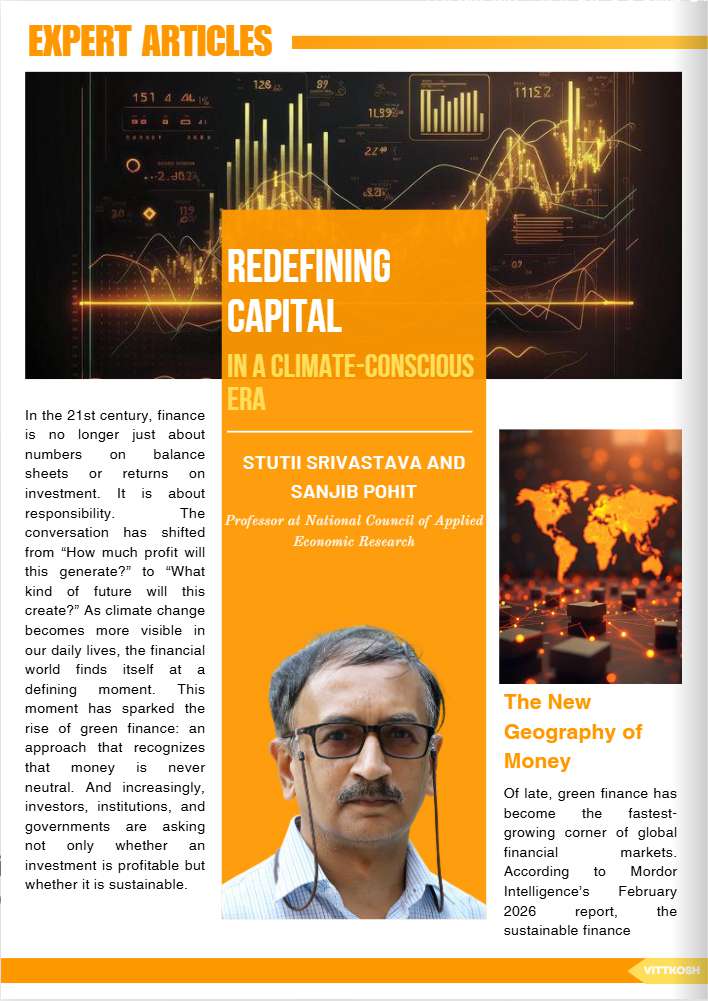
In the 21st century, finance is no longer just about numbers on balance sheets or returns on investment. It is about responsibility. The conversation has shifted from “How much profit will this generate?” to “What kind of future will this create?” As climate change becomes more visible in our daily lives, the financial world finds... Read More
What if India's pathway to net zero does not end at factories—but begins where terrestrial meets the coastal? As carbon emissions rise and climate risks intensify, the search for solutions has largely remained confined to land-based approaches. Yet beneath the waves lies an overlooked trillion-dollar economic and ecological frontier, one that can absorb carbon, shield... Read More
Private consumption, constituting nearly 60% of India’s GDP, remains the cornerstone of economic momentum, powered by rising disposable incomes, digital adoption, and an aspirational middle class. Manufacturing contributes about 17% to GDP with aspirations to reach 25% by 2030.
On examining the relationship of energy consumption with economic growth and carbon emission, we provide the evidence that the petroleum consumption growth significantly contributes to GSDP growth of Kerala (as indicated from regression coefficient of 0.70%), whereas electricity consumption growth affects GSDP growth with a time lag (as evidenced from Granger causality and regression coefficient of .13%). In... Read More
Air pollution is one of the five leading risk factors for mortality worldwide. India has been dealing with seriousenvironmental problems as its economy develops. The number of automobiles on the road has increased the risk of air pollution.Therefore, to reduce pollution levels, Government of India decided to leapfrog Bharat Stage V (BSV) (equivalent to Euro... Read More
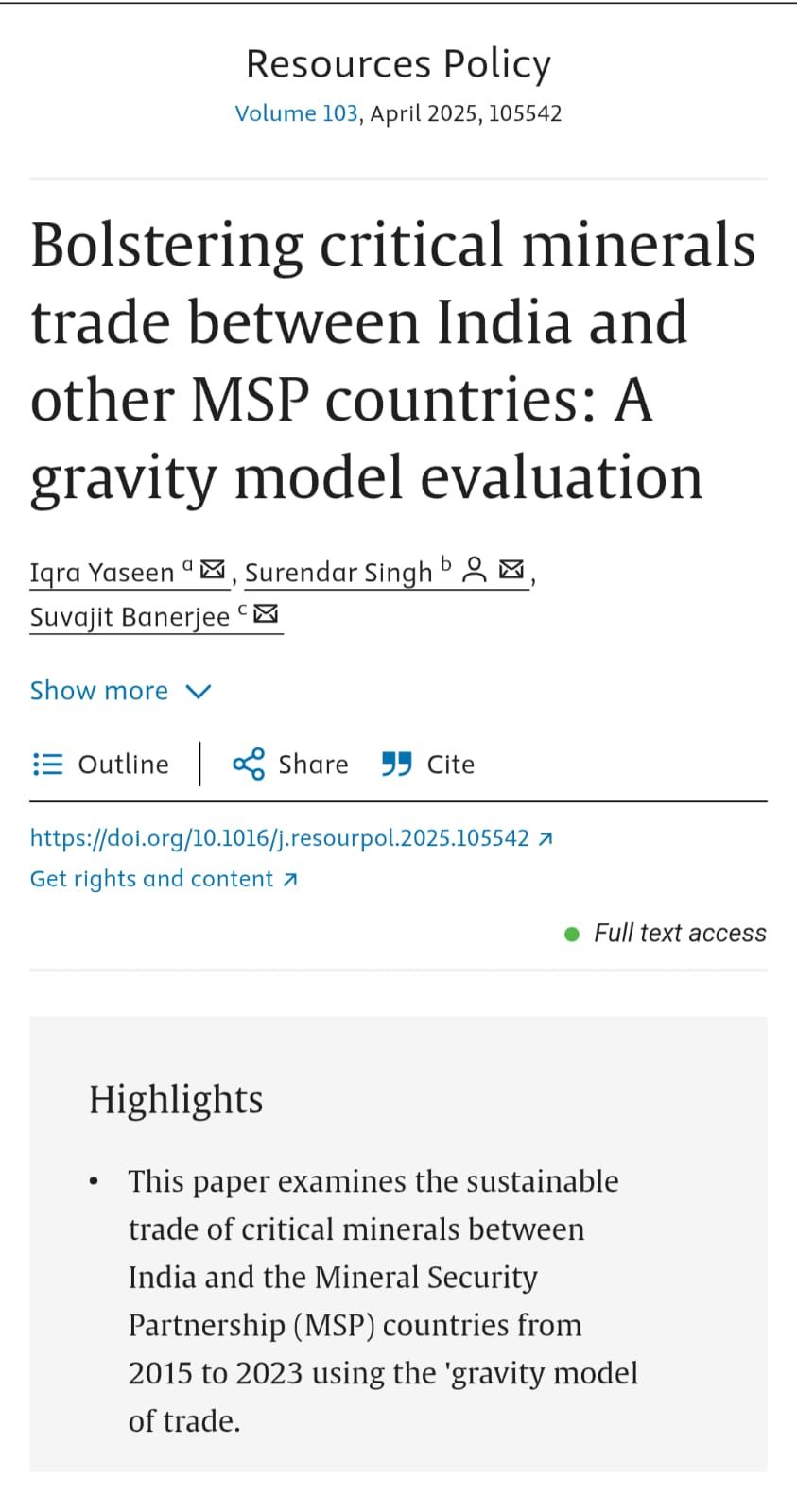
This study aims to evaluate the opportunities for a sustainable environment, an equitable economy, and a just society through the international trade of critical minerals. By employing a gravity model, it intricately analyzes the trade dynamics between India and 13 other members of the Mineral Securities Partnership (MSP). The study indicates a landscape rich with... Read More
We investigated how adolescents' time allocation across daily activities influences their body mass index and well-being by paying explicit attention to gender and activities relevant to low- and middle-income countries (LMICs). We hypothesized that the inequitable domestic burden shouldered by girls adversely affects their health and well-being. Using data from three waves of the Young... Read More