


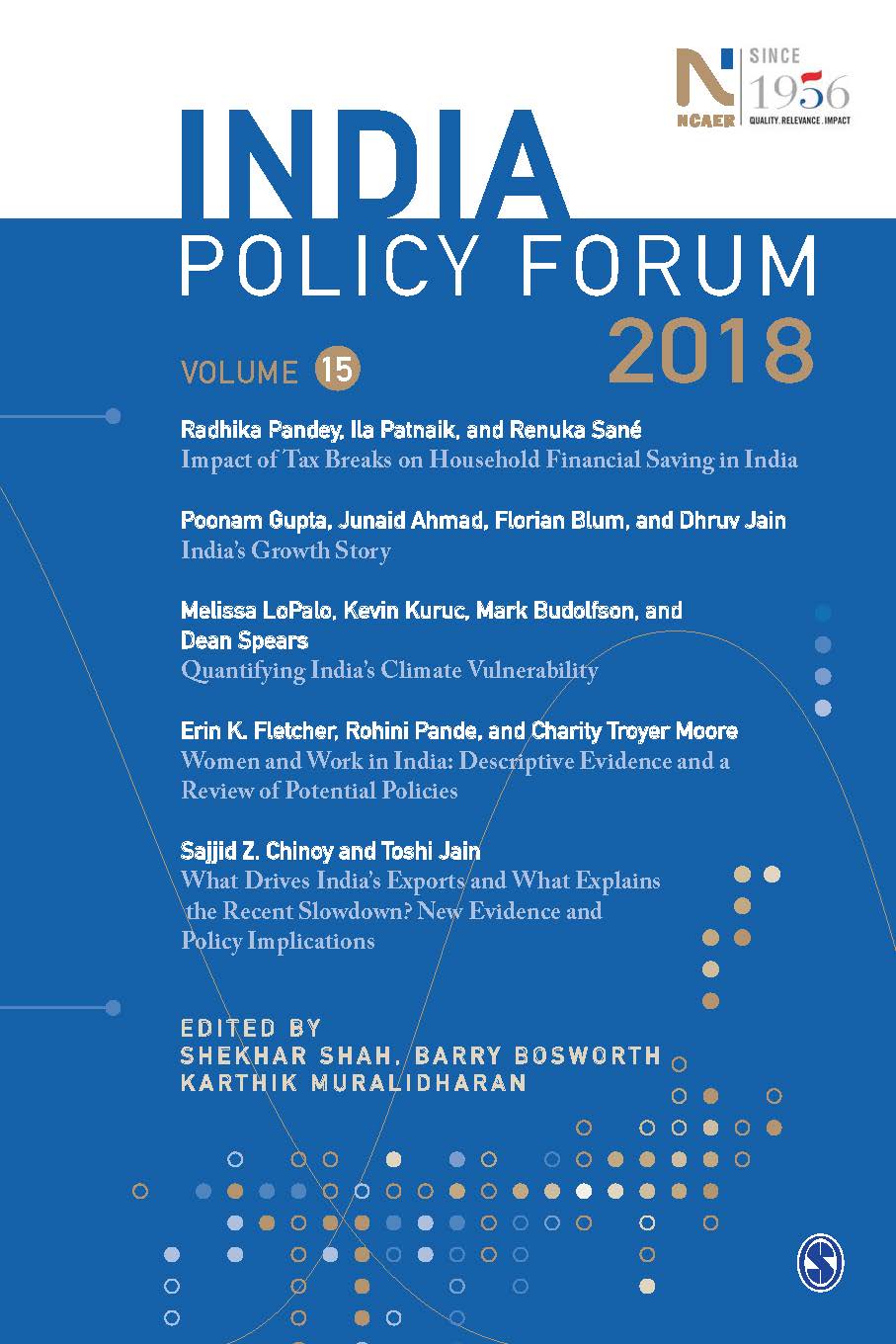
India has attained much economic success in the last three decades. Yet economic deceleration in the recent years has generated worried commentaries about India’s growth outlook. In this paper, we offer a long-term macro perspective on India’s growth experience. Analyzing past five decades of data, we note that growth has slowly but steadily accelerated over... Read More

Chief Economic Adviser Arvind Subramanian Wednesday said that it is not possible for the diverse Indian economy to have one uniform Goods and Services Tax (GST) across the country. The useful debate in fact can be whether there can be three GST rates instead of the present four rates with the possibility of reevaluating the... Read More
Download PDF
The GST Council may consider reduction in tax rates on host of items with low revenue implications as part of the tax rationalisation exercise in its next meeting on July 21. The items which could be considered for cutting of tax rates might include sanitary napkins handicrafts and handloom goods besides certain services. Several industry... Read More

Subramanian who had often batted for policy rate rate reduction said tighter monetary and fiscal policies were needed to hold the line at the time of shocks. Amid the demand for cut in taxes on fuel outgoing chief economic advisor (CEA) Arvind Subramanian on Wednesday said oil windfall should have been used for stepping up... Read More
Download PDF
To understand the interactions between real and financial aspects of an economy, this paper investigates cyclical relationship between credit and growth cycles in India and US over the period 1994-2013 in the frequency domain. Originality of our contribution is in the use of Multitaper method of spectrum estimation which has the advantage of giving reliable... Read More

This 14th India Policy Forum 2017–18 Volume comprises papers and highlights of the discussions at the two-day conference in New Delhi on July 11-12, 2017. The IPF is NCAER’s annual economic policy research conference that brings together academics, policymakers, industry representatives, media, and researchers for discussions on key issues of Indian economic policy. The IPF... Read More

The Office of the Central Registrar of Cooperative Societies (CRCS) assigned a study to the National Council of Applied Economic Research (NCAER) to analyse and come up with recommendations for broad-basing the organisational set-up of the office of the CRCS and suggest measures to ensure efficient compliance of provisions of the Multi-State Cooperative Societies (MSCS)... Read More

Public sector oil companies need to be transparent in their price fixation policies. Policymakers also need to question whether our oil companies/refineries are efficient by world standards. Only then can one identify the ex-post and ex-ante factors behind the high domestic oil price The spikes in petrol and diesel prices are the focus of attention... Read More

In India, quarterly growth of Gross Value Added (GVA) is published with a large lag and nowcasts are exacerbated by data challenges typically faced by emerging market economies, such as big data revisions, mixed frequencies data publication, small sample size, non-synchronous nature of data releases, and data releases with varying lags. This paper presents a... Read More

Trust in official statistics is vital for democracy — the new policy must avoid centralisation David Spiegelhalter president of Royal Statistical Society in the U.K. gave a most unusual presidential address in 2017. Instead of talking about esoteric statistical techniques he talked about declining trust in numbers in a post-truth society bombarded by fake news... Read More

In response to recent concerns expressed by Indian industry about the 'employability' of school and university graduates, this paper examines the role of pedagogy in developing life skills (or 21st century skills) and how these can be incorporated in the school/university curriculum. In recent curricular frameworks, life skills have been incorporated within the school curriculum... Read More

This paper contributes to the debate on the relationship between public and private investment in India along the following dimensions. First, acknowledging major structural changes that the Indian economy has undergone in the past three decades, we study whether public investment in recent years has become more or less complementary to private investment in comparison... Read More