Competing newspaper op-eds by PM’s Economic Advisory Council and two former chief statisticians have led to back and forth about the weakness of our statistical systems and political motivations behind impugning statistics. However, they offer a silver lining by highlighting the importance of statistics for evidence-informed policymaking. Several observations are noteworthy: Indian national statistical systems... Read More
India was an outlier on fiscal outcomes pre-pandemic, and it drifted further in the high-debt direction during COVID. At their peak in 2020-21, the public debt and fiscal deficit of the General Government (the Centre and the States together) stood at 89 per cent and 13 per cent of GDP, respectively. With the recovery of... Read More
The IHDS Forum is a monthly update of publications, op-eds and data news based on the India Human Development Survey (IHDS), jointly conducted by NCAER and the University of Maryland. While two earlier rounds of the survey were completed in 2004-05 and 2011-12, respectively, the third round has also been launched and is currently underway.... Read More
The Government of India has initiated various national highway projects of significant investment in the Northeast. The highway projects are expected to enhance internal connectivity as well as growth of the States’ economy and create new opportunities for people. The Government’s effort to enhance connectivity in the North-east is visible in many major national highway... Read More
It is important to consider multiple time zones for India, perhaps starting with two to keep things simple. A green revolution is underway, with green energy, green buildings, green transport, green finance and more. It is time to think of ‘greening the time’ to enable our ambitious climate goals. What does ‘greening the time’ mean?... Read More
Offering discounts on inflated MRP to lure consumers should be construed as an act of price manipulation. Online marketing or e-marketing has captured the landscape of shopping experience in the country. The ease of online browsing has meant consumers have a variety of choices, get convenient delivery services, return and exchange facilities and not to... Read More
India was an outlier on fiscal outcomes pre-pandemic, before drifting further in the high debt direction during COVID. High levels of debt limit the resources available for other priorities such as health, education and climate change abatement. At the same time, there is no immediate crisis of debt sustainability: institutional factors limit rollover risk, and... Read More
In the fifth and final article in the Ideas@IPF2023 series, Eichengreen, Gupta and Ahmed reveal how high levels of debt in India limit the resources available for other priorities. At the same time, they predict that there is no immediate crisis of debt sustainability, as institutional factors limit rollover risk, and interest rates have not risen with additional... Read More
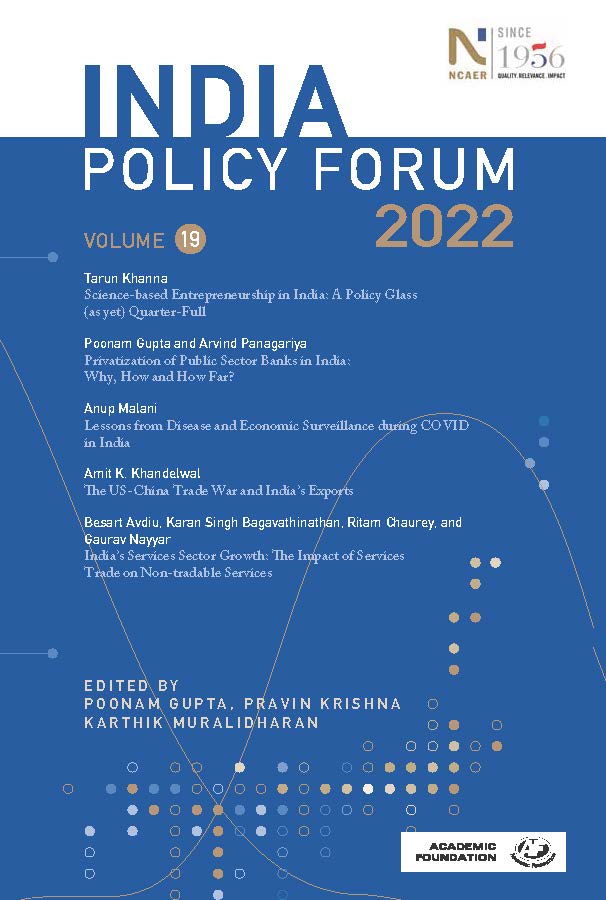
The 19th India Policy Forum 2022 Volume comprises papers and brief details of the proceedings of the IPF Conference held during 12-13 July, 2022. Apart from presentation of five papers, the IPF Conference also included two lectures, the 4th T.N. Srinivasan Memorial Lecture, titled, “Innovation, Experimentation, and Economics”, delivered by Professor Michael R. Kremer, University of... Read More
Women’s childhood, adulthood, and old age have all been transformed in India’s demographic journey. The passage of World Population Day (July 11) is also a time to look at how India’s demographic journey has changed the lives of its citizens, particularly its women. India’s population grew from about 340 million at Independence to 1.4 billion.... Read More