



Population growth and the changing geographic and generational balance of power The United Nations estimates that the world population will reach 8 billion on November 15, 2022. Our minds had barely wrapped around a global population of 7 billion in 2011, and now, only 12 years later, we are looking at a population of 8... Read More

The need to create a globally competitive electronics industry that meets international standards of excellence and efficiently caters to both the domestic and export markets has always been a priority for the country. Accordingly, the National Policy on Electronics (NPE), 2019, and its precursor in 2012, laid down certain goals to significantly boost domestic production... Read More

Exposure to nanoparticles, arising from both natural and man-made processes, can cause cardio and pulmonary problems Another winter and the discourse invariably turns towards air pollution in Indian metros, with a focus on Delhi. Increasingly, we come across studies that estimate the number of Indians who would die early due to air pollution, or have... Read More

In the Review, we summarise the economic and policy developments in India; monitor global developments of relevance to India; and showcase the pulse of the economy through an analysis of high-frequency indicators and the heat map. Click here for previous issues
Download PDF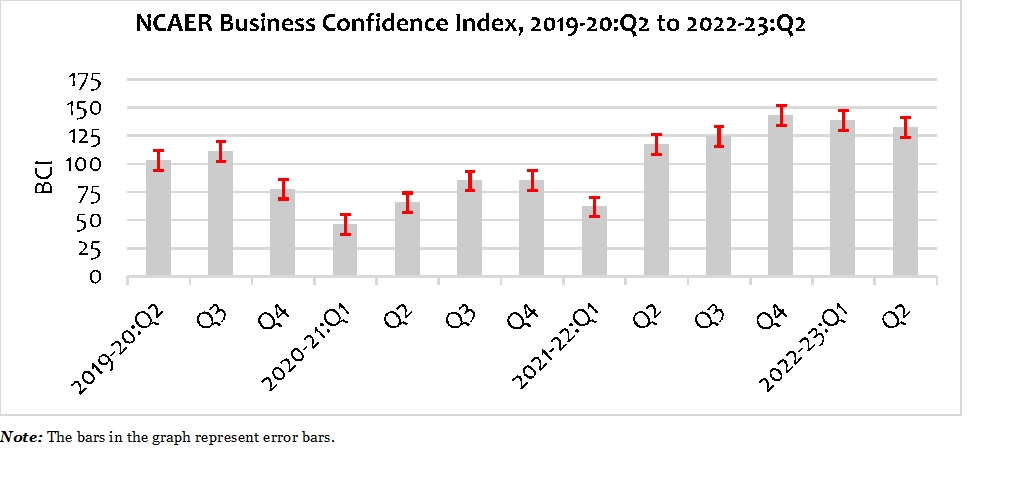
NCAER-NSE Business Expectations Survey for 2022–23: Q2 The Business Confidence Index is higher than it was a year ago but has softened sequentially New Delhi (Tuesday, October 26, 2022): The National Council of Applied Economic Research (NCAER), one of India’s premier economic policy research think tanks, carried out the 122nd Round of its Business Expectations... Read More

Global Hunger Index is riddled with inadequate and poorly described data and a lack of conceptual clarity. The problem with indices of this type is that it directs governmental attention to cross-national comparisons, sometimes resulting in the rejection of underlying issues and sidetracking the public discourse The world seems to have gone index-happy. Happiness Index,... Read More

The oft-cited 14% of GDP is an overestimate, arrived at by a consulting £rm using a model built for developed countries. India’s logistics cost is estimated to be around 14 per cent of GDP — a figure that has all of a sudden become cast in stone. High logistics cost, without doubt, impinges on competitiveness.... Read More

Earlier this year, the United Nations published data to show that India would surpass China as the world’s most populous country by 2023. According to the 2018-19 Economic Survey, India’s demographic dividend will peak around 2041, when the share of the working age population is expected to hit 59%. In this context, does India need... Read More

Interview of Dr Mridul Saggar, IEPF Chair Professor at NCAER and former MPC member, with Latha Venkatesh, discussing September CPI inflation data, was aired on CNBC TV18 on Thursday, 13 October 2022. Watch the programme here. For the full discussion, watch the video Speaking to CNBC-TV18, Citi India's Samiran Chakraborty and former MPC member, Mridul Saggar... Read More

Open economy challenges may haunt policies ahead as spillovers intensify A common economic sophism is that fiscal policy can prop up growth even when monetary policy is assigned to bringing inflation under control. In the short run, lifting demand amid supply constraints will only fuel inflation and the twin deficits, with a wider fiscal gap... Read More

Opinion: Mridul Saggar: Amid high inflation and exchange rate pressures, rate hikes and tight liquidity are the best bet. The RBI has been broadly getting its act right amid difficult circumstances. In my assessment, it has traversed about three-fourths of the amplitude of the current rate hiking cycle, but the economy is stronger than before.... Read More
Dominance of banking by PSBs has also been a hurdle in the way of improving the regulatory regime, which, in turn, hampers the modernisation and, therefore, healthy growth of the sector. This is because RBI has limited regulatory jurisdiction over PSBs. Indeed, this fact has at times provided RBI an easy cover for its own... Read More