



With the rapid rise in internet use in India, the incidents of online frauds/ scams/ cheating has also seen a spurt. Identity theft, social engineering, phishing, skimming, QR code fraud, OTP fraud, frauds using NFC technology, fake cashback links, UPI fraud, etc have now become the buzz words. Fraudsters and scammers are now using advanced... Read More

In the Review, we summarise the economic and policy developments in India; monitor global developments of relevance to India; and showcase the pulse of the economy through an analysis of high-frequency indicators and the heat map. MER October Report Click here for previous issues.
Download PDF
If south India wants a larger population, it needs to focus on family-friendly policies or encourage migration from more populous states. In 1944, Stalin (Joseph not MK) established the Mother Heroine award for women who had given birth to 10 or more children. In the wake of population decimation during World War II, motherhood was... Read More
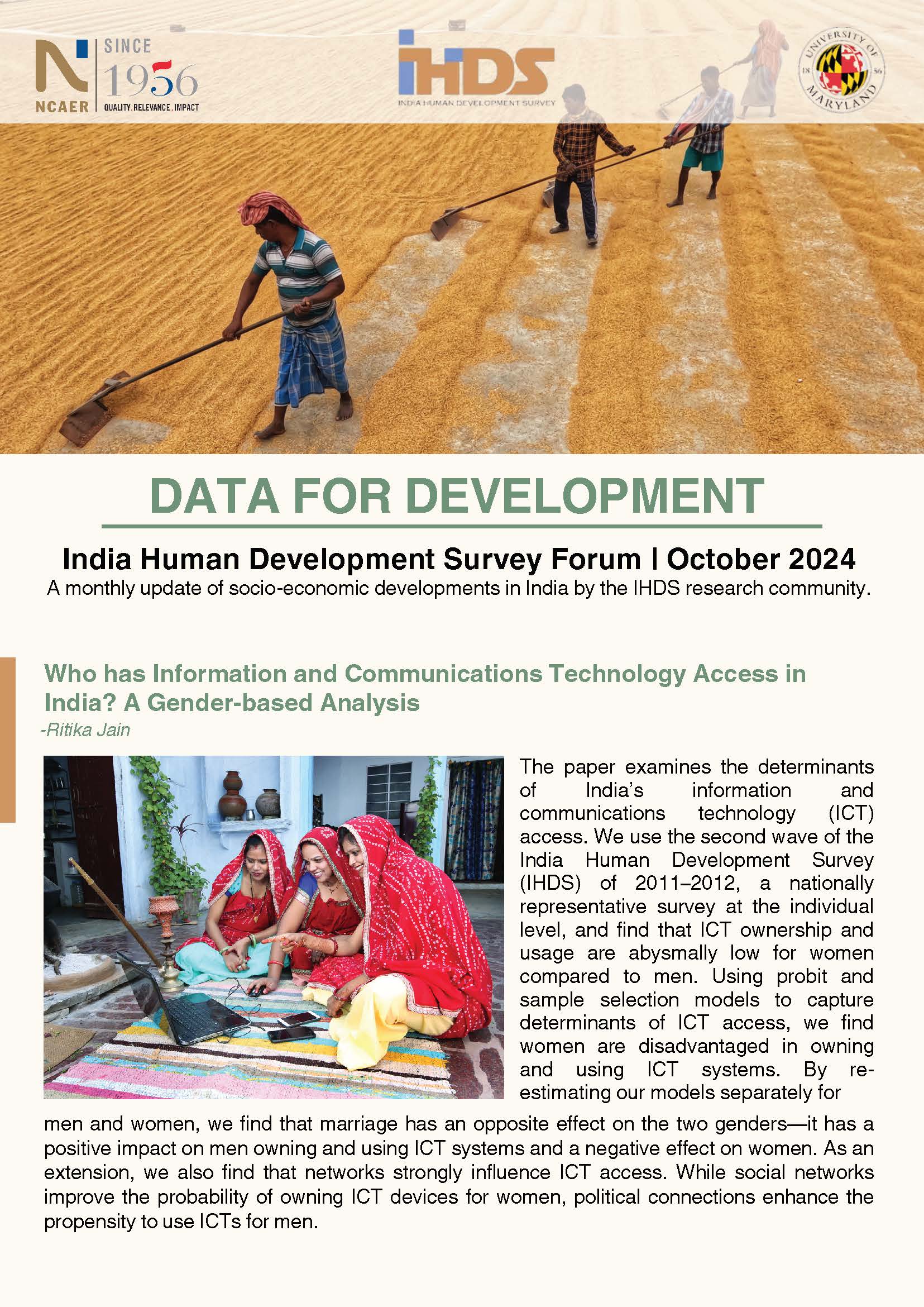
The IHDS Forum is a monthly update of socio-economic developments in India by the IHDS research community, based on the India Human Development Survey, jointly conducted by NCAER and the University of Maryland. While two earlier rounds of the survey were completed in 2004-05 and 2011-12, respectively. Fieldwork for the third round was undertaken in... Read More
Download PDF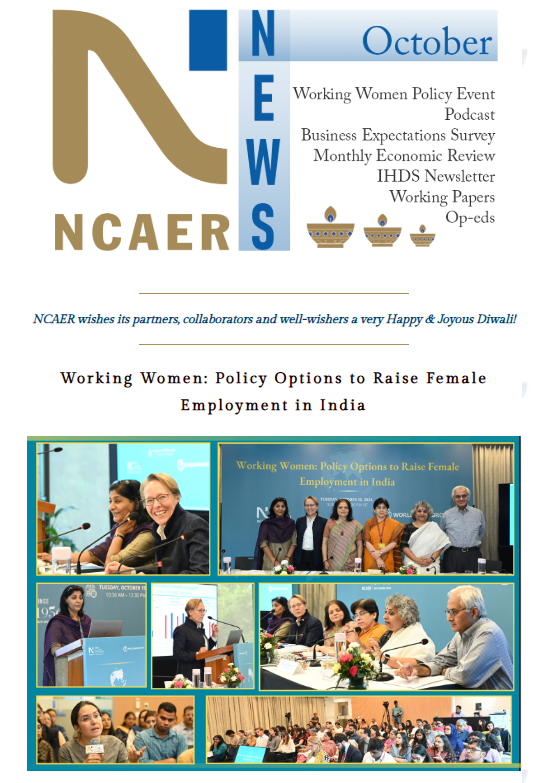
NCAER News is a monthly newsletter where you can learn about NCAER's research outputs, its latest events, and offerings.
Under the Right to Education Act (2009), the Indian government mandated private schools to reserve 25% of primary school places for socioeconomically disadvantaged children. This study examines the policy’s spillover effect on private schooling costs. Using household survey data and a difference-in-differences approach, it compares private school fees for disadvantaged children across two age cohorts... Read More
The National Council of Applied Economic Research (NCAER), one of India’s premier economic policy research think tanks, carried out the 130th Round of its Business Expectations Survey (BES) in September 2024, with support from the National Stock Exchange of India Limited (NSE). NCAER has been carrying out the BES every quarter since 1992, covering 500... Read More
Download PDF
These households or persons are generally difficult to approach, or they refuse to entertain survey investigators. Even when they do let them in, much of the data, especially related to income or expenditure, tends to be under-reported. This is a serious problem for a rapidly growing country like India, where incomes are rising at a fast rate.... Read More

India’s push toward electrical vehicles (EVs) by 2030 is a bold and necessary step, aimed at achieving 10 million EV sales annually and creating 50 million jobs across the ecosystem. India’s push toward electrical vehicles (EVs) by 2030 is a bold and necessary step, aimed at achieving 10 million EV sales annually and creating 50... Read More

Seawater must be used for producing this clean fuel, else there will be further pressure on groundwater. Green hydrogen seems to be the centre of action as the clean fuel for enabling net zero emission. As hydrogen has a much higher energy density than alternative fuel choices like propane or gasoline, it can serve as... Read More
Margin: The Journal of Applied Economic Research is a peer-reviewed bi-annual journal published jointly by NCAER & SAGE International. Volume 18, Issue 1-2, February–May 2024 includes the following papers- Inflation Targeting in India: A Further Assessment - Barry Eichengreen & Poonam Gupta The ‘Missing Middle’: How to Provide 350 Million Indians with Health Coverage? - Ajay Mahal, Vivek... Read More

From risk management to catalysts for growth. Following the Asian and 2008 financial crises, financial stability became the bedrock on which modern market-based financial systems were designed to withstand shocks. This shaped how central banks globally managed systemic risks, with many, especially in advanced economies like the Bank of England and Sveriges Riksbank, beginning to... Read More